The Counter-Revolution of Capital
This past July, the United States celebrated the 250th anniversary since the signing of the Declaration of Independence. This issue of The Pen is My Machete brings together anti-imperialist perspectives on the meaning of that founding for the rest of the world and the world’s first nation born entirely as a capitalist state. Historian Gerald Horne has convincingly argued that the 1776 American Revolution was, in fact, a counter-revolution—one that locked down and expanded the plantation economy and delayed the abolition of African slavery in North America (and perhaps the emancipation of the earth from capital) for nearly a century. A counter-revolution led by property owners—men whose wealth was counted in the flesh of Black human beings and the lands of Indigenous peoples—saw the writing on the wall as enslaved people across the British colonies began rising up, their clamor for freedom threatening to tear down the nightmarish institution of bondage. It is no wonder African peoples of the North American colonies took up arms with the British, choosing red coats over the chains of European-American colonists who sought to expand their plantation empires by seizing yet more Indigenous land.
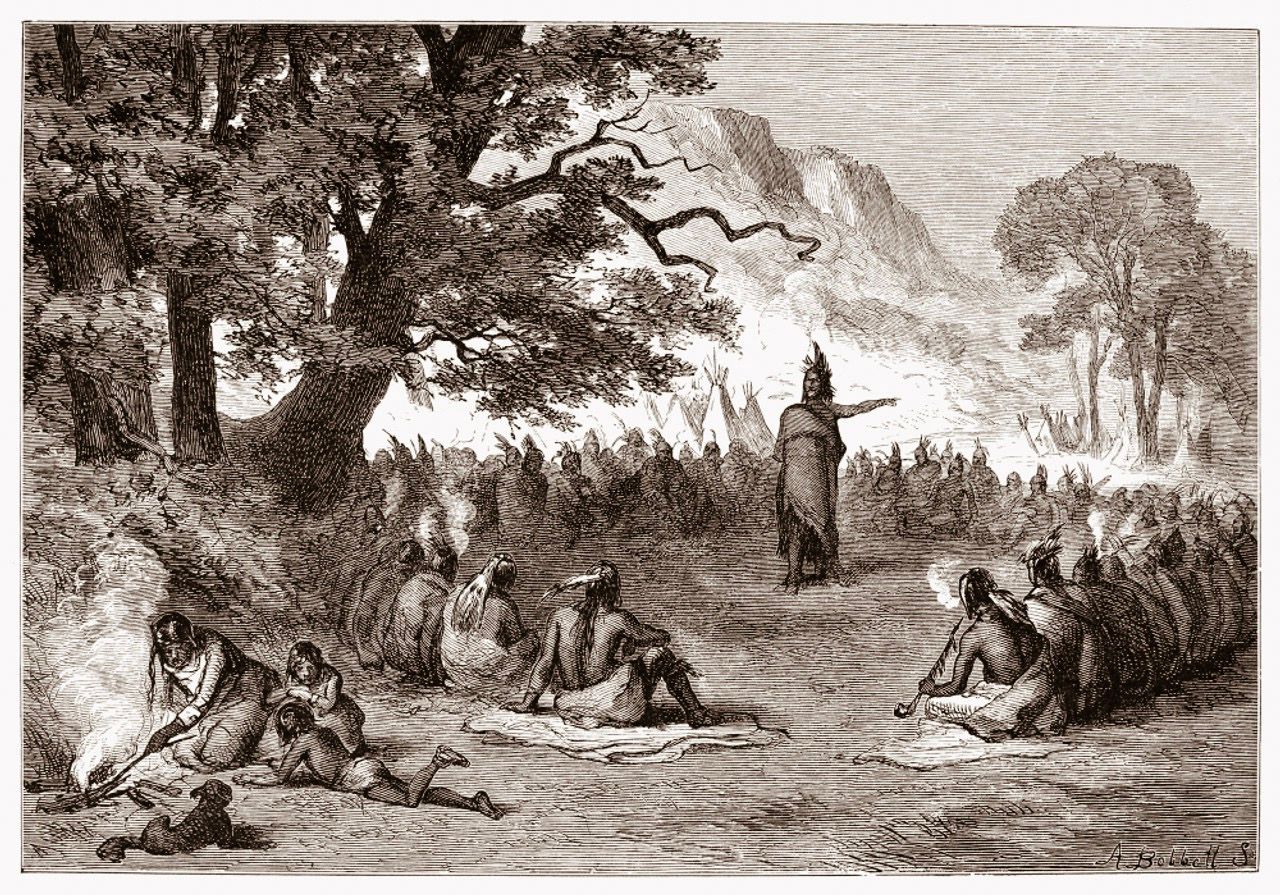
1776 was also a counter-revolution for the Indigenous nations of North America.
Prior to the 1776 war, Indigenous warriors fought alongside the French against British colonists who were pushing past the Appalachian crest and pouring into the Ohio River Valley during the French and Indian War of 1754–1763. Because of their relentless hunger for land, British colonists were recognized as a far greater threat to Indigenous sovereignty than their French counterparts. Hoping to pacify Indigenous nations and avoid endless, costly frontier warfare, the British Crown issued promises to stem the tide of colonial settlement in the Ohio Valley. In 1763, King George III pressed his royal seal onto a decree forbidding British subjects from settling Indigenous lands west of the Appalachian Mountains. The Proclamation line implicitly acknowledged the formidable military weight of Indigenous nations, setting the stage for growing confederacies and alliances—such as the one forged by the Odawa leader Pontiac, who rallied ten nations to unleash a wave of coordinated strikes against British forts, fighting to decolonize the Great Lakes before the ink had even dried on the treaties ending the French and Indian War.
The prohibition of western settlement and expansion was an untenable reality for the European-American colonists.
Thomas Jefferson had both the threat of slave rebellions and the reality of Indigenous military strength in mind when he wrote the 27th and final grievance against the King of England in the Declaration of Independence. “He has excited domestic insurrections among us,” Jefferson wrote, capturing the panic of slaveholders who watched runaway men and women escape into British lines and taking up arms against their former masters under the promise of freedom; “and has endeavored to bring on the inhabitants of our frontiers, the merciless Indian Savages whose known rule of warfare, is an undistinguished destruction of all ages, sexes, and conditions,” read the final lines, demonizing the Indigenous alliances defending their homelands.
Thus, the founding document consecrated U.S. policy toward Indigenous nations, framing them as the original enemies of the empire. From that early experience, the US created a model of military subjugation and kinetic force that, once it secured its own continent, would export to the rest of the globe.
U.S. national myth promotes the idea that the theft of Indigenous lands and westward expansion were undertaken for and by the common man—the rugged pioneer and homesteader carving civilization out of wilderness. The colonists' war for independence against the British Crown and the founding of their ever-expanding republic was framed as a democratic commitment to the many, throwing off the gilded tyranny of European monarchs. The hundreds of treaties that accompanied genocidal wars against Indigenous nations also appear to validate this perspective: a faceless government bureaucracy in Washington stamped red wax onto parchment paper, securing hundreds of millions of acres through "lawful" cessions, redistributing that land to the huddled masses pushing westward in search of lebensraum.
While such violence was lamentable, the thinking goes, it was an inevitable, if not necessary, step to achieve the lofty ideals of the U.S. democratic experiment—an experiment that, if wielded properly by the citizenry, could eventually undo its own founding injustices. The most glaring among these original contradictions are Indigenous genocide and the enslavement of African people. The abolition of the latter came about through a civil war that left half a million dead on muddy battlefields—the unfulfilled legacy of abolition haunts the present through modern forms of mass incarceration and the racial policing of Black people. And the imperialist wars of conquest that facilitated the former didn’t end when the dust settled behind cavalry columns on the plains—they forged a blueprint for the imperialist wars that raged for centuries and continue today.
How could “the world’s first modern democracy” have enshrined so much violence and inequality upon its founding? This has been the troubling question for generations of scholars—but it is incomplete.
The search for an “original sin” has led to important but ultimately limited moral crusades against this or that institution for enshrining inequality. This sidesteps the systematic and critical thinking and agency of those who have seized hold of the commanding heights of industry. If we were to put the United States on trial for the mass suffering it has inflicted upon the planet, we would first have to establish the evidence—the crime scenes, the murder weapon, so to speak—and then establish motive—the why of human action, why perpetrate such mass suffering. So far, the evidence continues to mount, but structural intent seems elusive. Grotesque, race hatred or racial superiority alone are insufficient explanations. After all, early Indian hating targeted Indigenous nations not because of cultural or racial difference; they were targeted for destruction because they stood in the way of acquiring their lands and resources. In other words, the profit motive.
More to the point, it was a particular class of people who benefited from the genocidal wars waged against Indigenous nations. Mainstream histories often frame U.S. expansion as an abstract process. In The Relentless Business of Treaties , Martin Case dismantles this theory. He identifies several sprawling, intermarried ruling-class dynasties whose overlapping business and political interests dominated the United States’ nineteenth century treaty negotiations with Indigenous nations. Just five of these family networks accounted for 515 signatures across nearly half of all U.S.-Indigenous treaties, while dozens of smaller families making up a significant portion of the rest. “A single large kinship group might include land speculators, fur traders, mine owners, and the politicians who legislated Indian policy and handed out trading and mining licences,” writes Case. The conspiracy to take and profit from Indigenous lands and resources rested in the hands of a few, stretching across several generations.
Mainstream commentary often dismisses elite coordination as paranoid conspiracy theory. The late Marxist thinker, Michael Parenti, argues that ruling-class elites routinely conspire—explicitly planning, networking, and using state power to advance their material and collective interests. This is as true with regard to the violent theft of Indigenous lands as it is today.
Today, 54 family dynasties in the United States hoard more wealth than the bottom 165 million Americans combined—the modern inheritors of a state apparatus engineered from its inception to protect and expand private fortunes. When we look past the high-minded rhetoric of the Founders, the central question shifts from how democracy failed to how capitalism succeeded. The genocidal campaigns against Indigenous nations, the enslavement of African people, and the global projection of U.S. military power were never tragic deviations from high-minded liberal ideals; they were the very engine of its wealth accumulation, driven by a ruling class that converted human lives and stolen land into private capital.
The crime scene is vast, stretching from the bloodied banks of the Ohio River Valley to the modern sites of U.S. military intervention across the Global South, set afire from the rubble of Gaza to the Strait of Hormuz, where cracks begin to show light. Where there is empire, there is resistance. Just as Indigenous alliances and runaway African laborers rose up against the counter-revolution of 1776, the struggle against the U.S. Imperium continues on every front line of liberation today. In this issue of The Pen is My Machete, we offer these perspectives not merely to document the machinery of ruling-class power, but to arm the movements fighting to dismantle it.
Nick Estes is a member of AISC.