Rabab Abdulhadi on the Palestinian Liberation Struggle, Anti-Imperialist Feminism, and the Power of Solidarity
AISC: What is your view on how Iran’s apparent strategic strength in waging a war of attrition against US imperial/Zionist aggression impacts the struggles and prospects of the Palestinian people in both Gaza and the rest of occupied Palestine?
RA: Let me first start by reminding the readers that the Palestinian liberation movement is not exceptional to other anti-colonial movements, whether in the region or throughout Africa, Asia, and Latin America. From its inception, Palestinian resistance rose to challenge and defeat colonial, settler colonial and imperialist powers. These powers included British Euro-white colonial rule, the Zionist settler colonial project and its consolidation in the Israeli Zionist regime in 1948, as well as the US expansionist Empire, which is based on the worst combination of European and white supremacy, settler colonialism, and imperialist interventionism.
We also need to stress that Palestinian resistance has always been shaped by the West Asian, Arab-Muslim regional context. Unfortunately, this indigenous analysis is often dismissed as “backward”, or as having inferior influences when it de-centers Euro-white political, social and cultural thought. This has manifested in hostility toward movements in our region that do not toe what is seen as a 100% Western Marxist line.
The priority of our movements has been the liberation of our region rather than winning popularity points among rigid Americo-Euro comrades whose secular fundamentalism, Islamophobia and Orientalism color their condescending outlook toward what Edward Said defined as the imaginary “East.” I am not suggesting that refusing to ameliorate our positions to the liking of our “more enlightened” comrades was not costly; it affected visibility, recognition, inclusion, and solidarity in international forums, publications, representation, material support, etc. Historically, the extent of harmony with the position of the Second International that recognized Israel and advocated for the so-called “two-state solution” was the barometer that measured which regional, and especially Palestinian groups were allowed into global “respectable” spaces and which were sidelined. This was played as well in the non-governmental spaces, or in the peace, anti-war and social justice movements.
Historically, Palestinian and Iranian resistance were comrades in the same trenches against US/European Imperialism, Zionism and the reactionary Arab, Turkish and monarchist regimes who collaborated to further colonize and dominate the region (Baghdad Pact), destabilize democratic governments, torture of prisoners, etc.
When the Iranian Revolution took place in 1979 it was celebrated by most if not all of the Palestinian people. Palestinian leftist parties naturally had stronger ties with Iranian leftist groups, while also supporting Islamist anti-colonial forces. Palestinian leftists also supported Iran and condemned Saddam Hussein for waging a war against the country instead of allowing the revolutionary forces in Iran to consolidate and build the new state.
This created a dilemma for the Palestinian movement that persisted through the end of the Iraq-Iran War, which brought immense loss of life and destruction to both countries and people, as well as for the region as a whole. The impact was to fragment and weaken broader regional anti-colonial and anti-imperialist struggle.
While Iraq slowly moved to the Imperialist camp, notwithstanding Saddam Hussein’s rhetoric—occasional calls to Arab nationalism—that many of us questioned given his opportunistic dance with imperialism and brutal treatment of the opposition, Iran, both as a government and a people, consolidated a strong anti-imperialist and anti-Zionist position and support for Palestinian resistance.
The imposition of brutal sanctions by a global US-led imperialist camp against Iran to punish the population and starve the people to attempt what it terms “regime change,” backfired, just as it has done—and continues to do—against people who reject its intervention and domination, from Cuba to Venezuela and including the Palestinian people upon whom an election was imposed by George W. Bush in 2006. The US & Imperialist camp’s failure in the 20th century to attempt to crush the peoples’ will from the Baku and Bandung conferences was being repeated again in the 21st century. Sanctions and the imposition of other forms of pressure have ultimately failed to achieve their stated objectives.
Let me also note a couple of interesting things about this question. You start with words such as “apparent” and “strategic”, which leads me to believe that you are wondering whether I agree with these suggestions. Like you, I agree that from what we can observe, Iran is employing a strategy of attrition and I’ll add asymmetrical warfare, which reminds me of what Palestinian resistance groups have historically called for.
Palestinian militant forces have historically emphasized the importance of understanding national liberation as a long protracted struggle, rather than expecting short victories; the necessity of fighting in one location and then moving to another; of spreading the fight over as many fronts as possible to disrupt the balance of forces, weaken and distract the powerful colonial-imperialist forces, and of mobilizing the smaller capacities of the allied colonized forces elsewhere. It also requires clarity on who are friends and who are foes.
This strategic orientation is quite clear in central documents of the PFLP and other Palestinian anti-colonial nationalist movements since the mid-1960s, as well as in Islamist groups since they adopted a clear liberation strategy for Palestine in the late 1980s. Inspired by the Vietnamese in their liberation struggle against US imperialism, this strategy is grounded in an acknowledgement that the military balance of powers does not favor the colonized, nor are they as militarily powerful as the colonizers. Thus, survival in the short term and victory in the long term depend on transforming the balance of forces—exhausting, distracting and demoralizing the colonizers, whose forces often lack the same level of conviction, until their leadership comes to recognize that the costs of domination outweigh its benefits. This applies to the US military forces today who are recruited through an economic draft and the Israeli forces who have been demoralized, escape service, and no longer carry the spirit of early Zionists.
The relationship to Palestinian resistance is dialectical. First of all, defeating colonial, imperialist, and Zionist forces is a shared goal by the axis of resistance, including Iran and all anti-colonial forces in the region—in Palestine, Lebanon, Iraq, Yemen, as well as those in Syria and across the Gulf and Arab Peninsula that must remain nameless for their safety. Secondly, Iranian defensive and offensive strikes against the US and Israeli attacks and targets not only lift the morale of the Palestinian and Lebanese people who have stood by and participated in the resistance despite the heavy costs of Israel’s genocide, starvation and displacement in Gaza, the West Bank, Jerusalem, 1948 areas and exilic refugee camps. Equally important is the effect of forcing US imperialist and Israeli Zionist military forces to fight on multiple fronts and defuse their combined concentrated strength. Politically and militarily, targeting US military bases in Arab countries—while being crystal clear in maintaining non-hostility toward neighboring populations—makes it quite easy for Palestinians and people around the world to align themselves with Iran against the US/Zionist aggression, while also preventing those Arab countries from siding with the US and Israel in regional alliances Iran or other matters, including Palestine.
AISC: Historically, and certainly today, especially during invasion and wars, colonizers and imperial aggressors in general, have weaponized various aspects of gendered oppression—impunity for mass rape and control of social reproduction (including forced sterilization, starvation, denial of health care for mother and child etc.): Please explain, first, how the Imperialist-sponsored Zionist war has unleashed these weapons against the Palestinian people. Secondly, what strategies and tactics have the Palestinian people used to protect themselves and their communities against these weapons? Please feel free to discuss here also what this tells us about the relationship between empire, propaganda, and gendered racialization considering, for example, the weaponization of narratives around sexual violence in the context of Al-Aqsa flood and its aftermath?
RA: I don’t think we have enough space here to discuss the relationship between gender, sexuality, and war for all humanity and across time and place. So let us focus briefly on Zionist settler colonialism in Palestine since its emergence in the late 19th and early 20th centuries, and discuss a bit more its intensification since October 2023. Historically this project has centered on the erasure of the Palestinian people, their roots, and their presence on the land, in line with the colonial myth of “a land with a people for a people without a land.”
Across all Palestinian areas under its settler colonial rule, the Zionist regime has employed a doctrine of collective punishment, including denying water and electricity, blocking the entry of food and medicine—including vaccines against contagious diseases—imposing siege inducing starvation, and killing large numbers of children. This has also included the targeting and destruction of hospitals, maternity wards, incubators, and pre- and post-natal units.
What we are witnessing in Gaza today is not new—it is an intensification of longstanding settler colonial practices, now livestreamed to the world. During repeated periods of curfews, military raids and siege of total or partial areas in the 1967-occupied Palestinian territories (Gaza, West Bank and Jerusalem), Zionist forces shot holes in water tanks, urinated in others, and used to snipers shoot anyone who attempted to leave their homes to get water. Electricity was cut off, urgently needed medicine was blocked from entering the old cities of Nablus and Hebron, and ambulances and food trucks were turned back by soldiers at flying checkpoints.
Historically, the settler colonial Zionist state has engaged in systematic projects of social engineering and population control targeting Palestinians in the 1948 areas and beyond. From uprooting Indigenous trees in the forests of the Galilee and replacing them with European species, to the destruction of ancient buildings and erasure of over 500 villages, to appropriation of Palestinian culture—food, music, and clothing—this process of erasure has intensified in an organized and structured fashion since the Nakba in 1948.
Fighting these strategies of erasure is not easy. Given the profoundly unequal balance of forces at every level and the cumulative effect of destruction, it is remarkable that Palestinians—and other Indigenous peoples—have not only survived, but have repeatedly risen with a revolutionary spirit of optimism to fight for self-determination, return and liberation.
I believe that a key factor is the conviction that this is a just cause, that must continue, that the whole world stands with us and will not allow the forces of death and destruction to win. It’s impossible to explain how people rise up each time they experience another episode of brutality, and how they teach their children to not surrender, and to keep their heads held high. This is not to say that we don’t mourn and feel the losses so painfully. But it’s also a sign of dignity to avoid allowing the oppressors to see you broken.
At the same time, it’s important to stress that no colonized people can recover everything that has been lost. That is precisely the intended design of colonialism—to destroy as much as they can, both materially and immaterially, and then reframe that destruction as deficiency among the colonized and deprive them of the most essential tools necessary to fight back. It is another strategy to break the spirit and material backbone of a colonized people.
To survive over a century of one of the most vicious settler colonial regimes in history, the Palestinian people, like other colonized peoples, have developed strategies of resistance grounded in collectivity, solidarity, and accountability, both internally and with global allies. These include preserving the memories of villages, homes, and worship sites that have been destroyed; finding Indigenous alternatives to family planning that do not promote sterilization or population control; planting and picking Indigenous herbs and plants and preventing them from extinction. I should add that Zionist Israel continues to attempt to destroy Palestinian Indigenous practices in the name of “nature preservation”, for example banning the picking of wild herbs—similar to the way in which US settler authorities claim that they care more about native salmon than the Indigenous people in Turtle Island. In both Indigenous communities and others, people are finding ways to fight, live and struggle despite the attempts at colonial control and erasure.
The relationship between empire, propaganda and gendered racialization has historically been framed as “complicated,” but this characterization is misleading and problematic, intended to signal to folx at the grassroots that the situation is beyond their comprehension. It is similar to how the Zionists characterize the Palestinian freedom struggle overall. It’s also elitist. It is crucial not to essentialize women or assume that gender is equal to women.
The narrative is constructed in ways that paint Palestinian men or Arab, Muslim, and men of color in general as hypersexual, sexually violent, excessively homophobic and sexist, as if these traits are part and parcel of their DNA, and a just cause for their elimination. Unfortunately, it’s not only colonial feminists like Hillary Clinton or Sheryl Samberg who rushed to believe and reproduce the Zionist myth that there was mass rape on October 7 by Palestinians. This Zionist tale was intended to divert attention from the massacres and genocide in Gaza. Some people who claim to be anti-colonial feminists believed it too. As if the only thing Palestinian men had on their mind in a crucial battle for liberation was to go and rape Israeli women colonizers. This is the same narrative historically used against Black men in the U.S. context, accusing them of desiring white women. We know these are lies. Nonetheless, Black men have been lynched as a result of these false accusations. Leading Black women figures like Ida B. Wells refused to align with white suffragists who owned the feminist mantle and instead challenged these narratives, defending Black men against lynching and other forms of racist terror. Today, similar dynamics are at play, as some accepted or failed to challenge such claims, revealing how deeply entrenched these racialized narratives remain.
The reason the so called “Hamas mass rape story” was believed was because Israel could not convince mainstream media of its lie that 40 newborn Israeli babies were beheaded or that children’s bodies were charred by Palestinians. These lies didn't work, but the Israeli settler colonial regime, the broader Zionist movement and their US allies in an election year, needed a narrative to justify the genocide and mitigate the impact of all of the horrific news of death and destruction coming out of Gaza.
This story, then, fit neatly within the colonial mindset, as many “feminists” accepted it, or at the very least did not challenge its veracity; they were predisposed to accepting it. Many of us were left asking: What happened to all the alliances that we have been building for so many years? What happened to the critical analysis that we have developed time and time again? At the same time, some of our own people internalized this Zionist logic and, apologetically, failed to challenge the Zionist narrative.
Although none of the claims added up, new allegations were being introduced- first they said there were children and two girls who were raped. Other stories spoke of different forms of undress but it was six in the morning so they were sleeping. Many girls and women came out of their houses in their pajamas, while others at the Nova festival were in different clothing—yet it was all blamed on Palestinians. I admit that I too was frustrated with Hamas's nonchalant position–that they already issued a statement denying it so why did they have to spend more time overstating their denial? On one hand, I totally agreed with them and felt the anger of resentment rising throughout my spine: The position was already stated. Why waste time to overstate it. Khalas—enough. On the other hand, Hamas leaders were not exposed to US-Euro-Americo “feminism” as many of us had been and thus no matter how much we rejected it, we needed to explain again and again. Was it OK to demand that of Hamas and other Palestinian resistance factions? My anger and resentment of US-Euro entitled positions made me so angry of another imposed question we had to answer. I felt like saying, Khalas, go to hell. I don’t even want to sit in the same room with you, let alone talk to you. However, the fact that some Palestinian and Third World and women of color actually bought the argument and were promoting it necessitated that I engage in the discussion irrespective of how much I hated it.
There is a Master Narrative and Western-Americo-white supremacist imaginary, deeply structured by racism, white supremacy, Orientalism, and anti-Palestinian, anti-Arab, and anti-Muslim racism. It constructs our men- Arab, Muslims and Palestinians- as inherently homophobic, hypersexual, excessively sexist, bloodthirsty and irrational. They say “that they do not know what they're doing” and “they simply want to spill Jewish blood,” while completely erasing the fact that Palestinian operations have consistently articulated political and strategic goals, including the capture of Israelis for prisoner exchange as has been conducted successfully several times in the past—which in fact has been the only way to free Palestinian prisoners. Another significant point is that there are usually between 55,000 to 60,000 pregnant women in Gaza, who face the possibility of giving birth under extremely difficult conditions, or even being killed while pregnant or during childbirth. Their children may or may not survive, and they may not receive adequate medical care, as maternity wards have been destroyed and babies have died in incubators due to a lack of fuel, electricity, and supplies.
I mention the 55,000 to 60,000 pregnant women not to privilege women and children in ways that erase the value of Palestinian men, but because it highlights the Israeli obsession with the so-called “demographic bomb” —the fear of Palestinian reproduction. This sentiment echoes the words of Golda Meir, Israel's first and only female Prime Minister, who said that she had nightmares every time a Palestinian child was born.
It is part and parcel of the definition of genocide—the elimination of an entire people. This is what the Zionist project has aimed to do since its inception in the late 19th century, and Palestinians have been resisting it for over a hundred years. The killings, targeting, and destruction—along with rape and other forms of systemic sexual violence against the Palestinian people—are not accidental or the result of a few “bad apples” within Israeli colonial forces. They are integral to the Zionist settler-colonial project and deeply connected to Western imperialism.
The genocide unfolding today in Gaza is targeting entire families—whole family lines are being eliminated. At least 2,700 families have been completely wiped out, with no survivors left, and at least 6,000 families have lost all but one member. It is crucial to recognize that genocide is not only a horrific outcome of this particular Zionist assault, but is also a central feature of settler-colonial logic, as seen in other contexts, including Turtle Island (the United States).
AISC: In your view, what lessons can those committed to building an anti-imperialist feminism can learn from Palestine?
RA: In my work on anti-imperialist feminism, I have emphasized that Palestinian women (as well as men, children and the elderly) have been involved in Palestinian resistance for as long as resistance has existed—that is, from the outset of the imperialist, settler colonial project. To claim that there are periods in which women or any other group was absent, and other periods in which they were present, is historically inaccurate and analytically untenable.
Obviously it’s in the interests of Zionist and colonial forces to advance such absurd arguments, and to throw in some Orientalist, Islamophobic and racist colonial tropes designed to render them more easily accepted. But these claims do not withstand scrutiny when tested against historical evidence. Of course, as organic intellectuals, we must continue to make these narratives and histories more widely known, but I do not believe that everyone we’re dealing with is an organic intellectual irrespective of whether they’d like to name themselves as such. The marginalization—or shadow-banning—of this work is also shaped by broader political dynamics: who is willing to learn, what is permitted to circulate, why, and perhaps the most crucial question, at what cost?
For our revolutionary comrades committed to changing the world, we must continue to share the knowledge we have accumulated—even as dominant institutions attempt to strip us of our histories, voices, and intellectual traditions.
AISC: In your work, you emphasize internationalism against the common enemy of Palestinian, Black, Puerto Rican, and other colonized people. What are the political possibilities in building these solidarities today?
RA: It is important to emphasize that solidarity with Palestine did not emerge spontaneously. People did not wake up and randomly choose to support Palestine. The surge of global solidarity with Palestine is the result of decades of cumulative work and community struggle—first and foremost by the Palestinian people themselves, who have persistently continued their struggle for liberation and self determination. Their steadfastness and resilience make it possible for the international solidarity movement to continue organizing and standing with them. This is especially significant for any people confronting powerful, repressive forces such as Israeli settler colonialism and US imperialism.
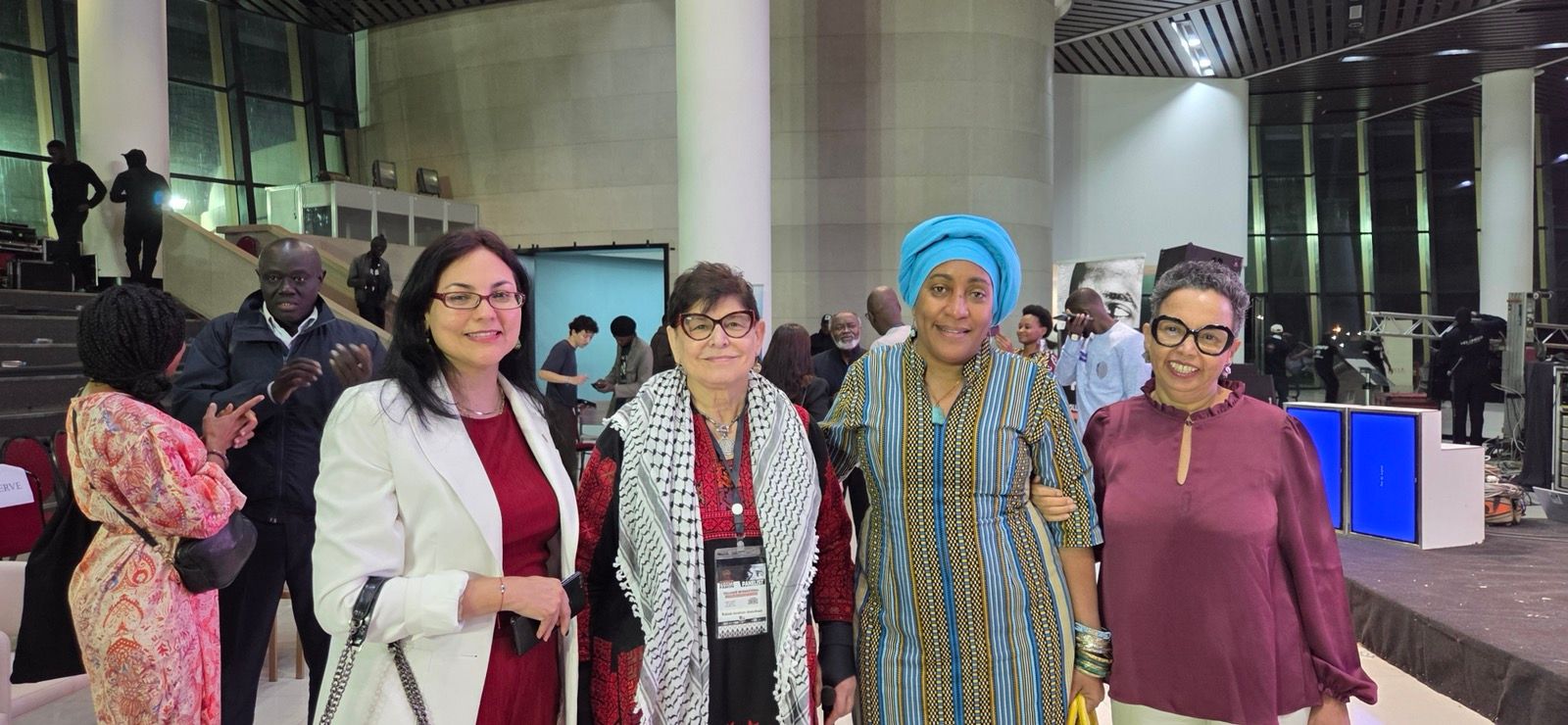
Rabab Abdulhadi (PhD) is the Director and Senior Scholar of the Arab and Muslim Ethnicities and Diasporas (AMED) Studies Program at San Francisco State University and Initiator and PI of Teaching Palestine: Pedagogical Praxis and the Indivisibility of Justice.