Possibilities: An Anti-Imperialist Women’s Movement in This Age of Genocide
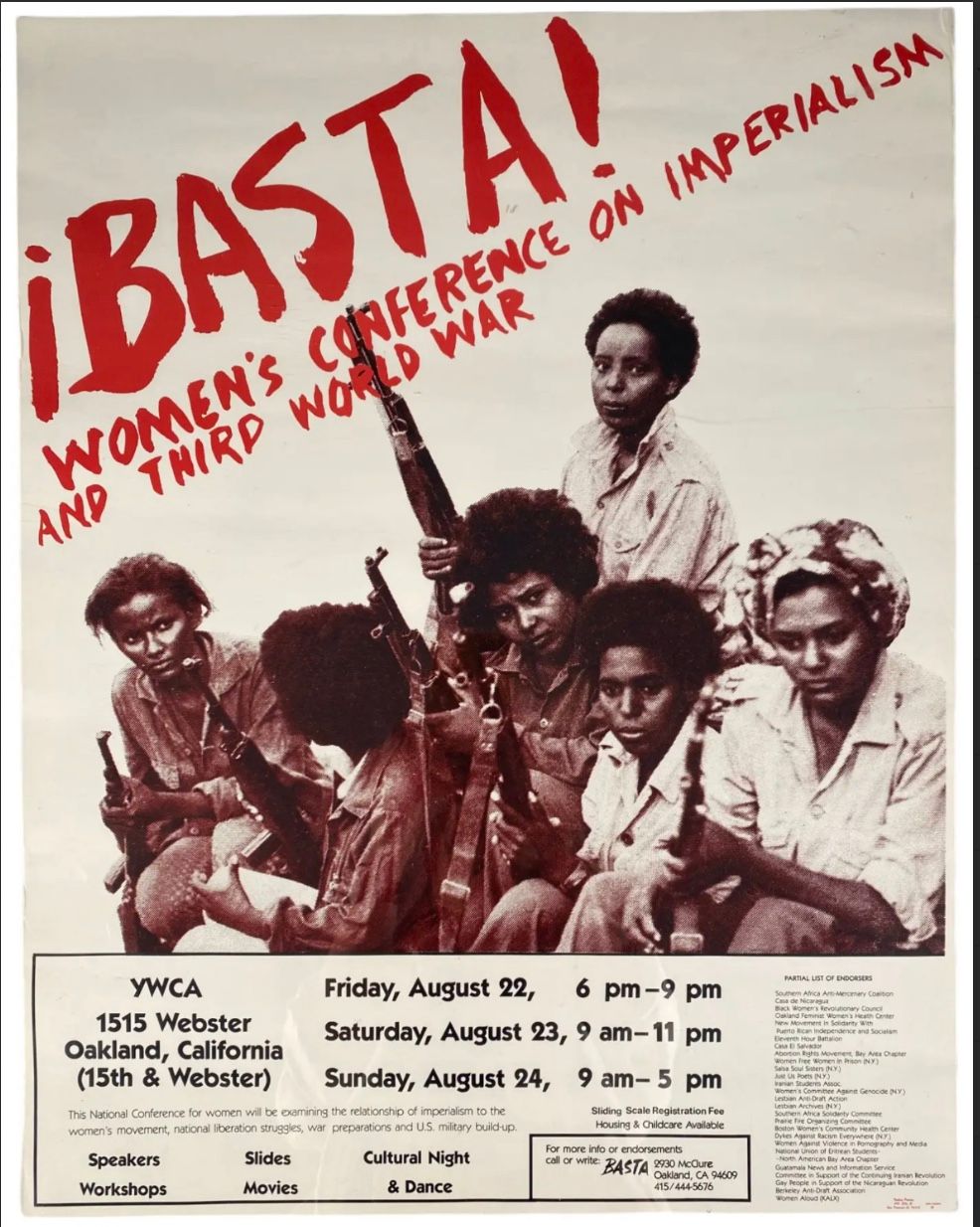
In every U.S. city, wave after wave of organized women, and all the comrades who stand in solidarity with the anti-imperialist women’s movement[1] , have rendered the U.S. ungovernable. They are bringing-business-as-usual to a standstill, they say, until the U.S. withdraws all its support for the Zionist entity, ends the war against Iran, and withdraws all its military assets from West Asia. - From an imaginary news bulletin
Inside the imperial core, if we do our part, we will build an anti-imperialist women’s movement that joins with all other anti-imperial forces to rid the world of U.S.-led imperialism—the system that threatens the survival of humanity itself. While there are clearly many obstacles to building such a movement, here I focus on the obstacle closest to my political home: the tendency of both anti-imperialist scholars and militants to minimize or ignore the importance of gendered labor and other aspects of patriarchal oppression.[2] Yet, as Clara Zetkin reported in “Lenin and the Woman Question,” Lenin insisted, “We must create a powerful international women’s movement, on a clear theoretical basis. There is no good practice without Marxist theory, that is clear. The greatest clarity of principle is necessary for us communists on this question.”[3]
If theory is to guide and motivate practice then it must go beyond a critique of bourgeois feminism. There is an often-overlooked roster of communists and other dialectical materialists, based in both the Global North and Global South, who have taken up the challenge made by both Lenin and scholars such as Walaa Alqaisiya to “build an anti-imperialist feminist movement.”[4] Based in this tradition of theorizing, this article outlines the foundational elements of a theory of patriarchy and its relation to late-stage imperialism.
While this paper will focus on patriarchy, it affirms that white supremacy is integral and essential to imperialism. Also, this approach is emphatically not “intersectional,” because intersectionality typically denies or ignores that imperialism is the primary contradiction. This essay does, however, recognize both the historical and sociological reality that other contradictions invariably exacerbate the primary one and, at times, political struggles may foreground them. For example, during the Viet Nam War, the Workers’ Party, founded by Ho Chi Minh, and the Viet Nam Women’s Union always recognized that U.S. imperialism was the primary enemy of the national liberation movement and the people of Viet Nam. They also welcomed the formation of the Women’s Committee to Defend the Right to Live, a strong mass organization based in Saigon and other cities still under the control of the U.S. puppet regime. In 1970, a well-publicized dual rape of a mother and daughter initially galvanized women to organize that Committee.[5]
The objective here is to begin to lay a solid ideological foundation for building an anti-imperialist women’s movement motivated by international solidarity. The objective is not to organize a reformist women’s auxiliary of an anti-war movement motivated by ephemeral moral outrage or white guilt. During an earlier era— time, like today, when U.S.-led imperialism dropped its liberal mask—Claudia Jones, one of the leading theoreticians of the Communist Party USA (CPUSA) and pioneer in organizing Black women, promoted an objective very much like the one proposed in this paper and a strategy for meeting it. In 1949 she wrote:
Without mobilization of the masses of women, particularly working class and Negro women, the fight for peace against a third world war will not be successful… [Also, we must fight against] the growing reactionary offensive against the civil rights of the American people, the outstanding example of which is the indictment and trial of the 12 leaders of our Party before a jury having a majority of women.
Finally, this understanding is necessary because without rooting ourselves among the masses of women, without building the progressive organizations of women,... the Negro women’s organizations, etc., and without organizing special struggles for the demands of women, we cannot win the women against the reactionary influences of the Roman Catholic hierarchy, and the bourgeois ideologists.
By successfully mastering our theory of the woman question, organizing masses of American women, and focusing attention primarily on the problems and needs of working class women, our Party can help usher in a new status for American women.[6]
“Who is the enemy?” (Scaffolding for A Theory of Patriarchy and Imperialism)
Imperialism
We start from the premise that imperialism is a comprehensive system of social reproduction—embedded in social, political and economic history—not a policy option or set of economic flows. The imperialist system extracts capital and resources from the colonized and racialized people of the world, leading to impoverishment and misery for the Global Majority. Genocide and environmental devastation are primary mechanisms of value extraction and capital accumulation by imperialism.
War is the norm for imperialism, essential to the accumulation of capital. It is both a market and sphere of production or industry. It consumes war materiel, destroys competing capitals, disciplines labor and generates profits. To paraphrase Ali Kadri and Matteo Capasso, it is the explosion of bombs – their related killing of humans and the waste of the planet function as both ends and means. War and its ensuing austerity, smother resistance. Mass death also serves to resolve the underutilization of human resources attendant upon overproduction.[7]
Following the Marxist-Leninist tradition synthesized by Mao Tse-tung, anti-imperialists identify U.S.-led imperialism as the principal contradiction, that is: “the contradiction whose existence and development determines or influences the other contradictions.” Mao also emphasized that each of the contradictions (principal and non-principal) has a principal aspect, but advised against a “mechanical materialist conception” that is anti-dialectical and fails to recognize when “theory and superstructure may play a decisive role.” Then he summed-up: “The study of the various states of unevenness in contradictions, of the principal and non-principal contradictions and of the principal and the non-principal aspects of a contradiction constitutes an essential method by which a revolutionary political party correctly determines its strategic and tactical policies both in political and in military affairs. All Communists must give it attention.”[8]
The past Vice President of the Viet Nam Women’s Union, Le Thi Xuyen, a veteran of Viet Nam’s wars against both French and U.S. imperialists, explained the Women’s Union approach to organizing and educating new recruits. When they were confused or had difficulty identifying the primary contradiction as they struggled to survive imperial bombing, remnants of polygamy and routine gender-based violence, “We simply asked them, who is most powerful?”[9]
Patriarchy
While the imperialist contradiction is the principle one, it is not the only one. Patriarchy is a system of gendered oppression that pre-dates capitalism and imperialism. Based on the limited anthropological Eurocentric knowledge of his times, Engels famously theorized that patriarchy first emerged with the development of agriculture and private property, during the “upper stage of barbarism.”[10] Patriarchy has persisted, in varying forms and functions, throughout material history-- in dialectical relationship with each mode of production.[11]
We define patriarchy as a system of oppression based on gendered division of labor and the institutions and ideology that have evolved to discipline and control “genderized” people. Historically and today, gendered division of labor—especially women’s unwaged labor in producing, maintaining and reproducing generations of workers (including forced breeding) and a labor market segmented by gender[12] —constitute the gendered relations of production essential to capitalism and imperialism. In addition, a system of structures, institutions, policies, norms and ideologies, including state-sponsored ones, have evolved to discipline and control gendered labor. They include: discrimination, denial of reproductive rights (including forced sterilization, abortion, health care, right to raise healthy and educated children), rape, gendered violence, forced migration, femicide, privileging the patriarchal nuclear family, enforced heteronormativity, social contempt, and all forms of misogyny. Moreover, patriarchy—most dramatically in the form of rape and denial of reproductive rights—provides essential weapons of imperial war, genocide, plunder, and waste.
When imperialism emerged as the principal contradiction, as Mao’s essay “On Contradiction” illuminates, patriarchy became “determined or influenced” by imperialism. Patriarchy is not an immutable abstraction, but rather is always rooted in a specific historic context. For example, as I have explained elsewhere:
The patriarchy that arose with the dawn of the concept of private property is not the same patriarchy that is enmeshed with imperialism today. The patriarchy that is enmeshed with white supremacy in the myths of protecting “white womanhood” is different from the patriarchy enmeshed with the Confucian feudal conquest of Viet Nam that imposed polygamy. At a 1975 Conference of Socialist Feminists, Barbara Ehrenreich emphasized, “there is a difference between a patriarchy that practices female infanticide and patriarchy in a socialist society in which women are under-represented on the central committee of the ruling party; and the difference is worth dying for.[13]
Clearly then, for 500 years, the patriarchy that confronted enslaved people differed sharply from the patriarchy that confronted peasants as their commons was enclosed in Europe.[14] In addition, class differences render gendered oppression experienced by people on different sides of the class divide barely recognizable to each other. Think about, for example, the woman with a precarious job who has to leave her child in the car while she works her minimum wage job. Then compare her to a bourgeois woman with a professional job or a rich husband who pays for a full-time nanny to care for her child. Moreover, to complicate the picture, the rich family’s full-time nanny is typically a migrant woman, most often a mother, who is forced to endure forced separation from her own children and other loved ones.
Also today, given the primary contradiction between US-led Imperialism and the peoples of the Global South, the patriarchies in the Global North and inside the imperial core pose different challenges and demand different strategies. Still, as Prasad and Yeros imply, those struggling against capitalism and patriarchy embedded in imperialism have a common enemy regardless of which side of the political equator they reside:
Patriarchy, as a social hierarchy which operates on a global scale, mediates the trajectories of agrarian transition and the social division of labor, which is essential for the maintenance and reproduction of capitalist accumulation. In this sense, patriarchy, along with race and other social cleavages deriving from caste, ethnicity, religion etc., is firmly embedded in the accumulation requirements of monopoly capital and results in the operation of systemic discrimination…In particular, we focus on the gendered nature of the massive growth of labor reserves….[15]
That is, both patriarchy and imperialism are global enmeshed systems and whether people are migrants, members of “internal colonies”[16] of the Global North, other racialized groups, or any other precarious workers, imperialism threatens all their survival.
U.S.-led imperialism continues to wage or sponsor war throughout the Global South. The especially intense hot wars against Iran, Palestine and the rest of West Asia, and also war by siege and sanction against Cuba and Venezuela, all add to the case that “capital ceases without militarism,” as Capasso and Kadri named it.[17] The financial consequences include U.S.-led imperialism flooding world markets with dollars, imposing more debt and tightening “austerity” so that social spending that sustains social reproduction dries up.
Along with mounting accumulation of waste (death and destruction), gendered oppression intensifies. While war, violence and disease prevail, with shrinking incomes and the privatization of social services, women are burdened with ever-more challenging tasks of social reproduction. Those most affected have issued the alarm. Crystal Simeoni, Director of the NAWI Afrifem Macroeconomics Collective, based in Kenya, elaborated: “We have to recognize that debt sustainability is built on the infinite elasticity of women’s labor. When the International Monetary Fund demands austerity, they are transferring the cost of survival from the State back to the household and back to the bodies of women.”[18]
In their lead essay to the anthology, Gender in Agrarian Transitions, which includes studies throughout the Global South, Prasad and Yeros underline the rising importance of patriarchy as a result of imperialist ravages. With the persistent growing immiseration of the peasantry and workers of the South, peoples’ survival becomes more dependent on subsistence farming, rural households and the unpaid work of women. Thus, they argue:
One may contend that patriarchy, when combined especially with race on a global scale, is the principal aspect of the contradiction between imperialism and working people and manifests itself in diverse forms in different geographical, political and socioeconomic context…This is possible because the cost of production of almost all produce is lowered through the deployment of the unpaid family labor of women.[19]
In other words, as the “Accumulation of Waste” mounts, patriarchy becomes more significant to the maintenance of imperialism.
Yet, few anti-imperialist cadres and fewer anti-imperialist scholars center, or even consider, gendered division of labor and/or patriarchy as a whole, as a major anti-imperialist concern. Anti-imperialists correctly reject bourgeois feminism. But they allow their contempt for bourgeois feminism to blind them to an objective political analysis. That analysis would lead them to see that an anti-imperialist feminism shares their view that imperialism or the imperial ruling class, not “all men,” and certainly not all Black and Brown men, are the “enemy.” The result is a serious failure of solidarity with those enduring the gendered oppression. This failure not only sabotages our chances to grow the anti-imperialist movement but also may lead to strategies that result in an even stronger imperialism.
The Urgency of Building an Anti-Imperialist Women’s Movement[20] Is Indisputable
For more than a century, and across continents, revolutionaries from V.I. Lenin and Claudia Jones to Françoise Vergès, from Le Duan to Argelia Laya; from Toni Cade Bambara and June Jordan to Rasmea Odeh; from Silvia Federici to Nguyen Thi Dinh; from Andaiye to Zohra Drif,[21] and so many more, have urged building anti-imperialist women’s movements.
Nevertheless, for nearly a decade, an anti-imperialist women’s movement has been largely absent during each major political upheaval or organizing opportunity:
- On January 21, 2017, the man who bragged with impunity about his success at “grabbing women by the pussy” was inaugurated as President of the leading imperialist country in the world. That day, in every major city, a total of more than two million, mostly women, galvanized by revulsion, gathered to express their outrage.
- Three years later, the public extrajudicial execution of George Floyd—one of the hundreds of Black people systematically murdered by militarized police each year, sparked national uprisings, many of which were led by women. An estimated 25 million people participated throughout the U.S.
- Then again on November 4, 2023, barely a month into the latest U.S.-sponsored Zionist holocaust against the Palestinian people, at least a half a million people mobilized to protest the genocide in Gaza. Tens of thousands continued to march, sit-in, build encampments, boycott and post against US/Zionist atrocities in solidarity with the Palestinian Resistance.
Additional imperial wars (direct and by proxy) assail Iran, Sudan, and beyond. Sanctions, sieges and “militarized police actions” hold Venezuela and Cuba hostage. Inside the imperial core local police, ICE and other state agents escalate their wanton murder, incarceration and deportation of Black, Brown and Indigenous people. At the same time, imperialist militarism weaponizes industrial-scale mass rape of men and women in Palestine, Sudan, and Haiti. Imperialism, as a genocidal project, requires its Zionist foot soldiers to systematically destroy the health of women and children and denies any semblance of women’s reproductive rights. At the same time, it grants impunity to militarized rapists. Imagine if a mass movement like the ones that freed Dessie Woods, Joanne Little or Yvonne Wanrow could be mobilized against the industrialized rape of Palestinian men and women.[22]
Inside the imperial core, white supremacy, and patriarchy—as old as the founding of the settler colony—have been dramatically exposed by two seemingly disparate headline-grabbing developments: Project 2025 and the publication of some of the Epstein files. Today, anti-imperialists are both ignoring the danger and squandering an opportunity to grow an anti-imperialist feminist movement by failing to build off of the mass attention to the Epstein orgy of imperial/Zionist, white supremacist and male supremacist power on full display. Re-directing the voyeurism blossoming around the Epstein revelations primarily requires an educational strategy and program.
Project 2025 is a detailed blueprint for the U.S. imperial class[23] to consolidate its fascist power in the face of the catastrophic political-economic costs of their disappearing imperial hegemony. To paraphrase Engels, Project 2025 foregrounds specific measures for the world-historic retrenchment and victory of gendered oppression. Yet it is not too late for anti-imperialists to join the battle.
The Project 2025 book details an organizational, political and budgetary plan for the takeover of each of the 30 White House-controlled offices, departments and agencies. Four main promises appear as throughlines in all 30 chapters. Promise #1 should be the focus of attention for an anti-imperialist feminist movement. It begins, “Restore the family as the centerpiece of American life and protect our children.”[24] Comprehensive proposals follow. They might have been written by the same Nazi patriarch who aimed to restore women to Kinder, Küche, Kirche[25] —to forced, supervised breeding for the Reich under supervision of a rigid heteronormative church.
A mass anti-imperialist women’s movement must challenge these measures, and others that will intensify the privatization of the tasks of social reproduction and repress all alternatives to patriarchal social relations and control. Such an agenda will not only meet some of the needs of racialized and working-class people caught up in gendered oppression, it will also weaken imperialism’s capacity to sustain its project of accumulation through war and destruction.
Inspired by the Black and Vietnamese liberation movements, Arlene Eisen has been a militant in the struggle against imperialism since the 1960’s. She was one of the founders of the Women’s Studies Program at San Jose State and is the author of two books on Vietnamese Women and of Operation Ghetto Storm, each available in PDF at her website . Her latest book is In The Worldwide Family of Militant Women, published in 2026 by Iskra Books. ____________________________________________________________________________________
[1] Throughout this article I try to avoid using the term “feminism” because the label, at least for now, has been so widely hijacked and thoroughly corrupted by bourgeois feminists, imperial feminists, femonationalists, hegemonic feminists and all those who fail to see that gendered oppression is inherent in imperialism. Bourgeois feminist victories are invariably made at the expense of the Global South, including Black and Brown people inside the U.S. I also recognize that using the terms “women’s movement” and “women’s oppression” raises the problem of not explicitly recognizing non-binary oppression and the ways that gendered oppression affects men—e.g., U.S. sponsored Zionist entity routinely and systematically rapes masses of Palestinian men, on an industrial scale. Scholars have somewhat resolved this dilemma by using the terms “gender” and “gendered”. But these terms often lose meaning outside Gender Studies classrooms. In mass work, few would propose, “Let’s struggle for gender liberation”? It is important that the difference between anti-imperialist feminism and bourgeois feminism be clear. It is our task to make it so.
[2] This problem is not new. For more than a century, since Lenin’s sessions with Clara Zetkin, Marxist-Leninists have been struggling to define and to avoid “liquidating the woman question.” For a brief summary of the efforts of Claudia Jones, the Third World Women’s Alliance, the Combahee River Collective and Black Panther Women to use the term “triple exploitation” to describe Black women’s oppression within the context of their primary commitment to anti-imperialist struggle, see Arlene Eisen, In the Worldwide Family of Militant Women (New York: Iskra Books, 2026), 411–412; 419-428.
[3] Clara Zetkin, "Lenin on the Women's Question," from My Memorandum Book, in The Emancipation of Women: From the Writings of V.I. Lenin (New York: International Publishers, 1920), Marxists Internet Archive, transcribed by Sally Ryan, accessed April 1, 2026, https://www.marxists.org/archive/zetkin/1920/lenin/zetkin1.htm .
[4] Walaa Alqaisiya, "The Urgency of Anti-Imperialist Feminism, Lessons from Palestine," Radical Philosophy 2 (2024): 33–46, https://www.radicalphilosophy.com/article/the-urgency-of-anti-imperialist-feminism .
[5] Arlene Eisen-Bergman, Women of Viet Nam, rev. ed. (San Francisco: Peoples Press, 1975), 75–76.
[6] "We Seek Full Equality for Women," Viewpoint Magazine, February 21, 2015, https://viewpointmag.com/2015/02/21/we-seek-full-equality-for-women/
[7] Matteo Capasso and Ali Kadri, "The Imperialist Question: A Sociological Approach," Middle East Critique 32, no. 2 (2023): 157, https://doi.org/10.1080/19436149.2023.2176943 . This discussion of imperialism draws on this article and the Anti-Imperialist Scholars Collective’s “Principles of Unity.”
[8] Mao Tse-tung, "On Contradiction," Marxists Internet Archive, accessed April 1, 2026, https://www.marxists.org/reference/archive/mao/selected-works/volume-1/mswv1_17.htm (emphasis added).
[9] Arlene Eisen, Women and Revolution in Viet Nam (London: Zed Books, 1984), 101.
[10] He wrote, “The overthrow of mother-right was the world historical defeat of the female sex. The man took command in the home also; the woman was degraded and reduced to servitude, she became the slave of his lust and a mere instrument for the production of children.”(p. 30) Ironically, because he neglected to consider women’s “degraded” position as “productive” or the dialectical interaction among the prevailing contradictions of an era, his assertion is often used to re-enforce a bourgeois feminist view that “men”, not the ruling class of an era, are the enemy of women. Friedrich Engels, The Origin of the Family, Private Property and the State, Marxists Internet Archive, accessed April 1, 2026, https://www.marxists.org/archive/marx/works/download/pdf/origin_family.pdf .
[11] For a critical review of various of Marx and Engels’ foundational contributions to theorizing about patriarchy, see "Engels for Our Times: Gender, Social Reproduction and Revolution," Monthly Review, accessed April 1, 2026, https://monthlyreview.org/articles/engels-for-our-times-gender-social-reproduction-and-revolution/ . Also see Silvia Federici, Caliban and the Witch (New York: Autonomedia, 2004), https://files.libcom.org/files/Caliban%20and%20the%20Witch.pdf ; Silvia Federici, Patriarchy of the Wage: Notes on Marx, Gender, and Feminism (Oakland, CA: PM Press, 2021).
[12] For elaboration and application of these principles in the Global South see Andaiye, The Point Is to Change the World: Selected Writings, ed. Alissa Trotz (London: Pluto Press, 2020), 107–152.
[13] Eisen, In the Worldwide Family of Militant Women, 410.
[14] Although anti-imperialists may take issue with aspects of her work, Silvia Federici pioneered in understanding the importance of unpaid women’s labor in social reproduction. Her Marxist feminist thinking is essential to anyone exploring the issue. See Caliban and the Witch and Patriarchy of the Wage, and Selina Gallo-Cruz and Chelsea Renea Morton, "On Continuity and Exceptionality in our Present Crisis: A Conversation with Silvia Federici," Capitalism Nature Socialism 35, no. 4 (2024): 78–87.
[15] Archana Prasad and Paris Yeros, "Patriarchy and the Contradictions of Late Neocolonialism," in Gender in Agrarian Transitions, ed. Dzodzi Tsikata, Archana Prasad, and Paris Yeros (New Delhi: Tulika Books, 2024), 3.
[16] The concept, “internal colonialism,” has a long political and academic lineage. Those who were most important to its development include Harry Haywood, Negro Liberation, rev. ed., intro. by Charisse Burden-Stelly (Chicago: Haymarket, 2026); Robert Blauner, "Internal Colonialism and Ghetto Revolt," Social Problems 16 (1969): 393–408; Robert Blauner, Racial Oppression in America (New York: Harper & Row, 1972);Charles Pinderhughes Jr., "How Black Awakening in Capitalist America Laid the Foundation for a New Internal Colonialism Theory," The Black Scholar 40, no. 2 (2010): 71–78; W. E. B. Du Bois, "A Negro Nation within the Nation," Current History 42 (1935): 265–270; Robert L. Allen, Black Awakening in Capitalist America (Trenton, NJ: Africa World Press, 1990). For a time, the Student Non-Violent Coordinating Committee, the Black Panther Party and a number of other Black Liberation organizations promoted that Black people constitute an internal colony within the U.S. In the 1960s and early 1970s, a number of Chicano organizations also endorsed the concept.
[17] Capasso and Kadri, "The Imperialist Question,” p. 157.
[18] Crystal Simeoni, presentation at Roundtable 1: "Race, Gender and Class in Pan Africanism," Sam Moyo African Institute for Agrarian Studies Summer School 2026, Harare, February 2, 2026.
[19] Archana Prasad and Paris Yeros, "Patriarchy and the Contradictions of Late Neocolonialism," p. 7 (emphasis added). See also, Lyn Ossome, "Imperialism and Crises of Social Reproduction in Africa," Review of African Political Economy, October 2, 2024, https://www.scienceopen.com/hosted-document?doi=10.62191/ROAPE-2024-0034 .
[20] Alqaisiya, "The Urgency of Anti-Imperialist Feminism.”
[21] Check Lenin’s commitment to women’s emancipation at Vladimir Lenin, "Soviet Power and the Status of Women," Marxists Internet Archive, accessed April 1, 2026, https://www.marxists.org/archive/lenin/works/1920/feb/21.htm . See also Charisse Burden-Stelly and Jodi Dean, eds., Organize, Fight, Win: Black Communist Women's Political Writing (London: Verso, 2022), which includes writings by Vicki Garvin, Claudia Jones, Louise Thompson, Lorraine Hansberry, Eslanda Goode Robeson and others); Françoise Vergès, A Decolonial Feminism, accessed April 1, 2026, https://dn721607.ca.archive.org/0/items/a-decolonial-feminism/A%20Decolonial%20Feminism.pdf ; Le Duan and Ho Chi Minh, quoted in Arlene Eisen, Women and Revolution in Viet Nam, 89; Andreína Chávez Alava, "Argelia Laya: The Afro-Venezuelan Woman that Ignited Grassroots Feminist Struggles," Venezuelanalysis, November 27, 2021, https://venezuelanalysis.com/analysis/15394/ ; Toni Cade Bambara, ed., The Black Woman: An Anthology (New York: Signet, 1970). Rasmea Odeh’s story is in Nahla Abdo, Captive Revolution: Oral Histories of Women Palestinian Political Prisoners (London: Pluto Press, 2014); Nguyễn Thị Định, No Other Road to Take: Memoir, trans. Mai V. Elliott (Ithaca, NY: Cornell University Southeast Asia Program, 1976); Zohra Drif, Inside the Battle of Algiers (Charlottesville, VA: Just World Books, 2017).
[22] Woods and Little were Black women and Yvonne Wanrow was an Indigenous woman. In separate incidents each were charged with murdering their would-be rapists. Due to enormous mass support, much of it organized by Black liberation and anti-imperialist forces, they were freed.
[23] The list of Project 2025’s “Advisory Board,” financial and political contributors, represents a cross section of the most conservative elements of the imperial ruling class. They first coalesced with the release of the Powell Memorandum of 1971. That document set the course for consolidating U.S. settler colonial traditions inside 21st century imperial institutions—especially the executive branch of the federal government. The Advisory Board includes 54 conservative foundations in addition to “educational organizations” (think tanks) like the Heritage Foundation and the lesser-known Susan B. Anthony Pro-Life Foundation whose biggest donor ($8.8 million in 2024) is the Concord Fund (aka Judicial Crisis Network) led by Leonard Leo. He is a member of Opus Dei, the leader/funder of the Federalist Society, the man who engineered the conservative takeover of the Supreme Court beginning with his maneuvers to get Clarence Thomas appointed in 1991.
[24] Mandate for Leadership: The Conservative Promise (Washington, DC: The Heritage Foundation, 2025), 4, https://static.heritage.org/project2025/2025_MandateForLeadership_FULL.pdf .
[25] Translation: Children, Kitchen, Church.