Pan-Africanism with Libyan Characteristics: South-South Development vs. Imperialism & Rational Fascism
In 2017, a CNN video became arguably the most cited video of maltreatment of migrants in Libya while the media channel claiming that the country is an open-air slave market. The video shows a Black reporter, standing next to Libyan smugglers, or “slave-owners,” and passing Black migrants and shouting numbers (e.g., 400, 500). It has been the go-to for many who claim that Libya today has open-slave markets, that Libya is hostile to Black people, and that Libyans are anti-Black. What is missing from this is the intent of speaking about the crimes that NATO-backed rebels committed in Libya against Black Libyans in 2011 (more on this below), while never addressing the question: If Black people are sold into slavery in Libya, how come the journalist herself, who is Black and foreign, was able to travel to Libya and film the seemingly selling of slaves?
There is a concerted effort to emphasize the internal contradictions that exist while forgoing the larger imperialist contradiction that produced Libya’s current state. In other words, what is the larger objective of highlighting the internal contradictions in Libya while forgoing the primary contradiction of imperialism and its manifestation in Libya? To de-Africanize Libya and turn the working people of the Global South against one another, something Western mass media have repeatedly done in Libya and elsewhere. This is why confronting the imperialist contradictions through Pan-Africanism, which Libya had forged, is a crucial project to recenter, not only in our analysis, but also in our political organizing.
What will lay ahead is a sketch of Libya’s demography, resources and how the Pan-African leadership between 1969 and 2011 attempted to address internal contradictions followed by regional and global ones. To understand how that Pan-Africanist project functioned—and why imperialism worked so ruthlessly to dismantle it—we must first appreciate the material conditions that made it possible. Libya’s revolutionary development strategy was not abstract idealism. It was a dialectical response to the unequal exchange imposed by colonialism and the imperialist world system. That response began with the land, the water, and the people.
Demography and equalizing the unequal exchange: The national question vis-á-vis development
Libya, since its independence, has had a small and sparse population (1.5 million in 1951), massive oil wealth (by 1959), and much of the country is desert. Southern Libya is an extension of its southern neighbors. To call a country northern Africa and its neighbor sub-Saharan is racist as it is not geographic, cultural, political, materialist, nor economic, but purely based on race. There are Black people in Libya, lighter skinned people in Mali. In fact, the term “Sub-Saharan” included northern African countries and Apartheid South Africa. Once Apartheid ended in 1994, South Africa became part of the so-called “Sub-Saharan Africa.” This is an indication of the longue durée of imperialist balkanization of the continent on alleged racial lines. In other words, if northern Africa was distinctly different because it is supposedly Arab, what unites the rest of the African continent? While discourse itself does not have the ability of world-making, one should not abandon the criticism of the language imposed on our struggles for unity.
With this articulation as a backdrop, Ramadan Breki, a renowned Libya political analyst and key media figure from the Libyan Arab Jamahiriya era (hereafter LAJ), spoke about the inherent contradiction between south and north: oil in the south, cities in the north; water in the south, people in the north; lighter skinned in the north, darker skinned in the south. Reversing and equalizing this entailed addressing the land question, for both the Libyans in northern Libya and its southern region.
In the northern region, the land has been forcefully reclaimed from Italian settlers. The equation was simple, settlers, including Italians born in Libya, are remnants of colonialism. Actual decolonization goes beyond the metaphor and addresses the materiality of what the metaphor purports it does. After land reclamation, Libya brought Australian experts, given their similar terrains to Libya’s arid lands, to provide some technical guidance to industrialize fertile lands and further achieve the objectives of self-reliance, food sovereignty and independence.[1]
Given the limited water sources and difficult ability to build different desalination plants across the country for the sparse population, the leadership of Libya created the world’s largest man-made irrigation scheme. As Libya sits on the abundant aquifers of the Nubian Sandstone, it built massive 20-foot wide concrete pipelines that travel more than 5,000 kilometers to deliver drinking water to Libyan houses across the country. Beyond consumption, this was also part of self-reliance and industrialization, as the water and irrigation system were used to transform fertile lands into productive lands, including in the south, where many of tomato, mango and other fruits and vegetable farms were developed.
This should be understood as to offset the unequal exchange between cities as extractive hubs that provide little remuneration for the rural, while the former enjoying the fruits of culture and politics, as the rural gazes at the urban as a destination and aspiration. To prevent this unequal exchange, the equalizing of the relationship was sought in the 70s until the early 2000s. This is to maintain demography and prevent the depopulation, while encouraging the south to be attractive to the northern people to relocate to. Population and industrialization are a tandem policy of development.
From these examples, we can see that the struggle for development is not about targeting specifically equality issues based on identities and backgrounds, but that development takes the form of the national question. The national question is misconstrued in the literature dominated by the Global North intellectuals who drown themselves in ideas of imagined communities, citizen and subject debates that obscure the material needs to develop and submerge themselves in conversations of perpetual liminality. National question (á la Stalin) and national culture (á la Cabral) are never about exclusion and imagining a nation of the same people; Third World Nationalism is drastically different from the often misconstrued understanding that exports European conceptions of nationalism that is imbibed with xenophobia to be applied on nationalism in the Third World. When national liberation and development are addressed, the secondary contradictions will begin to resolve themselves—because the primary contradiction (imperialism) has been halted. In other words, national development, however redistributive, cannot survive in a capsule. A revolution sealed within borders is a contradiction in terms. Imperialism operates globally; therefore, anti-imperialist struggle must operate globally, too. This is the lesson Libya absorbed and acted upon, moving from the national question to a continental and internationalist vision: Pan-Africanism with Libyan characteristics.
From the national to the continental-global: Pan-Africanism with Libyan characteristics
A revolution can never be isolated from its surroundings. Revolutions stem from material reality which dictates its objectives, thoughts and actions as interlinked with the fate of humanity, as opposed to mere thinking within the confines of the nation state. Revolutionary thought and action are inherently internationalist, anti-methodological nationalism, and in as much as the imperialist systems relies on two-fold approach of imperialist unity (IMF, World Bank, NATO, US dollar) that unity is predicated on wreaking disunity among the masses and peoples of the Global South through schemes of balkanization and division. In order for these revolutions in the Third World to materialize their ambitions, they can never resort to mere revolution at home, apathy to abroad. From the Bolshevik Revolution to the Cuban one, the goal has always been internationalist (not to be confused with vacuously idealist notion of Trotsky’s permanent revolution). Libya’s revolution of 1969 was also internationalist from its onset, as in the early 70s, Libya provided Egypt (before its reactionary-normalizing turn) 125 million dollars, 45 million to Syria, 20 million to Palestinian resistance, and 3 million to US Black Muslims, while using Libya’s largesse “Uganda, Mali, Chad, Niger, and Congo-Brazzaville have broken all diplomatic relations with Israel” (Times Magazine, 1973, April 2, p. 24).
Besides providing arms and logistical support for revolutionary struggles on the continent and globally, Libya established numerous financial and developmental architectures that were meant to supplant imperialist stronghold on the African continent. Libya’s oil wealth was not hoarded into the pockets of a select few, but the development of a sovereign wealth fund to foster delinking from the imperialist system. Whereas many westerners and Western left criticized Libya’s investments as mere blackmail of the African continent (some even went to call it Libyan imperialism), while others saying Libya’s vacuous investments in the African continent do not have the same returns as investing in SP500 (which includes numerous weapons manufacturers complicit in the genocide in Palestine and broader US-led imperialism), they pretend that the global financial architecture as neutral (a Gramscian common sense), while any aberration from this financial architecture is considered unorthodox, ideological and destructive.
In 1999, the African Union was established in Sirte, Libya. Libya’s push for Pan-Africanism aimed at freeing the continent from Western influence and costly reliance, and that is why Libya through its influence over the AU, sought to establish the African Central Bank (ACB), the Africa Investment Bank (AIB), and the African Monetary Fund (AMF). Libya’s investments in Africa are many, though they tend to be perceived as neocolonial. To the contrary, they have pushed African countries to sovereignly divorce themselves from relations of economic imperialism. The Libyan Investment Authority (LIA), Libya’s sovereign wealth fund, was meant to decenter the overreliance on oil income and invest in infrastructure, real estate, services, agriculture, and other forms of financial planning. For example, when 45 African nations established the Regional African Satellite Communication Organization (RASCOM) so that the continent would have its own satellite. That came with an annual price tag of US$500 million pocketed by Europe, which African nations deferred through loans. The Libyan African Investment Portfolio (LAP) paid the needed amount, with some aid from the African Development Bank, to obtain RASCOM and operate it while depriving the West from the annual US $500 million in debt and interest from Africa. The LIA and LAP’s funds have been frozen since 2011, which had two great benefits for capitalist countries of the Global North: first, since the funding of many developmental projects across Africa are stalled, they have either been nationalized or other imperialist nations interjected those agreements and have been reaping the benefits (as the emails of Jefferey Epstein show that he schemed for accumulation through sanctions of Libya’s abundant assets). Second, more than US$30 billion investments in US banks that have been frozen are essentially used as interest-free loans since 2011. Libya was the biggest proponent of financing the functions of the African Union, which was meant to create financial independence through ACB, AMF, AIB to replace the notorious International Monetary Fund and World Bank. All these factors combined have arguably shaped Africa's response to Libya's unrest.
Libya’s orientation towards African unity was from the beginning of the 1969 revolution. Whereas initially it sought military alliances and Pan-Arabism, but the reactionism and conservatism plaguing the region were unweathered by the Pan-Arab zeitgeist that simmered in some Arab republics. So, the orientation towards African unity, just like under Nasser’s Egypt, was never to seek one unity over the other. In fact, as ironic as it may sound, it is an imperialist ploy to make northern African countries Arab and not African. It is another imperialist ploy to make Arab countries separate entities, divided between Gulf Monarchies and Northern African Republics (as if Morocco) is not a (reactionary) monarchy itself. This has been and continues to be the strategy of imperialism, where semblances of same struggles are disguised and camouflaged by made-up barriers of unity by creating invisible and illusive constructs that divide peoples and movements. Even today, for one to learn about what is happening on the African continent from the US State Department mailing lists, they would have to sign up for two newsletters, one for so-called Africa and another one for the Middle East and North Africa. While this is the imperialist strategy, anti-imperialist strategy is its negation; invisible barrier between northern Africa and the rest of Africa are erased because of common fate, common history, and common underdevelopment induced by centuries of colonialism and the longue durée of neocolonialism and imperialism. These were the principles of African unity as envisioned by Libya. That vision, however, was not merely aspirational. It was material, financed, and organized. And for that very reason, it became a target. To understand how Libya’s Pan-Africanism was destroyed—and how anti-Blackness was weaponized as a fascist tool of imperialist counterrevolution—we must examine the 2011 uprising through the lens of what Michael Parenti calls “rational fascism.”
Imperialism & rational fascism: the de-Africanization project of 2011
“Some writers stress the “irrational” features of fascism. By doing so, they overlook the rational politico-economic functions that fascism performed. Much of politics is the rational manipulation of irrational symbols. Certainly, this is true of fascist ideology, whose emotive appeals have served a class-control function.”[2]
There is a symbiotic relationship between fascism and imperialism. Fascism does not always manifest itself in Nazi salutes, anti-Semitism, masculinist chauvinism, and so forth. Fascism takes roots based on the local dynamics in which such ideas ferment. But overall, there are common characteristics amongst them, which is nationalist chauvinism that is manifested in forms of racial, linguistics, ethnic, superiority complexes. While this identitarian dimension obtains most attention from observers and analysts, it is the political-economic dimension of fascism that is often overlooked. Fascism is the harbinger of imperialism in many contexts. When did fascism ever stand against imperialism, capitalism, or neoliberalism? From Pinochet (Chile since after 1973) to Millei and Orban in Argentina and Hungry, respectively, fascism works in tandem with imperialism to quell the working class, become popularized through racial and ethnic enmities and serve the larger interests of imperialism (and zionism for that matter). Fascism and fascists organize themselves globally, and they conspire against Third World nationalism (predicated on national liberation), only to serve larger imperialist interests. This was seen in Iran’s January 2026 protests, as well as in Libya in 2011. While foreign intelligence agencies worked with some Iranian agents from different factions to overthrow the government, the Libyan case was strategic in using the trope of African invasion, African replacement of Libyans (as if Libya is not an Africa country), and African mercenaries fighting on the side of the Libyan government against the supposed unarmed Libyans. This fomented the fascist elements within Libya to weaponize their anti-Blackness against Pan-Africanism.
The uprising, which is not to be confused with revolution (as Michael Parenti defines the revolution: if the poor people have something to eat after the disruption then it can be called a revolution), was militarized from the onset. Protestors attacked military barracks and captured heavy weaponry, which was met with increased surveillance, policed curfew, leading to the death of armed protestors and military personnel. In other words, when force was used in 2011, it led to the militarization of the uprising. The protestors in eastern Libya used Molotov bombs, stole ammunition and ransacked police stations and eventually became armed. What was an uprising has now turned into an armed rebellion.
Libya, more or less like the rest of Northern Africa, has a population consisting of Arabs, Tuareg, Tebu, Amazigh and Black peoples. Moreover, during what was the vision of Pan-Africanism (mid 1990s to 2011), Libya allowed the entry of migrant workers for 3 months without a visa, which increased their number to more than one million at any given time then. As elaborated earlier, the area the Black Libyans inhabited received generous government subsidies for agricultural projects (tomato farms in the south and sheep farms in a northern town called Tawergha) and the whole of the country, including the desert in the south, was provided with fresh water through the Great Man-Made River. These subsidies led many to ascribe to the state ideology of Third World Socialism, and as the Green Book ascribed to the ideology of the “People’s Army” and the strength of the nation is predicated on the armament of the individual, to showcase one’s loyalty to the nation many sought joining the military. A big number of those were dark-skinned Libyans.
These historical facts were completely ignored by liberal media and framed Black people as mercenaries. In the first instance of anti-Blackness, a Black Libyan military soldier, by the name of Hesham Al-Shushan, was captured and ridiculed on a video at the beginning of the uprising. They asked him if he is Libyan, to which he replied yes. The video conflates being human with being Libyan. As if by the virtue of being Libyan one’s humanity is gained, and the right to live is maintained. The opposite, meaning not being Libyan, negating the right to live in the rebel’s logic, and thus justifying the killing. Hesham Al-Shushan was slaughtered, publicly ridiculed, and then lynched on a public bridge in the eastern city of the Albaida. Al Jazeera, al Arabiya, CNN, BBC, France24, and many others reported that he was an African mercenary.
This racist formulation has legitimized the rebels’ use of anti-Blackness discourse as a tool to gain popularity. The war was cast as a fight between Libyans, meaning exclusively lighter skinned ones, and so-called African mercenaries whose loyalty had been bought by the Libyan government. Witnesses noted biased treatment against lighter and darker skinned military personnel. In a number of videos filmed in Tunisia, Italy, and Egypt, Black African migrant workers who fled Libya, have attested that the rebels forcefully dressed them in military clothing and filmed them in order to show that they were the government’s mercenaries.
As escalation between government forces and armed rebels intensified, the image became clear. Dark skinned Libyans were framed as non-Libyan, Black African mercenaries. And so, the fight between government forces and the rebels presented the pernicious conflict to be that of Arabs against dark-skinned foreigners; whites who demand “freedom” against Blacks who want “the dictator”. Obviously, with the army’s extensive military training, the rebels had no chance in fighting Libya’s army. That is where the pleas for a foreign intervention commenced.
The issue of framing Blacks in Libya as foreign mercenaries, or what the media purported as “African mercenaries," meant that the rebels were fighting foreign, Black Africans. NATO was portrayed as the dignified intervenors who will save Libyans from being slaughtered by “Africans.” In this overly simplistic narrative, which has won the hearts of many (for example, the only time the Danish parliament ever voted unanimously on an issue was when it came to intervening militarily in Libya), represented the conflict as an issue of morality; the West as the humane side and Africans as the savage side. The situation led the National Transitional Council, put in place under the helm of the pre-2011 Minister of Justice Mustapha Abdeljalil, to seek legitimacy through Western recognition, completely ignoring Africa. This resulted in the abandonment of the Pan-African project, causing a rupture between Libya and the rest of the African continent, and re-aligning Libya with its current “saviors,” Europe. Besides NATO’s campaign serving as the rebels air force and forgoing any human rights violations committed by the rebels against civilian populations, their role was also instrumental in sidelining Africa’s peaceful involvement in the conflict. NATO’s no-fly zone over Libya “rejected requests by the African Union High Level Ad-hoc Committee on Libya to fly to Tripoli to mediate [between the Libyan parties]”. Hence, the de-Africanization of Libya, harking back to the times when Libya was colonized, and Africa partitioned by European states.
It is important to remember that this is a faction of Libyans, backed by the West, that is doing this to Libya/Libyans. While it is also important that what might seem to be confined to the realm of media propaganda and warfare, there is an ideological-material nexus that is often overlooked.
After the overthrow of the government in 2011, the new rulers of Libya were staunch anti-Pan-Africanism and Pan-Arabism. They are reactionary Islamists with pro-Western orientation economically. As noted earlier, the African Union was established in 1999/9/9 in Sirte, Libya, thus replacing the Organization of African Unity and recentering the objective of African Unity: interconnected African economy that enhances self-reliance and reduces natural and human capital flight from the continent. Based on such principles, in April 2001 Libya launched a new airline titled, Afriqiyah Airways. Afriqiyah (African in Arabic) Airways had the objective of transforming Libya into a hub that connects African countries together and transform Libya into the node of connecting the outside world with Africa, such that Afriqiyah had flights and deals that connect many European capitals to Libya and other African capitals and major cities. According to Forte (2012), the pre-2011 website of the airline explained:
“The African Union contract, a vital part of the self-awareness of modern Africa, was completed on 09.09.´99 in Sirte/Libya. As this historical date is a milestone in the recent African history Afriqiyah Airways has chosen 9.9.99 for the company logo, which shall address to all African nationals. This shall create a common feeling of confidence and self-esteem for our African guests.”
The following two images show the logo of the airlines, with “9.9.99 Declaration Date of the United States of Africa, Sirte - Libya” printed on the front passenger door.
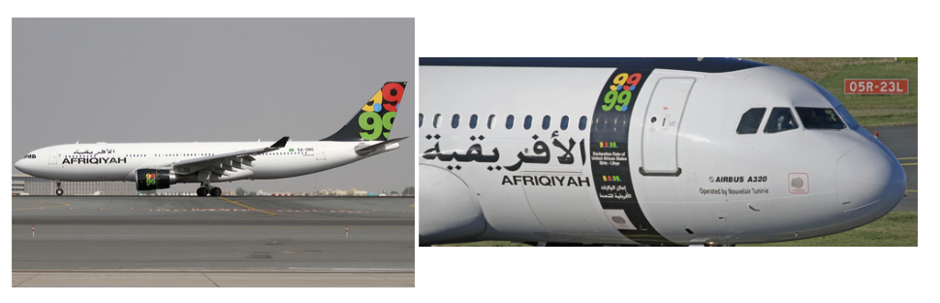
Wikimedia Afriqiyah Airways Airbus A330[3] (left); African Union colors on the passenger door, image from wayback machine (right). afriqiyahairwaysuk.co.uk
While the airlines fashioned its Pan-African orientation, in 2012 the logo was replaced from 9.9.99 to a generic three blue lines that allegedly represent the neck of the turtle dove. Further, the mission statement sited above on the history of the airlines has been removed and currently just shows when the airlines was founded and type of aircraft they operate (Airbus).
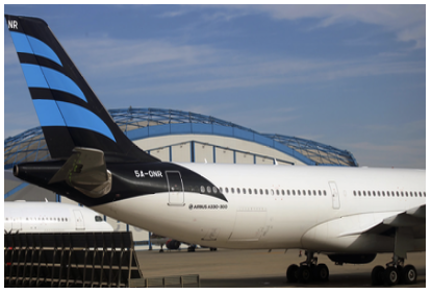
Afriqiyah Airways and its new tail logo[4]
Eventually, the airline re-centered its focus to cater for European airspace and cut most African routes except Alexandria, Cairo, and Tunis, and suspending long-haul flights to Dhaka and Beijing. After 2014, the EU banned Libyan carriers over security concerns. As a consequence of this reorientation—the de-Africanization of Libya—Libya lost a major share of the aviation market such that traveling to other distant African countries requires a layover in Europe (via Ita Airways, Lufthansa, Air France or KLM), Türkiye (Turkish Airlines), Qatar (Qatar Airways) or UAE (Dubai and Emirates Airways). In other words, the self-inflicted de-Africanization by the Libyans that was exacerbated by mainstream media has enabled capital accumulation for those who intervened in Libya in 2011 and capital deprivation for the Libyan people and its state-owned aviation sector. The school year began in January 2012 instead of September 2011 due to lingering unrest. With limited time to revise textbooks, the NTC resorted to revisionist measures. Pages glorifying the LAJ era, its national role, and criticism of the Monarchy (1951-1969) were folded in the 9th-grade History textbook (2010–2011 edition), removing about 60 pages. Meanwhile, 8th-grade Geography books reflected a new state orientation: the 2008–2009 edition titled “Geography of the Arab World and the Community of the Sahel and Sahara [CEN-SAD]” became simply “Geography of the Arab World” in 2012–2013, signaling Libya’s “de-Africanization.” ’Cover designs reinforced this shift—earlier editions showed the Arab region with Africa faintly in the background, while later ones depicted only the Arab region.
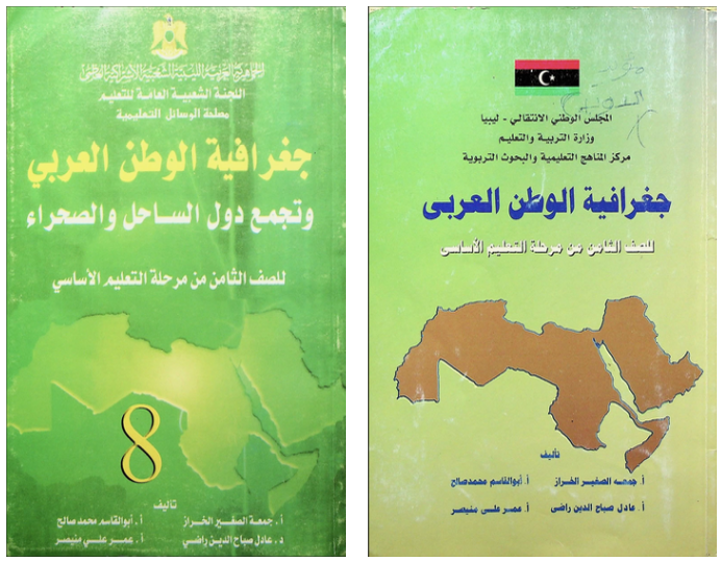
Front cover of the 2008-2009 Geography textbook, titled “Geography of the Arab world and the Community of the Sahel and Saharan” (left); front cover of the 2012-2013 Geography textbook, titled “Geography of the Arab World” (right).
For instance, the 2012–2013 textbook diverged significantly from the content promoted by the former Libyan state. The 2008–2009 edition included:
Unit 1: Geography of the Arab World
Unit 2: A Simple Study of the Geography of the CEN-SAD
Unit 3: The Food Crisis, with Chapter 4 titled “The Role of the Great Fateh Revolution in Confronting the Food Crisis.”
By contrast, the 2012–2013 edition retained Unit 1 but eliminated Unit 2, replacing it with Unit 3 (The Food Crisis) from the earlier edition, while Chapter 4 was entirely removed. This is the ideological manifestation of fascism and its imperialist expression in Libya.
Conclusion: The machete is still in our hands
The de-Africanization of Libya was never an accident. It was not the result of “civil war” or “ancient tribal hatreds” or “failed states”—the lazy lexicon of liberal imperialism. It was a deliberate, multi-pronged counterrevolution: military (NATO’s air war), financial (asset freezes that became interest-free loans to Western banks), ideological (the CNN “slave market” narrative stripped of context), and pedagogical (textbooks literally erased the Sahel and Sahara). Each prong was lubricated by the weaponization of anti-Blackness—the framing of dark-skinned Libyans and African migrants as “mercenaries,” “invaders,” or chattel to be auctioned.
What was lost in 2011 was not a “regime.” What was lost was a material experiment in Third World internationalism: a sovereign wealth fund that financed African infrastructure, an airline that connected Accra to Kigali without a European layover, a water project that sustained farming communities in the south, and a political vision that refused the colonial lie that northern Africa is somehow not African. But loss is not the final word. The same imperialist contradictions that produced Libya’s destruction are intensifying across the continent and the Global Majority. The African Central Bank, the African Monetary Fund, and the Africa Investment Bank—projects championed by Libya since Sirte in 1999—remain unrealized, but not impossible. The desire for delinking, for financial sovereignty has not died. It resurfaces wherever debt strikes, where coups are staged, where mines are plundered, where water is commodified.
The struggle to rebuild Pan-Africanism with Libyan characteristics—and with Malian, Sudanese, South African, Burkinabe, Nigerien and Palestinian characteristics—is not nostalgic; it is strategic. Imperialism did not defeat the idea of African unity; it defeated one iteration of its material expression. The task now is to learn from that defeat dialectically: to understand how anti-Blackness serves as the empire’s preferred wedge, how “rational fascism” mobilizes racisms to break solidarity, and how the global financial architecture punishes any nation that tries to build outside its circuits.
As the famous dictum of Fannie Lou Hamer reminds us, “nobody’s free till everyone’s free.” Libya’s Pan-Africanist project was a rehearsal for that truth. The next rehearsal is already underway—in the Sahel’s anti-French movements, in the BRICS expansion debates, in the growing calls to freeze zionist assets. Our job is to theorize, narrate, and organize as if a liberated world is possible—because dialectical materialism teaches us that what has been destroyed can be rebuilt, on new terrain, with sharper tools. The machete is still in our hands.
Essam Abdelrasul Bubaker Elkorghli is a Libyan doctoral researcher at the University of Illinois at Urbana-Champaign, researching imperialism, ideology and education with a primary focus on Libya. He serves as an assistant editor to the Middle East Critique journal, and member of the Global Pan-African Movement. He writes frequently for the Black Agenda Report and Pambazuka News.
Notes
[1] https://pir.sa.gov.au/__data/assets/pdf_file/0017/162080/Libya_story.pdf
[2] Michael Parenti (in Blackshirt and Reds: Rational Fascism and the Overthrow of Communism, 1996, p. 24).
[3] Wedelstaedt, K. von. (2009). Afriqiyah Airways Airbus A330 at Dubai International Airport [Graphic]. http://www.airliners.net/photo/Afriqiyah-Airways/Airbus-A330-202/1617648/L/. https://commons.wikimedia.org/wiki/File:Afriqiyah_Airways_Airbus_A330.jpg
[4] Hartley, P. (2024, June 21). What Happened To Afriqiyah Airways? Simple Flying. https://simpleflying.com/what-happened-to-afriqiyah-airways/