On Fighting and Talking: Lessons from Viet Nam’s Victories over Two Empires
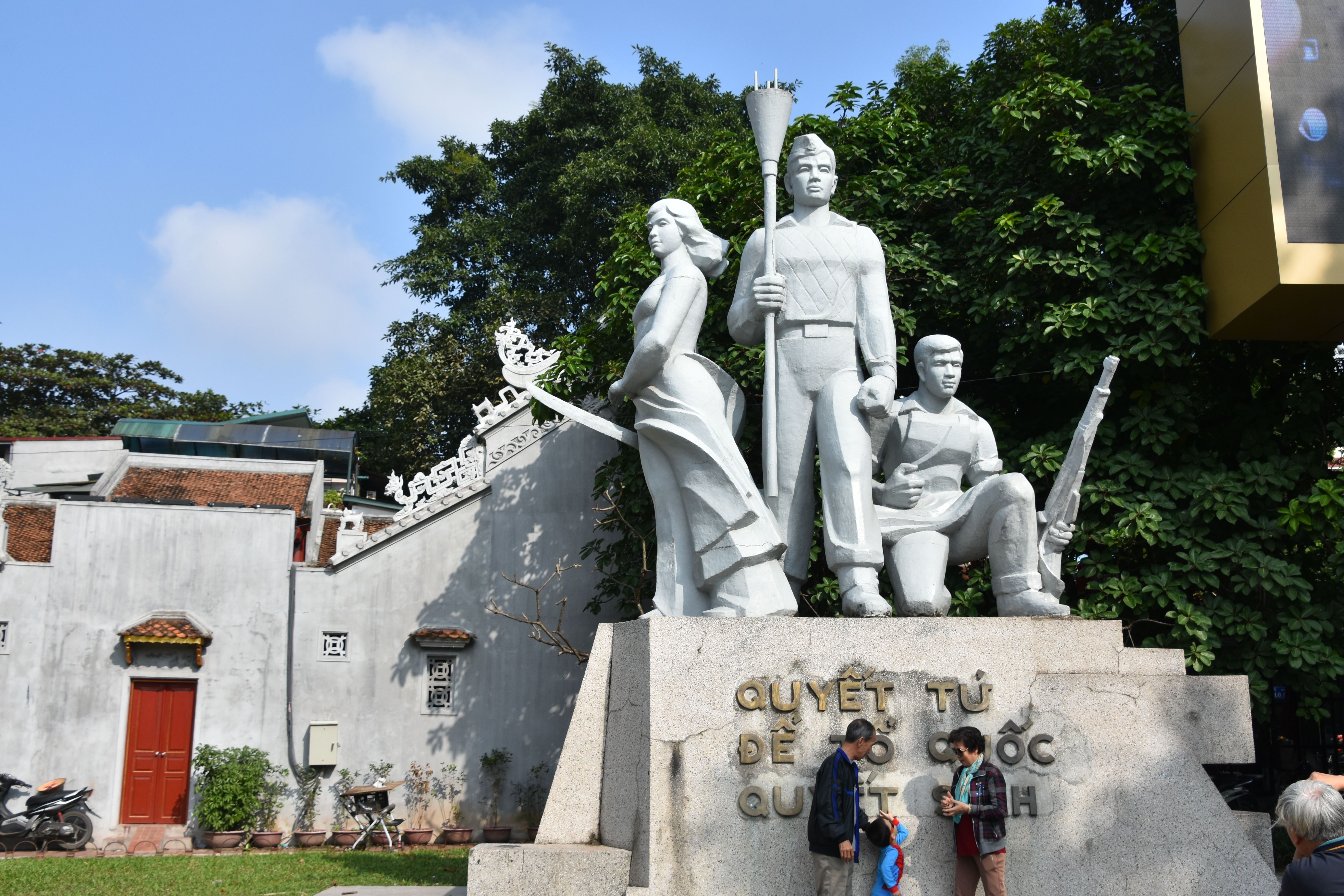
A half-century has passed since Viet Nam resoundingly defeated the United States in its war for liberation and reunification. Viet Nam’s final victory in 1975 was three decades in the making. In 1945, the revolutionary Viet Minh launched the August Revolution in northern Viet Nam, intending to liberate the entire country from its French colonizer. But with help from other imperialist powers, France reoccupied South Viet Nam and divided the country in two. The ensuing war of resistance culminated in Viet Nam’s triumph over the French at the famed Battle of Dien Bien Phu in 1954. That battle inspired revolutionaries across the globe and was supposed to be the catalyst for reunifying North and South. The United States prevented reunification, however. After arming and financing the failed French military campaign, the U.S. escalated its presence in Southeast Asia during the late 1950s and early 1960s.[1] The U.S. ultimately deployed hundreds of thousands of troops starting in 1965. It was a fruitless effort. The North Americans suffered the same fate as their European allies. By 1975, Viet Nam claimed victory over not one, but two global empires.
Fifty years later, Viet Nam still offers lessons to students and practitioners of revolutionary struggle. The resurgence of national liberation underscores the significance of theory and application in revolutionary warfare, including a commitment to protracted struggle. Vietnamese leaders from Ho Chi Minh to General Vo Nguyen Giap placed the utmost importance on long-term resistance, and the Palestinian liberation struggle has adopted this axiom in its war against Zionism. Two years of unyielding resistance forced the Zionist entity of “Israel” and its imperial backers to agree upon a ceasefire with Hamas and the other Palestinian resistance factions in October 2025. While the ceasefire, such as it is called, has allowed Palestinians in Gaza at least a temporary reprieve from incessant Zionist bombardment and repeated ground incursions, the Zionists routinely violate the agreement. Daily airstrikes have killed hundreds and injured thousands more since the “ceasefire” went into effect on October 11. The Palestinian resistance, having endured the treachery of Zionist-imperialist “diplomacy” for decades, surely knew the enemy would defy any agreement.
For Palestine’s international supporters then, the predictable Zionist duplicity raises major concerns about the efficacy of a “ceasefire” to which only one party adheres. This speaks to the larger issue of negotiations during an anti-colonial struggle. Can imperial powers be trusted to follow their word? History has undoubtedly disproved any pretense of imperialist diplomacy with their revolutionary adversaries. Revolutionaries as early as the eighteenth century understood this lesson. The ingenious military leader Jean-Jacques Dessalines proclaimed that Haiti’s thirteen-year liberation struggle faced its greatest challenge not from the French imperialist armies but from the “Chicanery of the Proclamations of their Agents.” Two centuries later, the Palestinian resistance remains undefeated on the battlefield but fights an equally perilous political war.
Second, many of Palestine’s professed supporters—often those speaking more in words than deeds—have concluded that the “world” has failed the Palestinian people. This criticism implicitly targets Palestine’s regional allies in the Axis of Resistance. Yemen is perhaps the only country spared of such criticism, as the Yemeni resistance maintained its world-historically significant blockade against the Zionist entity until the “ceasefire.” Critics more prominently trouble the roles of imperialism’s greatest global rivals, namely China and Russia.
These concerns require a deep analysis of military and political strategy in a national liberation struggle. Intentional or not, they amplify scrutiny of the Palestinian resistance. And in doing so, they unfortunately obfuscate more than clarify, forcing the resistance and its supporters to repeatedly elucidate what constitutes an anti-imperialist analysis of the Palestinian liberation struggle.
This essay considers the various forces with which the Palestinian liberation struggle contends. History is again instructive in this regard. Specifically, the Vietnamese liberation struggle offers crucial guideposts.
On Fighting and Talking
In December 1965, as the United States relentlessly filtered troops into Viet Nam, the Vietnamese Communist Party held its 12th Plenum of the Party Central Committee. In a speech given at the 12th Plenum, Party Secretary Le Duan outlined what was to become North Viet Nam’s central strategy in dealing with U.S. imperialist aggression. The Party had concluded that the world’s major contradictions were all concentrated in South Viet Nam, including the irreconcilable struggles between national liberation and imperialism, communism and capitalism, proletariat and bourgeoisie, and peace and war.
Le Duan focused on two main concerns. First, he addressed the necessary balance between what he called fighting and talking. The Party understood the importance of negotiations and did not dismiss them outright. As Le Duan explained, the question “of fighting until we win and then talking…or of fighting and talking at the same time” required “the correct stratagem, and it is directly linked to our political and military policies.” The goal was not to fight until the U.S.’s total destruction and unconditional surrender. This was unrealistic. Rather, the Vietnamese resistance was to wage a protracted war through which it outlasted the enemy. It would shatter the U.S.’s resolve to continue a long-term war across the ocean, including by demoralizing its troops and gradually disintegrating the U.S.-backed South Vietnamese puppet army. Crucially, this strategy involved attracting international support for Viet Nam’s righteous liberation struggle. “Our most basic strength is political; it is that we have the just cause,” Le Duan determined. Based on this calculation, the resistance could foment antiwar sentiment among Western populations by exposing the atrocities of the U.S.-led imperialist war. Yet, Le Duan was also quick to highlight the risk of devising an incorrect stratagem. In such a case, the resistance would be unable “to consolidate and expand the world people’s front” against U.S. imperialism.
A properly calibrated strategy would dictate when the Vietnamese should hold talks with the United States, including during active hostilities. Goals included restricting the enemy’s military actions, winning broad global support, and concealing the strategic intentions of the Vietnamese resistance. For the Vietnamese, the issue was finding “a favorable opportunity to employ this stratagem.” The resistance created those conditions in early 1968 when it launched the Tet Offensive, a military operation which took the war to South Viet Nam’s urban areas for the first time. The U.S. and the Vietnamese began negotiations soon thereafter.
Le Duan also addressed the “many differing opinions” on talks with the U.S. The Vietnamese fully grasped that imperialist countries like the United States weaponize diplomacy and aim to “negotiate” from a position of strength. Collaborationist countries in the imperialist camp—including for instance, Thailand, the Philippines, and in today’s context, Egypt and Jordan—also legitimize the imperialists’ actions by providing political cover in international institutions and direct military support on the ground. Conversely, Le Duan highlighted the tenuous position of anti-imperialist countries. There were countries who sincerely favored the Vietnamese resistance but had their own diplomatic and domestic considerations to which they must attend. He also clarified that these countries, despite their best intentions, “do not have a clear understanding of our situation” and thus worry “that in prolonged combat, our side’s losses and sacrifices will be too great.” Finally, Le Duan described the positions of Viet Nam’s major allies in the socialist camp. Speaking of the Soviet Union and China, the Party Secretary argued that although these large powers firmly backed the Vietnamese, their strategic goals in the world differed from the objectives of the resistance in Viet Nam.
National Liberation in International Context
The question of the great powers brought Le Duan to a second major issue, the international context. Importantly, the Party understood that the international situation did not preclude political backing and material support from Viet Nam’s major allies. The Vietnamese resistance received significant assistance from both the Soviet Union and China to be sure. Nonetheless, major world developments also led to key differences. This was a dialectical truth.
First and foremost, Viet Nam’s war of resistance against the United States unfolded at a time of significant strife in international communism. The Vietnamese were faced with a regrettable reality. “The revolutionary war in the southern half of our country is raging [at] a time when our camp, and the international communist movement, is not of one accord about the path of the world revolution,” Le Duan admitted. He was primarily referencing the early 1960s Sino-Soviet split, a division in the communist camp that the U.S. began to leverage later in the decade.
Viet Nam had to navigate this global reality in both a delicate and resolute fashion. While all parties and countries in this camp were connected “through the spirit of international proletarianism,” major discrepancies also existed in the relations between various nations. They resulted from a nation’s particular geographical and historical conditions, which led to different strategic imperatives. “If we fail to clearly understand those concrete differences, then we are not being objective, and at the same time we will not have the necessary foundation for correctly understanding many of the other complete international issues in the world today,” Le Duan cautioned.
To avoid the traps of an uncertain international context, the Party concluded that it must be self-determining and self-reliant in Viet Nam’s struggle against imperialism. The Vietnamese accordingly developed an independent strategy geared toward national liberation, reunification, and the attendant development of socialism in Viet Nam. The Vietnamese Communist Party acknowledged the political and strategic lessons of the Soviet and Chinese revolutions. From the Russians, it learned the need to establish and consolidate a dictatorship of the proletariat, to likewise form an alliance between the proletariat and the peasantry, to have a strong Marxist-Leninist vanguard party, and to “use revolutionary violence to combat counterrevolutionary violence.” From China, the Party learned that the peasantry constitutes the main force in its revolution, the necessity of waging a guerrilla war, and from this, the value of protracted war and building base areas. In both cases however, Le Duan qualified that it was necessary to create a revolutionary path bearing “distinctly Vietnamese characteristics” and one “adapted to suit the realities and circumstances of our nation.”
The party leader took this notion a step further. Rejecting the “mechanical imitation” of other revolutions, which may lead to errors and even foster reactionary strategy, Le Duan built on Mao Zedong’s revolutionary maxims.
If we want to maintain solidarity with the Soviet Union and with China, then our Party must be independent and self-reliant. Independence and self-reliance represent the spirit of high responsibility of a Marxist-Leninist party toward the fate of the citizens of its country, toward its entire nation, and toward the international communist movement. It represents the correct and creative use of the principles of Marxism-Leninism, viewed in the context of our own national situation and of the realities of the world revolution, to determine the policies of our Party.
The Party’s accountability to the international movement stemmed from the direct responsibility it had toward its own people. If it could not live up to that responsibility then it lacked the basic character of a Marxist-Leninist party. Thus, although both the Soviet Union and China expressed reservations to their Vietnamese allies about launching a revolution in the South, the resistance pursued an independent policy direction through a people’s war that ultimately proved correct. Le Duan foretold this path to victory in his speech. “Our Party’s experiences and our revolutionary realities have demonstrated that whenever we firmly maintain a spirit of independence and self-reliance, we are able to be creative in our development of policies and directions, and we achieve success.” Implicit in Le Duan’s proclamation is that independence is not possible without self-reliance.
The 12th Plenum was a private meeting, and Le Duan gave his speech behind closed doors. Thus, whatever differences he spelled out with Viet Nam’s global allies were solely for internal strategic planning purposes and not a public display of dissent from the international communist movement. Among the lessons to be drawn from the speech, it is important to start there. The Vietnamese revolutionaries operated on Marxist-Leninist precepts both by developing an independent political trajectory and by refusing to publicly provide the imperialist camp with ammunition to further split the international communist movement. To gain international support, the Vietnamese understood that they must publicly frame their resistance as a national liberation struggle. Imperialism was the enemy.
From Viet Nam to Palestine
The Palestinian liberation struggle contains both historical and contemporary particularities that render linear comparisons with Viet Nam difficult. Nonetheless, a materialist analysis can draw upon lessons from other liberation struggles, including Viet Nam’s, to develop the appropriate analysis and help advance Palestinian liberation. The task is to identify those lessons and apply them properly. “Our Party's sacred historical mission and its heavy but glorious responsibility is to defeat the American aggressors,” Le Duan spelled out in his speech. “The defeat of the American imperialists will not only be a great victory for our nation and our people. It will also be a major victory of profound international significance.” The Palestinian resistance likewise understands that Zionist-imperialism is the primary contradiction not only in Palestine and the West Asia region, but throughout the world.
As was the case with Viet Nam in the 1960s, Palestine is currently the site where all the world’s major contradictions are concentrated. Iran’s late President Ebrahim Raisi emphasized this point in 2024. “Currently, Palestine stands as the moral compass for humanity, ethics, and the conscience of the global community.” Venezuelan President Nicolás Maduro recently stated that Palestine is currently humanity’s “greatest cause.”
But beyond the moral concerns underlying the Zionist genocide in Gaza, Palestine embodies a twenty-first century national liberation struggle against imperialism. Palestine also signifies the ongoing struggle between flailing Euro-American hegemony and Asia’s ascendance, the contradictions between NATO domination and Global South resistance, and the transition from a Western-controlled global order toward multipolarity. Every defeat the Palestinian and regional resistance inflict upon the Zionist regime reflect the further weakening of U.S.-led imperialism in the world. Finally, the Palestinian liberation struggle represents the class contradictions that exist in the world today. It is a struggle for the international proletariat against the Zionist-imperialist bourgeoisie. All revolutions in the world are part of the proletarian revolution, Le Duan asserted, regardless of whether they are socialist revolutions or national liberation struggles.
More importantly, Viet Nam helps to contextualize the current “ceasefire” and the stance of regional and global forces. The Vietnamese experience illuminates the enduring strength of the Palestinian resistance even amid heavy losses. After Operation Al Aqsa Flood on October 7, 2023, the Zionist regime explicitly articulated its aims to eradicate Hamas and all Palestinian resistance in Gaza, to retrieve the Zionist captives through military force, and to “secure” the Gaza Strip.
However, the Al-Qassam Brigades and the other Palestinian resistance factions continued their operations until the ceasefire went into effect. After murdering a multitude of its own captives through its scorched-earth campaign in Gaza, the Zionist entity only retrieved the remaining living captives via a negotiated prisoner exchange with the very resistance it vowed to destroy. Finally, Gaza remains a site of resilience and resistance even after the ceasefire. The Palestinian factions have spent the ceasefire period eliminating those who collaborated with the Zionists during the war.
Meanwhile, Zionist soldiers are demoralized and exhausted from the war. Suicide and desertion rates among Israeli military forces are exceptionally high. Zionist settlers are leaving or attempting to leave the colony and return to Europe or North America. And the Israeli economy is experiencing a protracted collapse thanks to the entity’s perpetual and multi-front wars. The Zionist entity increasingly lacks the capacity to administer its own colony, even as its forces seize territory in Syria and the West Bank. Its international legitimacy is also at an all-time low.
As part of the ceasefire, the Zionist regime and the United States demand that the Palestinian resistance disarms. However, Hamas and the resistance factions view the subject of weapons as non-negotiable. With mounting failed objectives, it becomes clear that the Zionist entity’s ongoing ceasefire violations, the U.S.’s continuous political cover for these abuses, and even the genocide itself reflect desperate acts that aim to establish U.S.-Israeli regional hegemony through unmitigated force. As with similar cases in the history of colonialism, this effort has failed. Israel’s proliferating crises even drove Zionist officials to extend diplomatic recognition to Somaliland this week, fueling speculation of plans to forcefully relocate Palestinians there. The decision immediately garnered global condemnation and fueled pro-unity protests in Somalia given Israel’s violation of its national and territorial sovereignty.
The Palestinian resistance meanwhile engages in negotiations while waging a protracted war on the battlefield. Even perceived compromises in the ceasefire—the release of Israeli captives or the Zionists’ continued occupation of certain areas in Gaza—must be understood in the context of a long-term resistance. General Vo Nguyen Giap highlighted the importance of preparing for prolonged resistance in Viet Nam when the French imperialists invaded the South in 1946.
The Vietnamese people’s war of liberation had…to be a hard and long-lasting war in order to succeed in creating the conditions for victory. All the conceptions born of impatience and aimed at obtaining speedy victory could only be gross errors. It was necessary to firmly grasp the strategy of a long-term resistance, and to exalt the will to be self-supporting in order to maintain and gradually augment our forces, while nibbling at and progressively destroying those of the enemy; it was necessary to accumulate thousands of small victories to turn them into a great success, thus gradually altering the balance of forces, in transforming our weakness into power and carrying off final victory.[2]
The Palestinian resistance has continually expressed its commitment to a war of attrition, particularly by accumulating “thousands of small victories.” As the war decelerates after the so-called ceasefire, the resistance maintains its attritive position and its ability to wage a protracted war.
Through its operations, the resistance has also created international conditions more favorable to the Palestinian struggle in the post-Al Aqsa Flood moment. As the martyred Commander Yahya Sinwar stated in 2022, “we will make the occupation have two options” through continued resistance. “Either we force it to implement international law…and achieve establishment of a Palestinian state…or we place this occupation in a state of contradiction and collision with the entire international will and isolate [it]…and end its state of integration in the region and in the entire world.” Al Aqsa Flood, an operation Sinwar helped mastermind, successfully forced the Zionist entity into an irreconcilable contradiction and isolation in the global landscape.
Palestine in the World
The international context also merits further consideration. Specifically, it is necessary to address the contention that the “world abandoned Palestine.” The Vietnamese experience again answers this concern by highlighting the centrality of self-reliance in one’s own resistance. Likewise, the Palestinian resistance maintains operational and diplomatic independence at every stage of the struggle. Contrary to Western media and academic claims , the Palestinian resistance is not a “proxy” of regional partners, such as Iran. Al Aqsa Flood was planned and executed solely by the Palestinian resistance. This does not deny the reality of regional support for Palestine, however. The Palestinian factions coordinate with the broader Axis of Resistance. Led by Hizbullah in Lebanon and followed by Ansarallah in Yemen, the Popular Mobilization Forces in Iraq, and the Islamic Republic of Iran, the Axis of Resistance quickly established a Support Front after Al Aqsa Flood. Hizbullah’s operations began in earnest the following day. Palestinian leaders have repeatedly expressed gratitude for regional support.
Yet, the various forces in the Support Front must also take their respective domestic conditions into consideration while resisting the Zionist regime. For instance, Iran endured a Zionist-U.S. onslaught during the 12-Day War because the government garnered overwhelming domestic support in its resistance. Internal support allowed Iran to sustain an offensive operation and ultimately inflict a strategic defeat on the Zionist entity in the June 2025 war. In Yemen, Ansarallah’s blockade of the Red Sea and its airstrikes against Israel were enabled by massive domestic backing. Hundreds of thousands of demonstrators mobilized in Yemen every Friday to express solidarity with Palestine and give their blessing for Yemen’s operations. In short, a movement or state must have popular internal support to persist in resistance. If we are to learn anything from Le Duan, we must heed his words about solidarity being reflected in self-reliance.
The Palestinian resistance also maintains positive relations with the world’s two major anti-imperialist powers, China and Russia. To be sure, there are points of contention, including Russian-Israeli diplomatic relations and Chinese trade with the Zionist entity. These realities give rise to contradictions in the quest for both Palestinian national liberation and global multipolarity. Nonetheless, political differences do not obscure the reality that these forces face a common imperialist enemy. Russia’s gains against NATO in Europe have weakened the U.S.’s standing across the globe, including in West Asia. According to Marxist-Leninist theory, we must differentiate between primary and secondary contradictions in the world system. Russia’s protracted war against the U.S. and NATO targets the primary contradiction in the world system today, U.S. imperialism. Conversely, Zionism cannot exist without U.S. imperialism. Its finances, its logistical support and resources, its weapons, and above all, its violent ideological basis all derive from the United States. Zionism is thus a secondary contradiction whose fate is inextricably tied to the destruction of the primary contradiction. Russia’s own policy contradictions, moreover, should not overshadow or obscure its close ties with Iran and the signing of the Iran-Russia Comprehensive Strategic Partnership Agreement in 2025.
China’s ever-growing economic and strategic capacity likewise help facilitate a shift in global power from which the Palestinian resistance benefits. Whereas the United States aims to destabilize the West Asia region, China successfully brokered renewed relations between Iran and Saudi Arabia and thereby helped curtail the Saudi-Emirati aggression against Yemen. Unconfirmed reports have even surfaced that China and Russia funnel weapons to Ansarallah. Beijing also hosted talks between the Palestinian resistance factions and Fatah in order to foster Palestinian national unity. While these efforts are nominally successful, they undermine the U.S.’s diplomatic power in West Asia and thereby disrupt attempts to normalize Zionism’s existence. More importantly, China’s efforts to establish parallel international institutions destabilize the West’s control of the international order.
Although Russia is no longer a socialist state, China-Russia ties are much stronger now than at the time of Viet Nam’s anti-imperialist war. This fact in and of itself provides space for countries in the anti-imperialist camp—such as Venezuela, the Democratic People’s Republic of Korea, the Alliance of Sahel States, and Iran—to pursue independent development. It also creates favorable conditions for national liberation struggles, just as national liberation helps advance multipolarity.
Of course, Le Duan’s words about the strategic differences between various anti-imperialist countries and large nations remain deeply pertinent today. But if the Palestinian resistance can navigate these differences and contradictions to both maintain self-reliance and foster deeper ties with other forces in the anti-imperialist camp, then those engaged in international solidarity must also commit to the political work of connecting these fronts. In effect, the interests of a free Palestine also stem from U.S. imperialism’s defeat in the Caribbean, West Africa, Eastern Europe, the Pacific, and every other region.
Le Duan himself understood the importance of overextending U.S. imperialism in South Viet Nam. “Fighting for a prolonged period is a weakness of U.S. imperialism,” he explained in a July 1965 speech. “The Southern revolution can fight a protracted war, while the U.S. can’t, because American military, economic, and political resources must be distributed throughout the world. If it is bogged down in one place and can’t withdraw, the whole effort will be violently shaken.”[3] Led by Ho Chi Minh, Vo Nguyen Giap, Le Duan, and the steadfast resistance, the Vietnamese produced a world-historical revolution by defeating two imperialist powers. The lessons they provide are of utmost importance today to prevent despair and continue the protracted struggle against imperialism and for national liberation in Palestine and beyond.
As the Palestinian activist Nizar Banat once asserted , our job as anti-imperialists is to “fortify society against the spread of defeatist thought.” Calling forth our histories of victory does just that.
Navid Farnia is a member of AISC. ____________________________________________________________________________________
[1] By 1954, the United States shouldered 80 percent of France’s expenses in Viet Nam.
[2] Vo Nguyen Giap, People’s War, People’s Army (Honolulu: University Press of the Pacific, 1961), 28.
[3] “Speech by Lao Dong Party Secretary Le Duan,” in Vietnam: A History in Documents, 316.