In the Name of Revolution: Four Latin American Speeches for a Better World
With the infamous phrase ‘America for the Americans,’ President James Monroe laid out the foundations of the Monroe Doctrine. The occasion was a State of the Union address to Congress on December 16, 1823.[1] After 200 years, the United States confirms and retrenches its role of ‘zealot guardian’ of the entire Western hemisphere, perpetrating military and economic aggressions against Latin American countries and humanity.
Towering figures like Simón Bolívar and José Martí fought against ‘the neighbor to the North,’ which was eager to seize the future of Latin American nations. Indeed, the voracious territorial appetite of the US empire led to the expulsion of imperial Russia from Alaska (1823), the annexation of Texas (1838), the purchase of New Mexico (1846), dozens of military interventions in Nicaragua, Colombia, Panama, and Haiti (1850s-1880s), and the military occupation of Cuba and Puerto Rico (1898). In the following century, the US empire escalated military invasions and occupations of Caribbean and Central American countries. US-sponsored dictatorships covered the entire hemisphere: in Argentina (during 1932-1943); Cuba (during 1934-1940); El Salvador (1931-1944); Ecuador (during 1935- 1937); Guatemala (during 1931-1944); Haiti (during 1934-1946); Honduras (during 1933-1948); Nicaragua (during 1936-1979); Peru (during 1933-1939); Uruguay (during 1932-1938); and Venezuela (until during 1934-1941).[2] Every imperialist assault cemented the conditions for the birth of a ‘caste of US millionaires’[3] commanding political power in the US and the hemisphere.
The Monroe Doctrine justified the complicity of the US empire with right-wing populist bourgeois governments of Nazi-fascist leanings, such as Getúlio Vargas in Brazil (1934-1938), Arturo Alessandri Palma (1932-1938) in Chile, and later Juan Domingo Perón in Argentina (1946-1955). The United States also cooperated with British colonial regime, allowing old Britain to prolong colonial possessions in the Caribbean and Central America while it began its pillaging of ‘the most abundant sources of tribute of the collapsing Mughal Empire.’[4] The British paid back by granting the US the privilege of opening a dozen military bases in British Caribbean colonies (in the Atlantic Charter of 1941). France and the Netherlands also granted the US empire the right to ‘guard’ their Caribbean colonies during the Second World War. During the postwar period, the Monroe Doctrine provided the rationale for military invasions and right-wing coups in Guatemala (1954), the Dominican Republic (1965), Grenada (1983), Nicaragua (1987), Honduras (1988), Panama (1989), Haiti (1994), and Colombia (in 2000, under the Clinton’s policy of using paramilitary groups).
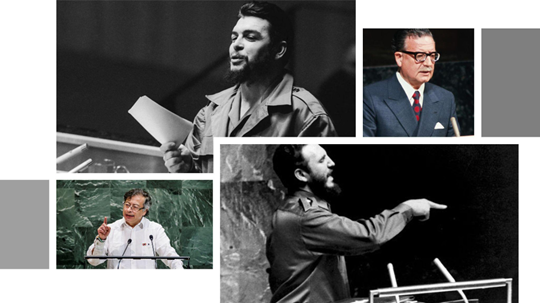
But neither the assassination of the General of Free Men, Augusto César Sandino in 1933, nor the overthrow of President Jacobo Árbenz of Guatemala in 1954, or the terrorist ‘death squads’ the US empire sponsored in Guatemala during 1966-176, or the authoritarian and military regimes the US empire sponsored in the continent, or the brutal repression of the revolutionary struggle of the Puerto Rican nation, and the imprisonment of Puerto Rican revolutionary leader Pedro Albizu Campos, ‘set free at the age of 72, almost unable to speak, paralyzed, after spending a lifetime in jail,’[5] prevented the rise of men and women willing to confront the US empire. This time, it was in the house of the empire, the UN General Assembly, where words were the weapon of choice. The speeches made by Fidel Castro Ruz in 1960 , Ernesto ‘Che’ Guevara in 1964 , Salvador Allende Gossens in 1972 , and the current president of Colombia, Gustavo Petro Urrego in 2025 , will be forever remembered at the UN and beyond. They brought to the UN the colossal weight of ongoing Latin American struggles against the US empire, posing three elemental historical truths about the Monroe Doctrine.
First, that the US empire sustains itself through wars. Addressing the 15th Session of the UN General Assembly on September 26, 1960, Fidel Castro put it in powerful ways:
The dangers of war that threaten the peoples and humanity today do not come from those who love justice, from those who love the progress of humanity, from those who desire a better life and destiny for humankind […] Wars do not come from those who fight for freedom, for the sovereignty and independence of peoples, for the right of each nation to self-determination, for the right of peoples to enjoy their natural resources and the fruits of their labor.[6]
His commanding prose reverberated through the UN floor and walls, as the tall guerrillero dressed in olive-green military uniform delivered the longest speech in UN history. His speech lasted almost four hours and was constantly interrupted by applause from African and Asian delegates and Latin American diplomats.
Recently, the spirit of the speech of Castro returned to us in the powerful words of President Petro of Colombia at the 80th Session of the UN General Assembly last year. Daring to feel the wounds of Gaza, Cuba, Venezuela, and his own country, President Petro warned UN delegates that the West and its ‘fashionable new Hitlers’ are waging wars against humanity:
An oppressed humanity is not humanity, but a beast. The beast is the one who enslaves, puts migrants in chains, launches missiles at young people, riddles children with missiles in a village very near where Jesus was born […] This can no longer be resolved by states that talk but do nothing, nor by rulers bribed by oil and willing to launch missiles at the peoples of the Global South. A new political subject then emerges: humanity united and diverse in its cultures. While the collapse approaches and while the old, white societies of Europe and the United States continue to applaud their fashionable new Hitlers, they listen neither to their youth, nor to their children, nor to humanity, nor to the stars, nor to their grandparents who died as heroes on the battlefields of Europe, truly fighting against Hitler and his criminal idea of a superior race.[7]
The second elemental truth is that oppressed peoples of the world know who the perpetrators are. Ernesto Che Guevara put it with his characteristic eloquence when he said to the 19th Session of the UN General Assembly on December 11, 1964:
Flung in our faces are the acts that fill the world with indignation. Who are the perpetrators? [...] Peaceful coexistence has also been brutally put to the test [...] Soldiers were turned into sub-humans by imperialist machinery, believe in good faith that they are defending the rights of a superior race [...] In this Assembly, however, those peoples whose skins are darkened by a different sun, colored by different pigments, constitute the majority. And they fully and clearly understand that the difference between men does not lie in the color of their skin, but in the forms of ownership of the means of production, in the relations of production.[8]
Castro said it succinctly: ‘revolutionaries do not wage wars against nations.’ Likewise, the speech delivered by President Salvador Allende at the 27th Session of the UN General Assembly in December 1972 pointed at the US empire as the perpetrator of economic warfare. Allende expressed this reality when he said at the UN that:
After all the innumerable agreements and resolutions adopted by the world community, recognizing the sovereign rights of each country to dispose of its natural resources for the benefit of its people; after the adoption of the International Covenant on Economic Social and Cultural Rights, the International Development Strategy for the Second United Nations Development Decade, which solemnly confirmed all these instruments, here we are, well into the 1970s, suffering from yet another manifestation of imperialism, one that is more subtle, more cunning and more terrifyingly effective in preventing us from exercising our rights as a sovereign State [...] The aggression that we are suffering makes it seem illusory to give any credence to the promises that have been made in recent years regarding large-scale action to bring the nations of Africa, Asia and Latin America out of their backwardness and want […] It is now clear that none of those pledges has become a reality. On the contrary, we have moved backwards.[9]
The US empire then inflicted a ferocious economic genocide against the Chilean nation. It closed off all lines of credit and development aid which kept the Chilean copper industry alive, and orchestrated a military coup that culminated with the assassination of Allende on September 11, 1973. President Petro reminded UN delegates that, ‘The economic blockade [against Cuba] is an economic genocide.’ Condemning the imperialist genocide of Palestinians, President Petro expressed to Assembly delegates that: ‘There is no superior race, gentlemen. There are no chosen people of God.’[10]
The last elemental truth conveyed in these four speeches is that ‘this is the opportunity to speak the truth on behalf of humanity.’ In the words of Fidel Castro:
There is something we must remember, something that should concern us all. All of us, without exception, are actors and participants in a pivotal moment in human history. Sometimes, seemingly, censorship doesn’t reach us—that is, we don’t seem to notice the criticism and condemnation of our actions—and this is especially true when we forget that just as we have had the privilege of being actors in this pivotal moment in history, one day history will also judge us for our deeds.[11]
The four speeches are militant poetry that spare no word to describe the wounds that imperialism inflicts to humanity, and the necessary struggles ahead. For this reason, they are a must-read for all seeking to understand how Latin American revolutionaries confronted the Monroe Doctrine and their fidelity to the anti-imperialist cause. At a time when the US empire seeks ‘to push humanity back to the Dark Ages,’ in the words of President Petro, these speeches are historical documents for us to remember past events, scan present events and act accordingly. The genocidal blockade against Cuba, the unilateral, criminal sanctions against Nicaragua, Venezuela and Cuba, the recent kidnapping of President Maduro of Venezuela, and the savage bombings of fishermen in the Eastern Caribbean reveal that the Monroe Doctrine continues to shape inter-American relations. This condition makes these speeches foundational texts for developing theory and action. Each renewed our ‘achievable utopia’ in its times. There are other Latin American revolutionaries whose thought and action added fire to our achievable utopia. Names like Hugo Chávez Frias, Nicolás Maduro, Evo Morales, and Maurice Bishop are well known. Their UN speeches remain for a future work, as they added the needed fuel that moves our achievable utopia forward. Their words continue to move our work forward, in the name of Revolution.
The links to the speeches are available here:
Jeannette Graulau is a member of AISC. ____________________________________________________________________________________
[1] Bethell, Leslie, ‘The Monroe Doctrine in US-Latin American relations and the Trump corollary,’ Journal of the Brazilian Center for International Relations, 4 (2025) https://cebri.org/revista/en/artigo/241/the-monroe-doctrine-in-us-latin-american-relations
[2] Suárez Salazar, Luis, and Tania García Lorenzo, Las relaciones interamericanas continuidades y cambios (CLACSO, 2008).
[3] I borrowed the phrase from Fidel Castro Ruz, in Gobierno de Cuba, ‘Discurso pronunciado por el Comandante en jefe Fidel Castro Ruz, Primer Ministro del Gobierno Revolucionario, en la sede de las Naciones Unidas, el 26 de septiembre de 1960,’ Discursos e intervenciones del Comandante en Jefe Fidel Castro Ruz, Presidente del Consejo de Estado de la República de Cuba (Habana, 2008) http://www.cuba.cu/gobierno/discursos/1960/esp/f260960e.html.
[4] Arrighi, Giovanni, The long twentieth century (New York, 1994), p. 20.
[5] The phrase comes from Ernesto Che Guevara, ‘Discurso en la Asamblea General de las Naciones Unidas,’ Comandante Che Guevara at XIX Session of the UN General Assembly, December 11, 1964.
[6] Gobierno de Cuba, ‘Discurso pronunciado por el Comandante en jefe Fidel Castro Ruz […].’
[7] Guevara, ‘Discurso en la Asamblea General de las Naciones Unidas.’
[8] Petro Urrego, Gustavo, ‘Intervención del Presidente Petro en el 80 Período Ordinario de Sesiones de la Asamblea General de las Naciones Unidas,’ UN Library, https://gadebate.un.org/sites/default/files/gastatements/80/co_es.pdf.
[9] Allende, Salvador, ‘Discurso en la Asamblea General de las Naciones Unidas,’ Salvador Allende y América Latina (Santiago, 1972) https://www.memoriachilena.gob.cl/602/w3-article-7739.html.
[10] Petro Urrego, Gustavo, ‘Intervención del Presidente Petro […] en las Naciones Unidas.’
[11] Gobierno de Cuba, ‘Discurso pronunciado por el Comandante en jefe […].’