Empire by Proxy: Paramilitarism, Authoritarianism, and U.S. Cold War Power in Haiti and Iran
This essay examines Haiti under François Duvalier (1957–1971) and Iran under Mohammad Reza Pahlavi (1941–1979) as paradigmatic cases of U.S.-backed authoritarianism during the Cold War. Drawing on scholarship by Iranian historians and analysts alongside Haitian political theorists, it argues that U.S. foreign policy systematically cultivated proxy dictatorships, paramilitary violence, and the suppression of democratic institutions in pursuit of a global order favorable to U.S. ruling-class interests. Far from aberrations, these regimes exemplify a recurring Cold War governance model in which repression was outsourced to compliant local strongmen, while the United States retained strategic control without direct colonial administration.
Cold War Ideology and the Strategic Use of Authoritarianism
The Cold War, framed rhetorically as an existential struggle between capitalism and communism, functioned ideologically as a legitimating discourse for imperial intervention. Under the banner of “containment,” the United States repeatedly undermined democratic movements in the Global South while supporting authoritarian regimes willing to guarantee geopolitical alignment, market access, and anti-communist discipline. The result was not the defense of freedom, but the maintenance of unequal exchange and capital accumulation within the world system.
In the Middle East, Iran emerged as a linchpin of U.S. regional strategy, particularly after the nationalization of oil under Prime Minister Mohammad Mossadegh (Abrahamian 1999; Takeyh 2021). In the Caribbean, Haiti’s geographical proximity to the United States rendered it a strategic outpost in Washington’s hemispheric security calculus, especially following the Cuban Revolution (Trouillot 1990, 95–112; Fatton 2007, 107–108). Despite their cultural and historical differences, both countries were drawn into a shared political logic: authoritarian consolidation justified as anti-communist necessity.
The CIA-orchestrated coup of 1953 in Iran, which overthrew the democratically elected Mossadegh, marked the decisive turn toward authoritarian rule under the Shah (Ghazvinian 2021, 227–255). With sustained U.S. backing, Mohammad Reza Pahlavi constructed a centralized state emphasizing military modernization, technocratic reform, and the systematic elimination of political opposition. Central to this apparatus was SAVAK, the secret police established with direct assistance from the CIA and Mossad (Ward 2009, 267–276; Mousavian 2014, 24–32). As Abrahamian documents, SAVAK fused intelligence gathering with terror, targeting intellectuals, clerics, students, and workers through surveillance, torture, and execution (Abrahamian 1999, 1–12).
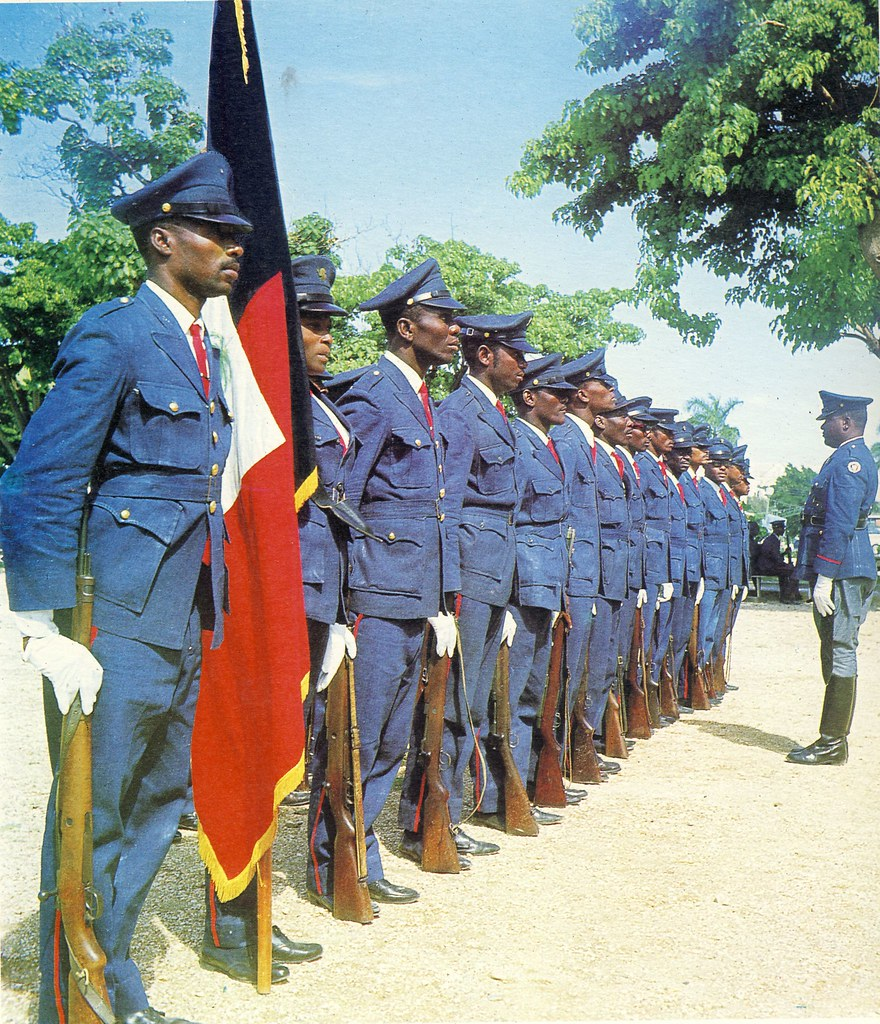
In Haiti, François Duvalier exploited Cold War anxieties by presenting himself as an uncompromising anti-communist strongman. In exchange for political loyalty, the United States tolerated— and at times materially supported—his regime despite full knowledge of its brutality (FRUS, Haiti, 1960–1970). Duvalier’s creation of the Tonton Macoutes (Milice Volontaires de la Sécurité Nationale) institutionalized paramilitary violence outside the formal military chain of command. As Trouillot argues, this force became the regime’s primary mechanism of domination, embedding terror into everyday social life while insulating Duvalier from coups and popular revolt (Trouillot 1990, 177–180; Fatton 2002, 78–85).
Paramilitarism as Governance and Spectacle
In both Iran and Haiti, paramilitary organizations were not auxiliary institutions but central instruments of rule. SAVAK and the Macoutes functioned simultaneously as mechanisms of repression, surveillance, and symbolic domination. Declassified documents from the National Security Archive reveal that SAVAK incorporated U.S.-designed interrogation and intelligence techniques into a comprehensive architecture of fear (National Security Archive, “Iran 1953”).
Similarly, the Macoutes operated with legal impunity, publicly displaying violence as a means of social control. Trouillot famously described them as a “state within the state,” exercising both punitive and performative power (Trouillot 1990, 179). Their uniforms, weapons, and ritualized brutality transformed repression into daily spectacle—what Alex Dupuy identifies as a politics of terror designed to normalize fear and erode collective resistance (Dupuy 1997, 160–167).
Azimi observes a parallel dynamic in Iran, where modernization coexisted with theatrical repression: public executions, forced confessions, and omnipresent surveillance served to dramatize the Shah’s absolute authority while hollowing out civil society (Azimi 2008, 252–256).
Both regimes dismantled democratic institutions under the pretext of modernization and national security. In Iran, constitutional forms—elections, parliament, political parties—were preserved as empty rituals, while genuine pluralism was systematically eliminated (Azimi 2008, 126–131). In Haiti, Duvalier abolished opposition parties, censored the press, ruled by decree, and converted the state into a personal fiefdom (Pierre-Charles 1986, 143–150).
These cases illuminate a broader Cold War pattern: U.S. support gravitated toward authoritarian regimes that promised stability, anti-communism, and openness to foreign capital. The rhetoric of the “free world” concealed a global system rooted in repression, militarized aid, and clientelism. Proxy dictatorships were not deviations from U.S. policy but structural components of imperial governance.
Conclusion: A Cold War Culture of Proxy Power
The comparative trajectories of Haiti and Iran demonstrate that U.S. Cold War interventionism relied on the systematic cultivation of authoritarian proxies. Ideological paranoia was translated into institutional practice, producing regimes that delivered “stability” for monopoly capital through force and fear. In both contexts, paramilitarism was not an accidental byproduct of authoritarianism but its lifeblood—a calibrated mechanism for enforcing ideological conformity and foreclosing democratic possibility.
Democracy, in this framework, was not a value to be defended but a risk to be neutralized. The long-term consequences were devastating: the erosion of civic institutions, the normalization of terror, and the entrenchment of political cultures hostile to popular sovereignty. Haiti and Iran caution against any narrative that frames U.S. intervention as benevolent or humanitarian. The Cold War record reveals a consistent logic of coercive diplomacy, outsourced repression, and the systematic subordination of Global South sovereignty to imperial and class interests.
William Balan-Gaubert is an independent scholar of Haitian history and culture affiliated with the University of Chicago.
____________________________________________________________________________________
References
Abrahamian, Ervand. Tortured Confessions: Prisons and Public Recantations in Modern Iran. Berkeley: University of California Press, 1999.
Azimi, Fakhreddin. The Quest for Democracy in Iran. Cambridge, MA: Harvard University Press, 2008.
Dupuy, Alex. Haiti in the New World Order: The Limits of the Democratic Revolution. Boulder: Westview Press, 1997.
Fatton, Robert. The Roots of Haitian Despotism. Lynne Riener Publishers, 2007
Ghazvinian, John. America and Iran: A History, 1720 to the Present. New York: Knopf, 2021.
Heinl, Robert D., Jr., and Nancy Gordon Heinl. Written in Blood: The Story of the Haitian People, 1492–1995. Lanham, MD: University Press of America, 2005.
Mousavian, Seyed Hossein. Iran and the United States: An Insider’s View on the Failed Past and the Road to Peace. London: Bloomsbury, 2014.
National Security Archive. “Iran 1953” Collection. George Washington University.
Pierre-Charles, Gérard. Haiti: Past, Present, Future. Havana: Casa de las Américas, 1986.
Takeyh, Ray. The Last Shah: America, Iran, and the Fall of the Pahlavi Dynasty. New Haven: Yale University Press, 2021.
Trouillot, Michel-Rolph. State Against Nation: The Origins and Legacy of Duvalierism. New York: Monthly Review Press, 1990.
U.S. Department of State. Foreign Relations of the United States (FRUS). Volumes on Iran (1951–1954; 1977–1980) and Haiti (1960–1970).
Ward, Steven R. Immortal: A Military History of Iran and Its Armed Forces. Washington, DC: Georgetown University Press, 2009.