Challenging the Theory of Black Male Patriarchy: Imperial Feminisms and their Pitfalls for Anti-Imperialist Resistance
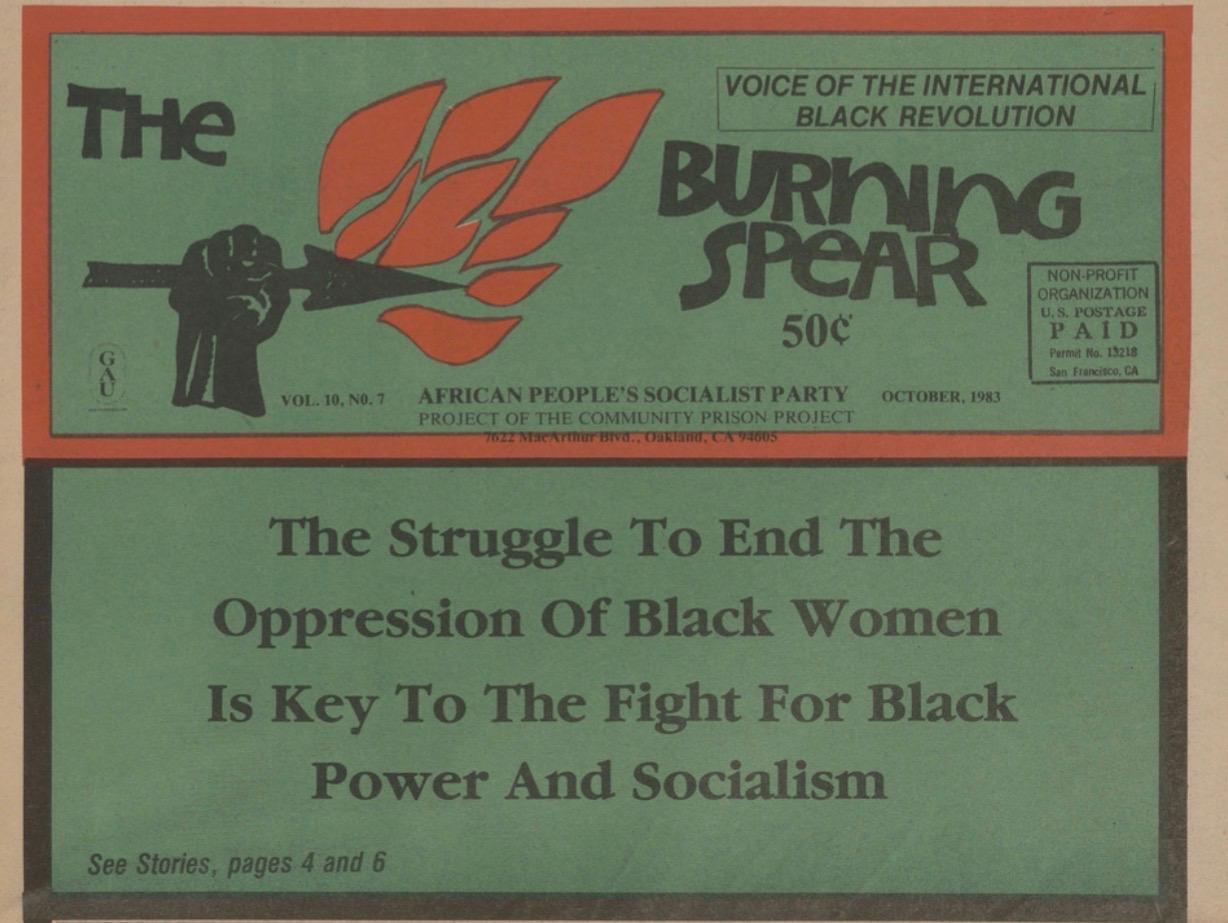
A belief among feminists is that patriarchy is the rule of all men over all women. This understanding is both ahistorical and ideological in its insistence that men, regardless of the historical and empirical nuances of race and class, dominate women because of their maleness. This essay challenges this definition of patriarchy on account of its inapplicability to Black (colonized) men and hence the idea of “Black male patriarchy.” Taking its cue from theories put forth by the historic Black Panther Party (“internal colony”), the Uhuru Movement today, and even potentially V.I. Lenin who characterizes Black people as a “dependent” or “subject nation,”[1] this paper understands Black people in the U.S. as colonized subjects in a settler colonialist state. By exploring the history of ethnological theories on race and sex and the racial origins of first wave feminism , this paper seeks to show how feminisms that align with imperialism are unable to apprehend Black men’s experiences. Anti-imperialist movements today need to reckon with the shortcomings of feminism as a liberatory framework for colonized men and women.
When examining the definition of patriarchy alongside the history of discrimination and anti-Black misandry to which Black men have been subjected, it becomes clear that patriarchy is not a valid framework to understand their lives in historically patriarchal societies like the United States. The contradictory complexity of being labeled an ungendered, feminine, yet hyper-sexualized male requires a nuanced analysis for which imperialist feminism does not have room.
Studies centering the Black male experience are few and far between. Even less common is the argument that despite being male, Black men do not benefit from the supposed advantages of patriarchy. However, this suggestion becomes increasingly compelling when one looks at tangible and measurable ways a man may benefit from patriarchy. Because of historical and contemporary social norms and practices, many males do experience advantages like higher wages, safety from sexual assault or intimate partner violence, and a higher standard of living in general. But this paradigm does not neatly fit the experiences of Black males—one of many understudied groups in and out of academia.
In refutation of Black Male Patriarchy
When looking into previous research done in this sphere, studies centering Black men and their experiences of gendered oppression or anti-Black misandry, the work is concentrated among a few scholars. The few existing empirical studies converge on the conclusion that Black men tend to be one of the main victims of patriarchy. A 2018 study investigated whether Black men truly experience privilege on account of their maleness. It concluded that, when measuring what the researcher deemed appropriate and quantitative aspects of privilege, Black men were one of the main victims of U.S. patriarchal society, not a beneficiary. Even in the case of income, where Black men were shown to be doing better than Black women, it was deemed so because “incarceration contribute[d] to growing joblessness, especially among low-skilled [B]lack men,” and that this “drove up reports of average wages of [B]lacks, inflating rates of [B]lack economic progress.”[2] This study then suggests that the perceived privilege granted by masculinity for Black men does not quite reflect the reality of their socioeconomic conditions.
In “Reconstituting the Object,” Tommy J. Curry argues that Black men are theorized by white intellectuals through anti-Black caricatures; Black manhood and masculinity are contemporarily studied and understood under the idea that Black men’s “response to white patriarchal norms” is through the emulation of the same subjugating white male patriarchy. This is called mimetic theory. Curry also establishes Black Male Studies as a paradigm that argues that Black men, “like other racialized male groups throughout the Global South” are the primary targets of patriarchal violence.[3] Likewise, in another study , Curry uses a historical and empirical approach to explain the racial origins of twentieth century concepts of gender and how that has impacted the parochial ways Black men are contemporarily studied and theorized. The same study shows how nineteenth and twentieth century European ethnological and white feminist narratives have greatly contributed to how we understand gender today. This understanding has erased the possibility of understanding Black men as an oppressed group not despite, but rather because of, their maleness.
Despite pathologizing representations of the “Black Macho,” most Black men are not prone to domestic violence, one of the manifestations of patriarchy. A 2008 study investigates domestic violence rates with Black men as both victims and perpetrators and the “risk factors that make Black men vulnerable to dating violence.” Rather than attributing Intimate Partner Violence (IPV) to the innate savagery and patriarchal nature of Black men, as prior studies had done, this study draws conclusions solely from the statistical findings, using “socioeconomic status, exposure to family violence during childhood, and exposure to community violence” to explain the high rates of IPV among Black couples. West concludes that “the majority of Black men do not commit violent acts against their girlfriends and dates.” She continues, “too often, African American men are portrayed within the mainstream society, and sometimes within the Black community, as irresponsible and prone to violence.” She argues that this contributes to the perpetuation of this stereotype.[4] This misperception is the result of Black male life being theorized by descendants of white ethnologists—and their non white adherents—and the transformation of those findings into dogma within the academy and mainstream society.
Mainstream conceptualizations of masculine privilege also do not fit the realities of Black manhood. In the “Controlling Masculine Hierarchies” chapter of Black Masculinity and Sexual Politics, Sidney Lemelle argues that the societal position of Black men is an “appendage to real masculine labor.” To reach this conclusion, Lemelle looks at the changing ways in which Black men have been possessions of the powerful status classes. Black men were first possessed in a literal sense during slavery, and this continued past the civil rights movement through “the system of buying and selling black athletes” as well as the way “the prison industrial complex organized black familial instability” and reintroduced servitude through the “convict lease system.” Controlling and “possessing” Black people, and Black men in this case, was a perpetual phenomenon that existed well past literal ownership of Black people during slavery. This, argues Lemelle, routinely broke “the spirit of masculinity, and specifically patriarch masculinity” among Black men. In this section, Lemelle argues that “Black male gender requires a more sustained examination” than feminist and masculinist theories provide, especially when arguing that “[B]lack men oppress [B]lack women just as white men oppress white women.” Lemelle argues that this idea becomes appealing when examining the negative implications that “binary gender categories of Eurocentric dominance” has on Black men and women.[5]
These studies ask us to interrogate and resist taking at face value notions of gender’s nexus with privilege when considering colonized subjects—in this case Black men in the U.S. As colonized subjects, privilege allotted to white men because of their maleness in a colonial society, is not necessarily transferable to Black men because of their maleness or masculinity.
The racial origins of “first-wave” feminist theory: A compromised beginning
The “first wave” of feminism, mostly characterized by the suffragette movement spearheaded by the likes of Susan B. Anthony and Elizabeth Cady Stanton, saw the 19th century mobilization of elite white women’s efforts to win the fight for enfranchisement. The suffragist movement was closely tied to the antiracist movement of the late 19th century, ostensibly advancing the “linked fate” of Black men and white women in their struggle to win the vote. This argument is usually backed by the presence of Frederick Douglass at the historic Seneca Falls Convention of 1848. This supposed camaraderie was swiftly proved fruitless when the 15th Amendment to the U.S. Constitution passed in 1870 and legally gave Black men the right to vote, leaving white women to stand and watch. It was this critical moment in history that shifted, or rather exposed, the suffragist movement for what it really was: a way for white women to finally join the same socioeconomic position that white men enjoyed and “improve the electorate,” as a poster from 1912 stated. White women intellectuals who led the movement did not celebrate the passage of this amendment as a progressive moment in history, but rather vehemently opposed and condemned the government for deigning to make “former slaves the political masters of their former mistresses.”[6]
Suffragettes of the “first wave” used white supremacy and the idea of “improving the electorate” with their civilized vote to convince the public (white men) that giving Black men the right to vote was a mistake. They appealed to that sense of kinship and sanctity of white womanhood to relay that they should vote. As leading suffragette Carrie Chapman Catt put it, “White supremacy will be strengthened, not weakened, by women’s suffrage."[7] Anna Howard Shaw, another leading suffragist, was recorded to lament that “You have put the ballot in the hands of your black men, thus making them political superiors of white women.”[8] In addition to their vehement opposition to the 15th Amendment, some women suffragists publicly encouraged lynching Black men as a means to protect the white woman and her vote. Rebecca Latimer Felton, suffragist and one-day U.S. senator, said, “If it requires lynching to protect woman’s dearest possession from ravening drunken human beasts, then I say lynch a thousand negroes a week, if it is necessary.”[9]
In White Women’s Rights, Louise Michele Newman argues that “racism was not an unfortunate sideshow in the performances of feminist theory. Rather, it was center stage: an integral, constitutive element in feminism’s overall understanding of citizenship, democracy, political self-possession, and equality.”[10] This racialized rhetoric and history were “root and branch” of feminism.
Similarly, dominance feminism appeals to this idea of white women inferiority and victimhood. This type of feminism, largely developed by Catherine Mackinnon, “attributes women’s inferior societal position to men’s concerted effort to subordinate and control women.”[11] This theory does not draw a difference between white men and non-white men nor colonizer men and colonized men; it relies on the essentialist idea that all men are equally oppressive because of their masculinity.
Feminism must fully confront these problematic origins in order to accurately theorize the effects of patriarchy on all groups and to ensure that the ongoing struggle for women’s equality results in gains for all marginalized groups. There have been attempts at alternative frameworks that break with this past or recenters those in the margins, (Black feminism, intersectional feminism, decolonial feminism, ad nauseam). However, as Clenora Hudson-Weems has noted in Africana Womanism, “the Africana woman does not see the man as her primary enemy as does the White feminist.” The African National Women’s Organization, a mass organization of the Uhuru Movement, is an expression of this belief in their express separateness from feminism. They write, “Patriarchy, as problematic as it may be, is not the core contradiction. It can be overturned with political education in the form of discussions and, from time to time, physical resistance. Colonialism, on the other hand, cannot be reasoned with. Its very existence is at the expense of the lives and lands of many of the world’s peoples regardless of age, gender, political alignment, class or religion.”
But if decolonial resolves these tensions because it is “what women do when they fight racism, capitalism, imperialism,” then we are delinking the aforementioned history of feminism, and inadvertently attaching it to the work of Black radical women like Claudia Jones or Assata Shakur. This not only risks ahistoricity but can potentially suggest the primacy of patriarchy as the central issue their organizing dealt with.
Moreover, the tragedy is that the racist and imperialist tendency of feminism is not the bygone era of a movement that has since redeemed itself. The decades-long war on Gaza that has now reentered our political imagination due to the events of October 7, 2023, has brought imperial feminism’s contradictions into sharp relief. The protection of women during this war was atopic of conversation when it came to the rights of Israeli women, but not the Palestinian women who have suffered unimaginable degradation, pain, and violence at the hands of the Israeli state. In fact, Israeli women in the Israeli Defense Force (IDF) were celebrated by the state and supporters of the war alike for waging war against states like Iran they have deemed oppressor of women. Yasmine Akrimi’s April 4, 2024 article succinctly discusses Western feminism’s objectives as expressed through the French feminist organization named ‘La Parole Des Femmes.’ Though “Western” denotes a geographical location, Akrimi’s operationalization of “Western feminism” is one consistent with tendencies within feminisms that endorse the political projects of imperialist powers.
Exposing the fallacy of Black Male Patriarchy is one way of exploring imperial feminism’s historical, conceptual, and political limitations for colonized subjects. The myth of Black Male Patriarchy also offers an opportunity to see how imperial feminism’s risks are not only those directed at colonized women. Given the incompatibility of Black men’s experiences, and considering too the longstanding Womanist or Africana Womanist critiques of the white-centeredness of some feminisms, a true decolonial anti-imperialist framework requires both colonized men and women to put at the center the primary contradiction that is the imperialist scourge avowed by the international colonial capitalist system.
Solyana Bekele is a Graduate Student in Africana Studies at the University of Delaware. She writes about politics, history, music, and anything she deems important, interesting, or both.
____________________________________________________________________________________
[1] V.I. Lenin, Lenin on the National and Colonial Questions (Foreign Languages Press, 1967).
[2] Becky Pettit, Invisible Men: Mass Incarceration and the Myth of Black Progress (Russell Sage Foundation, 2012).
[3] Tommy J. Curry, “Reconstituting the Object: Black Male Studies and the Problem of Studying Black Men and Boys Within Patriarchal Gender Theory,” 2022,https://doi.org/10.1007/978-3-030-83947-5_27 .
[4] Carolyn M. West, "A Thin Line Between Love and Hate"? Black Men as Victims and Perpetrators of Dating Violence," Journal of Aggression, Maltreatment & Trauma 16, no. 3 (2008): 238–257, https://doi.org/10.1080/10926770801925569 .
[5] Anthony J. Lemelle, Black Masculinity and Sexual Politics (Routledge, 2010).
[6] Anna Howard Shaw, The Story of a Pioneer: Autobiography of Anna Howard Shaw (2018).
[7] Carrie C. Catt, Woman Suffrage by Federal Constitutional Amendment (National Woman Suffrage Publishing Company, 1917).
[8] Shaw, The Story of a Pioneer.
[9] Jerome A. McDuffie, “Politics in Wilmington and New Hanover County, 1865–1900: The Genesis of a Race Riot” (PhD diss., Kent State University, 1979), ProQuest Dissertations & Theses Global (8003476).
[10] Louise M. Newman, White Women's Rights: The Racial Origins of Feminism in the United States (Oxford University Press, 1999).
[11] Andrea Mazingo, “The Intersection of Dominance Feminism and Stalking Laws,” Northwestern Journal of Law & Social Policy 9, no. 2 (2014).