AES and Mali: Regional Dynamics and the Internal Roots of External Assault
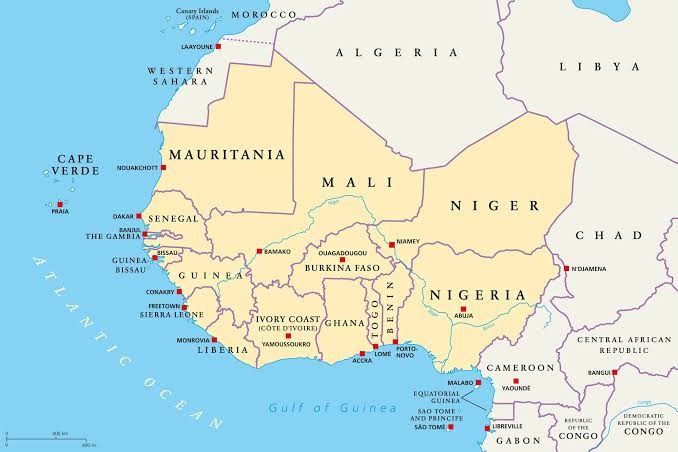
The Alliance of Sahel States (AES) was established in 2023 out of the political convergence of Mali, Burkina Faso, and Niger, following a series of military-led transitions that repositioned each country's relationship to France and reoriented them towards a sovereign path. The AES formalized its alliance as both a security and political project, explicitly rejecting neocolonial arrangements, eventually announcing its withdrawal from the Economic Community of West African States (ECOWAS) and charting an independent regional course.
Beyond its sovereign model of regional security and its framework for economic integration, what makes the AES particularly significant is its political federation – which is, in itself, a precondition for Pan-African unity as advocated by Kwame Nkrumah and Cheikh Anta Diop [1;2]. The move towards establishing a federation in 2025 proved critical in enabling a unified response among the three countries against imperialist pressures, while simultaneously deepening the bonds of regional economic integration. The coordinated responses and demonstrations of mutual solidarity whenever any AES member state faces external pressure, whether in tensions with ECOWAS or with other outside actors, are a positive indication of the vitality of this political union. Nonetheless, the distinct regional, historical, and politico-cultural contexts of each AES member state can at times generate political divergences with regional partners or adversaries. For example, while Niamey and Ouagadougou have pursued rapprochement with Algiers to revive trade and advance the Trans-Saharan pipeline project, tensions between Bamako and Algiers remained heightened until the resumption of their diplomatic relations, announced on July 11th. Though such divergences do not critically undermine the broader AES project of sovereignty and anti-imperialism, they underscore the need to understand each country's particular circumstances–relations with Western powers, coastal neighbors, and unique historical-political contexts–on their own terms.
In this regard, while Burkina Faso is perhaps the best known of the three countries, Mali's trajectory may be the most consequential for the AES project of sovereignty. Among the three AES member states, Mali maintains the most entrenched historical tradition of resistance to French domination in the Sahel, with its origins in islamic anticolonial resistance wars of the 1850s, and Samory Touré's eighteen-year guerrilla campaign against French imperial rule until his capture in 1898. It is also the member state waging an existential war against the enduring threat of balkanization as a longstanding project of French imperialism with roots in the colonial era. France's massive deployment of troops in Mali under Operation Serval and later Barkhane in 2013, following the 2012 northern bloody insurgency and coup led by terrorist groups, marked its largest military intervention in Africa since the Algerian War (1954-1962). The renowned Malian thinker and writer Aminata Dramane Traoré, an alter-globalist, anti-imperialist, and pan-Africanist, condemned this military intervention as a cover for French imperial expansion in Mali, noting “I am Malian, and I say loud and clear that Mali has been stolen from us, under the pretext of protecting it from jihadists.” [3] (p. 111)
Mali has been confronted with a secessionist movement in its northern region, one that France has systematically instrumentalized to advance its imperialist interests and undermine the integrity of the Malian state. These conditions have made Mali the primary target of external aggression. The deadly attacks of April 25 in northern Mali and Bamako, along with the sustained terrorist strikes on oil and fuel convoys—clearly aimed at asphyxiating Mali's economy—are evidence of the escalating nature of such assaults. Understanding Mali and its challenges is therefore of paramount importance for grasping the future of the alliance as a whole.
This essay addresses broad questions concerning the historical and contemporary dynamics shaping the AES countries' relations with their regional neighbors, with particular emphasis on Mali, including the internal factors that have rendered it a primary target of external aggression. In addressing them, we gain a better understanding of the regional context and the internal factors shaping the AES's political cohesion and its future viability.
How have the specific regional, historical, and political-economic particularities of AES member states conditioned their current development paths and their collective project of sovereignty?
Culturally and socially, all three countries share the same people among themselves and between their coastal neighbors. This human geography predates and transcends the colonial borders imposed upon them and is marked by centuries old trade routes and migration patterns across the Sahel. This particularity is not exclusive to AES countries. Yet, by virtue of its geographical position and sheer size, especially around the region known as the Niger Bend, Mali is in many ways one crossroad in the region where peoples who also inhabit much of the rest of West and Northern Africa converge. These shared populations and the porous borders that reflect their historical movements continue to shape the bloc’s relations with other regional nations to this day.
Economically, uneven development sets AES apart from its coastal neighbors. This disparity is often attributed to their landlocked geography or to political instability. But it cannot be understood outside of its colonial context that imposed distinct development paths in the region. West Africa’s integration into the world capitalist system, followed by more than half a century of extraverted and neoliberal economic arrangements, produced structurally uneven regional development that continues to shape each county’s relationship to the imperial core.
As Samir Amin described in his 1972 work on underdevelopment and dependence in “Black” Africa, West Africa's integration into the world capitalist economy was organized around the large-scale production of tropical agricultural commodities—groundnuts, cocoa, palm oil, and others—destined for export to the metropole. These plantation systems were concentrated along the coast, and it was around them that colonial infrastructure, investment, and administrative priority were structured, often at the expense of the hinterland. Within French West Africa, Côte d'Ivoire and Senegal emerged as the administrative and economic poles of the French colonial state. According to Amin, "...the colonial trade necessarily gave rise to a polarization of dependent peripheral development at the regional level. The necessary corollary of the 'wealth' of the coast was the impoverishment of the hinterland" (p. 523)[4].
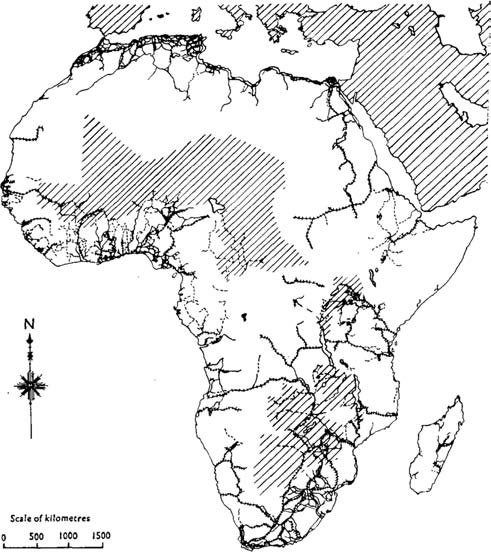
Figure 2: Map showing Africa’s networks of colonial railways, 1968; Source: Cupers, K., & Meier, P. (2020). Infrastructure between statehood and selfhood: The trans-African highway. Journal of the Society of Architectural Historians, 79(1), 61-81.
The hinterland, what would become Mali, Niger and Burkina Faso, was not developed as a productive zone in its own right but rather supplied forced labor to the coastal plantations. While some cotton production existed in these hinterland territories, particularly Mali and Burkina Faso, it remained marginal relative to the coastal agricultural economy [4]. Railroads were built to connect those countries to the plantation poles and were designed to move labor and goods. The French anthropologist, David Phillipe, documented the history of the seasonal agricultural migration to serve groundnut production in Senegambia within the context of French colonial labor regimes and local social relations. The majority of these migrants came from what was then called French Sudan but is now present-day Mali [5].
In French West Africa, colonial organization fostered a comprador class in coastal countries like Côte d'Ivoire and Senegal, a landowning agrarian bourgeoisie whose peripheral dependence tied it to French interests. Though active in independence movements of the 1950s, this class voted to remain within the French Community, securing nominal independence while preserving French political and economic influence. Their integration into colonial parliamentary institutions, alongside more progressive African politicians, enabled France to marginalize those advocating full sovereignty and African federation. Félix Houphouët-Boigny, who led the independence movement in Côte d'Ivoire and accumulated his wealth as a landowning agrarian bourgeois, embodied this comprador tendency [6].
In Niger and Mali, political parties of Marxist-Leninist orientation received popular support and exercised immense influence over the decolonial movements and stood firmly against remaining under France's tutelage. Faced with this resistance, France was compelled to intervene directly to install neocolonial puppets subservient to French interests. This strategy proved successful in Niger, where France intervened directly by sending troops to influence elections against the Sawaba socialist party led by Djibo Bakary shortly before independence, installing a comprador regime in his place, much as it did in Burkina Faso. The latter would not see its first anti-imperialist government until 1983, when Thomas Sankara seized power. In Mali, however, decolonization led to a socialist postcolonial government under Modibo Keïta [6].
France has maintained immense neocolonial political and economic influence across the region through monetary policy, military agreements, and entrenched economic structures. The three AES nations have among the lowest GDP per capita in the region, yet together hold vast mineral reserves—including gold, uranium, zinc, lithium, copper, and nickel. Mali and Burkina Faso, Africa's third- and fourth-largest gold producers, account for roughly 20 percent of continental output [7]. Niger, the world's seventh-largest uranium producer, was long dominated by French nuclear giant Orano (formerly AREVA), which held majority ownership of its SOMAÏR operation until late 2024. Orano produced 11 percent of global uranium in 2024, ranking as the world's third-largest producer [8].
The significance of these mineral reserves has drawn the interests of imperialist powers, and under conditions of imposed economic liberalization since the 1980s, has driven the privatization of these resources. As Nigerien researcher Hamadou Y. Daouda demonstrates in his empirical study, this model generated enclave economies that enabled massive profit repatriation and minimal reinvestment in national development–while exacting a devastating toll on local communities through dispossession, immiseration, and ecological ruin [9]. In addition to these economic factors, the three nations also face unrelenting aggressions by armed terrorist groups which, as a consequence of the 2011 NATO led assault on Libya, have gained a firm foothold and expanded in the region. This insecurity has been the impetus of the formation of the alliance.
What internal dynamics make the imperialist assault more intense and longstanding in Mali than in Niger and Burkina Faso?
In my view, two major factors set Mali apart and have made it the target of more protracted imperialist attacks in comparison to Niger or Burkina Faso: its history of anti-imperialism and the secessionist movement challenging its national integrity since independence.
First, Mali's anti-imperialist legacy predates comparable movements in Burkina Faso under Thomas Sankara and Niger's SAWABA party, which engaged in armed guerrilla struggle. It is seldom remembered that Mali achieved a genuine, if short-lived, degree of sovereignty under Modibo Keïta's socialist government. Like Sékou Touré and Kwame Nkrumah, Keïta held a Pan-Africanist vision in which African sovereignty was inseparable from continental political unification. This conviction led Keïta and his party, the Union Soudanaise – Rassemblement Démocratique Africain (US-RDA), to champion the federalist cause and refuse membership in the French Community. Mali and Senegal briefly formed the Mali Federation, though it survived only two months following independence. In 1961, Mali joined the Ghana-Guinea federation, forming the Union of African States—a bloc that dissolved when its members joined other African nations to establish the broader Organization of African Unity, known today as the African Union.
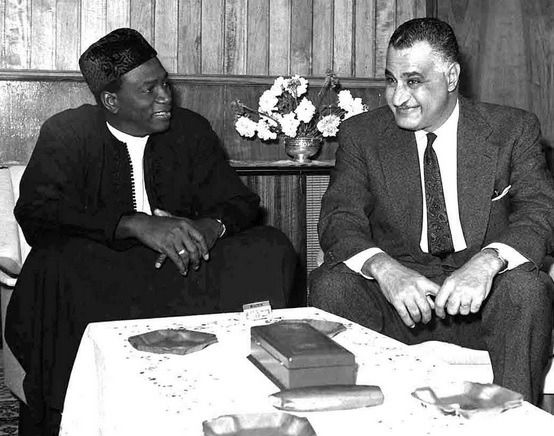
Modibo Keita (left) and Egyptian president, Gamal Abdel Nasser (right) at Addis Ababa for the Organization of African Unity conference, November 1966; Source: Wikipedia, photo not credited (Public Domain)
After independence, Keita rejected France's postcolonial military agreements and demanded the rapid withdrawal of French troops from Mali in 1961. His government's development of political and economic ties with the Soviet Union was a further act of defiance toward France and the broader Western imperialist order. Keita also led Mali to break from the CFA franc monetary system and adopt its own currency, the Malian Franc, in 1962. His government pursued a socialist path based on endogenous development planning, which led to the nationalization of resources and foreign-owned enterprises, the formation of farming cooperatives, and production focused on local needs. This socialist path bore fruit, including the provision of free education and healthcare, alongside the creation of national agricultural enterprises that provided employment while valorizing local products [10].
Yet internal and external pressure culminated in Keita's overthrow by Moussa Traoré in 1968. Domestically, the merchant class and peasantry grew increasingly disaffected by state policies that while pursuing national developments, eroded their economic interests. Externally, France responded to Keita's defiance by cutting off financial backing and using its political and economic leverage to impose restrictive trade conditions on Mali. These measures severely undermined regional trade revenues and generated chronic budget deficits, setting the stage for the devaluation of the Malian franc in 1967 and the inflation that followed. In 1984, Traoré reintegrated Mali into the CFA zone, paving the way for economic liberalization [10]. Though short-lived and not without its own challenges, this assertion of sovereignty endures as a legacy of Mali's protracted struggle for national liberation.
The second factor is the secessionist movement in northern Mali, led by a minority of Tuareg, which serves as one instrument among several in France's longstanding pursuit of regional balkanization. The Tuareg are a semi-nomadic people present across Mali, Niger, Algeria, Libya, and Mauritania, with a feudal social organization structured around confederacies as well as caste and lineage-based hierarchies. Though they initially resisted French colonial expansion, from the 1920s onward the elite Tuareg—those occupying the highest rank in the caste-system—became significant French allies, serving as a vehicle through which France consolidated control over the Niger Bend and Northern Mali. During the independence movement, this Tuareg elite advanced a racialized social hierarchy in which they viewed themselves closer to the white and Arab races, and superior to Black Africans. They rejected the nation-state model based on Modibo Keïta's US-RDA's egalitarian and Pan-Africanist vision and instead demanded an autonomous territory in the north—a region also inhabited by other ethnic groups and lower-caste Tuareg who did not subscribe to Tuareg nationalism [11;12;13].
The northern territory claimed by Tuareg secessionists is rich in oil, gas, and minerals of strategic interest to France since the colonial era. Given their imperial interests, France extended promises of support to the secessionist project in exchange for Tuareg cooperation in regional military operations—including against the Algerian war of liberation. In 1957, France formally established the Organisation Commune des Régions Sahariennes (OCRS), a vast administrative zone covering much of Tuareg territory across Mali, Niger, Algeria, Mauritania, and Chad, designed to keep regional resources under French control [11]. The entity dissolved in 1963 following Keïta's successful opposition to the balkanization project. In many ways, this is the genesis of the unrecognized state of Azawad in Northern Mali claimed by Tuareg nationalists. Today, were the Tuareg secessionists to succeed in seceding the north from the rest of Mali, the resulting entity would risk becoming a French vassal state—a territorial foothold for projecting influence into the Sahel and controlling its resources.
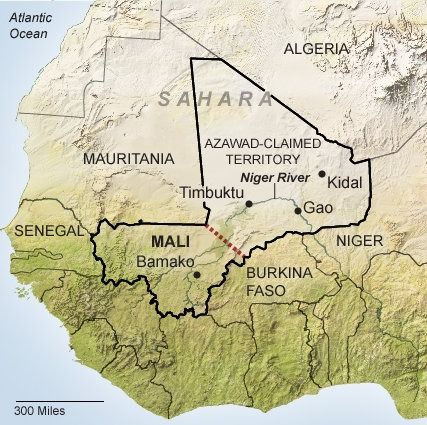
Figure 2: Map of Mali with Azawad claimed territory, 2012. Source: New York Times Archives.
France's support for the secessionist cause continues. Credible allegations suggest Nicolas Sarkozy promised Tuareg fighters integrated into Gaddafi's forces renewed French backing for their territorial claims in exchange for defecting and joining NATO's 2011 intervention in Libya [11]. Aminata Traoré called out the devastating consequences on Mali of NATO assault on Libya explaining “the truth is that these jihadists would not have spread terror in Kidal [a northern region besieged by terrorist groups] […] if Nicolas Sarkozy had not felt compelled to set Libya in flame and bloodshed, disregarding the tragic and entirely predictable consequences…’[3] (p111)
More recently, in the immediate aftermath of the deadly April 25, 2026 terrorist attack, French mainstream media opened their channels to the leaders of the Tuareg secessionist group known as Front de Libération de l'Azawad (FLA) to plead their cause, plainly revealing where French sympathies lie. This support has persisted even as FLA has moved into open cooperation with terrorist organizations. Moreover, during France's military operations in Mali, French forces reportedly refused to allow Malian troops to enter the north, a posture that intensified tensions between the two armies and deepened popular Malian distrust of the French military presence [11]. Niger and Burkina Faso have joined Mali under the AES military umbrella to defend the territorial integrity of all three states, deploying most of their joint efforts in Mali, the epicenter of the most intense attacks.
Broadly speaking, what is the class character of the Tuareg secessionist movement, and what is its relationship to both the Malian state and French imperialism?
Western analyses of the Tuareg secessionist movement broadly follow two lines. The first advances a discrimination narrative, claiming that state-sanctioned deprivation of the northern region is driving Tuareg rebellion against the Malian state. The second concerns ideological questions of nationalism and jihadism, given the increasingly visible merging of Tuareg rebels with Al-Qaeda affiliates in the Sahel.
These are not irrelevant, but focusing solely on ideological questions and regional disparities to understand the Tuareg secessionist movement tends to dislodge the structural analysis of capitalist production and imperialist machinations amidst geopolitical and economic shifts. Furthermore, the regional disparity narrative suggests that there is a state-sanctioned discrimination of Tuareg. But regional disparity is a product of decades of imposed austerity, economic liberalization, and the hollowing out of state-led social programs–factors that have produced enclave economies across AES countries. In Mali particularly, neoliberalism has caused the significant retrenchment of state institutions, opening the door for an influx of international NGOs to fill the vacuum left by governance institutions [14]. The state became increasingly dependent on foreign assistance to finance rural development programs particularly in the northern region [11]. Yet this aid dependence not only exposed the government to Western-imposed conditionality on northern governance but also enabled a ruling class that exploited these resources for self-serving ends. These conditions collectively weakened Mali's state institutions, undermining their ability to resolve the northern issues and ensure a more equitable distribution of resources [11]. Nonetheless regional disparities are not unique to Mali; in Benin, comparable northern inequalities partly fueled a coup attempt in December 2025. Perhaps most importantly, these narratives erase other groups, such as the Songhai, who hold significant landholdings in the same territories; it cannot be overemphasized that the Tuareg are not the only ethnic group in northern Mali.
What is rarely discussed, however, is how the Tuareg movement is ultimately a movement along class lines, serving specific class interests within the Tuareg community. They are not a unified front behind this nationalist project as I previously mentioned. There are Tuareg who are part of civil society and government institutions, such as the governor of Kidal, a town located in northern Mali that is under constant siege by rebels. Over decades, state reconciliation efforts have led to the integration of former rebels into the national army, even as many subsequently turned against the state [11]. Many Tuaregs, whose loyalty to the nation-state precedes their ethnicity [15]. Tuareg government officials have publicly denounced the attacks coordinated by FLA and the Al-Qaeda affiliated terrorist group called JNIM (Jamaat Nusrat al-Islam Wal-Muslimin). Even within the Tuareg coalition opposing the Malian government, there are splits along ideological and class lines, cemented through a rigid social hierarchy based on caste and lineage.
It is therefore important to ask whose class interests this nationalist project serves. It serves a minority Tuareg elite that, during the colonial period, accumulated land, cattle, and indentured labor through a feudal system based on lineage and caste-based divisions of labor, a system French colonizer instrumentalized to advance their aims of domination and capitalist production [11;13]. This class dynamic also produced a split within the secessionist movement: the aristocratic Tuareg, who embraced jihadism to pursue their autonomous territorial project, broke from the Inaden Tuareg (artisans and free peoples, as opposed to slaves), leading to the formation of the FLA distinct from the MNLA (Mouvement National pour la Libération de l’Azawad). The French collaborated with the Tuareg aristocracy, defending and expanding the caste system to secure labor for colonial needs.
Moreover, it is striking how rarely analysis of Tuareg elite engages with post-colonial state-led land reforms and their relationship to capitalist development. In fact, a primary anxiety driving the rebellions of the 1960s was the abolition of customary laws–a major source of political and economic power for the Tuareg aristocracy–and the nationalization of property in support of Keïta’s state-led socialist development planning. Later, under Moussa Traoré, the government enacted the 1986 Rural land Act, which was a series of sweeping land reforms that reasserted the State’s ownership over customary lands and laid the ground for structural adjustment programs. It was in this context that, in 1987, the Movement Populaire de Liberation de Azawad (MPLA) was formed. This organization would go on to lead the 1990 Tuareg rebellion [11].
A pattern emerges when major Tuareg rebellions are mapped onto Mali's postcolonial history: each erupted at critical inflection points of political and economic transition, or at turning points in Mali's relations with France. The first rebellion broke out in 1963, shortly after independence, as Modibo Keïta's government directly challenged French imperialism—supporting the Algerian liberation struggle, pursuing West African federation, canceling military agreements with France, and moving to abolish the CFA franc. The second erupted in 1990, amid the turbulent period leading to the coup against Moussa Traoré. A third flared in 2006, against a backdrop of deepening socio-economic crisis, widening structural inequalities produced by economic liberalization, and a multiparty democracy that failed to deliver on its promises, fueling popular discontent and student protests. The fourth and most consequential broke out in 2012, a year after the U.S.-NATO assault on Libya, directly precipitating the coup against Amadou Toumani Touré, at a moment when relations between Touré and France had deteriorated, in part due to his rejection of French special military interventions and refusal of migrant deportation agreements [11].
AES relations with neighboring states are frequently framed in terms of their contentious relationship with ECOWAS. Yet what other factors should be considered to better understand these regional dynamics?
Each AES member state faces tensions with at least one peripheral neighbor, exacerbated by ECOWAS sanctions that have pushed Côte d'Ivoire, Benin, and Nigeria to pressure the bloc. There has been understandable focus on AES tensions with its neighbors, as ECOWAS members—most notably Côte d'Ivoire, Benin, and Nigeria—have taken actions to undermine the AES project and have been accused of hosting French bases used to launch attacks against the three countries. Yet West Africa remains a geopolitical space structured by porous borders, dense regional trade networks dating back to pre-colonial trans-Saharan commerce, and shared ethnic and cultural ties that predate colonial boundaries. Migration and transhumance patterns have produced transboundary kinship networks capable of intervening in diplomatic affairs, as seen between Côte d'Ivoire and Burkina Faso. Captain Ibrahim Traoré and President Alassane Ouattara often evoke these kinship ties in their diplomatic exchanges in order to assuage moments of heightened political tensions between the two heads of states.
Though AES states are often framed as landlocked – a presumed obstacle – their contribution to regional trade is understated. Migration has fostered a significant regional market in food and cultural products, benefiting a substantial merchant class across all involved countries. The closure of Benin's Mallanville border with Niger following ECOWAS sanctions caused a dramatic drop in transit business, which once handled 80 percent of freight from Niger to the Port of Cotonou. Moreover, an estimated 42 percent of Côte d'Ivoire's regional food exports are destined for Mali and Burkina Faso, while the three AES states collectively supply nearly 90 percent of live bovine animal exports, owing to their prime location in the Sahelian pastoralist belt [17]. These critical trade relationships have proven capable of tempering political volatility and help explain Ouattara's willingness to revisit ECOWAS sanctions, which were ultimately lifted in February 2024. They are also fostering rapprochement with other countries, as seen with Benin's new government under President Romuald Wadagni, who assumed office in May 2026 following his electoral victory.
Mali's regional relationships remain more contentious and complex, shaped by the protracted war in its northern region—a conflict that has bred instability for decades. Tensions between Mali and its northern neighbors, Algeria and Mauritania, are longstanding and rooted in geopolitical contestations over their shared borderlands, an area of profound instability marked by armed groups, secessionist movements, drug trafficking, and recurring political upheavals. This volatile borderland is now undergoing a deep geostrategic reconfiguration in which significant imperialist interests are actively at play [18].
While the factors fueling this conflict are vast and complex, they can be traced back to France’s Organisation Commune des Régions Sahariennes from 1957 to 1963 mentioned above. These interests have converged over time with Tuareg and Arab rebel factions, supported variously by Algeria and Mauritania, exacerbating the conflict. Yet Algeria's relations with Mali have not always been contentious: Mali supported the National Liberation Front, and Algiers has served as mediator between rebels and the Malian state. However, over the past two decades, the shifting geopolitical context—particularly the 2011overthrow of Gaddafi—has created devastating conditions for conflict intensification, with more frequent and violent terrorist attacks as Tuareg secessionist movements have collaborated with Al-Qaeda and Islamic State-affiliated groups [10].
In January 2024, Mali's head of government, Assimi Goïta, withdrew from the 2015 Algiers Accords—a peace agreement between Bamako and Tuareg rebel factions that was unpopular among Malians for conceding too much to Tuareg demands and weakening state authority in the north, with potentially grave consequences. These factors, compounded by Algiers' hosting of Malian opposition figure Imam Dicko and well-founded accusations that Algeria harbors terrorist bases, have led Mali to adopt a markedly different posture toward Algeria than that of Niger and Burkina Faso which have adopted a politic of rapprochement [16]. On July 11, 2026, it was announced that Bamako and Algiers had restored diplomatic relations following a yearlong political rift [19]. The rapprochement comes as both countries face a common national security threat and share trade relations as well as deep historical cultural and kinship ties.
Conclusion remarks:
In this commentary, I have attempted to outline the contours of the historical and regional particularities of the three AES countries that form the foundation of their convergence. I have further argued that, although Burkina Faso may be the most visible AES member among anti-imperialists—especially in Western circles—Mali remains the most consequential state for the alliance's long-term viability. Mali has also elicited most scholarly research, owing it to its rich cultural and Islamic heritage dating back to its pre-colonial complex social organization, as well as the post-colonial political impasses and economic crises that have marked its neocolonial trajectory. In this essay, I have drawn on this research and, more importantly, on the work of Malian scholars and thinkers—most notably Aminata Dramane Traoré, Aly Tounkara, and Choguel Maïga. Their vital contributions to understanding the crises afflicting their beloved country—a country that profoundly shaped them through their upbringing, education, and politics—remain largely neglected by Western self-styled experts on Mali and the Sahel. For any serious anti-imperialist analysis in particular, Aminata D. Traoré's work is indispensable. She exposes Mali's internal contradictions as products of neocolonialism and the broader Western-imposed capitalist imperialist order—a perspective notably missing from most scholarship on Mali and the Sahel.
LatSouk Sène is a member of AISC.
References:
1. Nkrumah, K. (1963). Africa must unite. F.A. Praeger
2. Diop, C. A. (1974). Les fondements économiques et culturels d'un état fédéral d'Afrique noire. Présence Africaine.
3. Diop, B.B. & Traoré, A.D. (2014). La Gloire des Imposteurs. Editions Phillipe Rey.
4. Amin, S. (1972). Underdevelopment and Dependence in Black Africa—Origins and Contemporary Forms. The Journal of Modern African Studies, 10(4), 503–524
5. David, P. (1980). Les navétanes: histoire des migrants saisonniers de l'arachide en Sénégambie des origines à nos jours. Nouvelles éditions africaines.
6. Pigeaud, F., & Sylla, N. S. (2024). De la démocratie en Françafrique: Une histoire de l'impérialisme électoral. La Découverte.
7. World Gold Council. (2026, June 9). Global mine production by
country. https://www.gold.org/goldhub/data/gold-production-by-country
8. World Nuclear Association. (2026, January 20). World uranium
mining production. https://world-nuclear.org/information-library/nuclear-fuel-cycle/mining-of-uranium/world-uranium-mining-production
9. Daouda, Y. H. (2014). Responsabilité sociétale des multinationales en Afrique Subsaharienne: enjeux et controverses. Cas du groupe AREVA au Niger. VertigO-la revue électronique en sciences de l'environnement, (14-1).
10. Traoré, A. D. (2002). Le viol de l'imaginaire. Actes Sud; Fayard
11. Tounkara, A. (2020). Mali: analyse sociohistorique des conflits (Nord et Centre) : l'État entre recherche de légitimité et calomnies. L'Harmattan
12. Maïga, C. K., & Singaré, I. A. (2018). Les Rébellions au Nord du Mali: Des origines à nos jours. Edis.
13. Hall, B. S. (2011). A history of race in Muslim West Africa, 1600–1960 (Vol. 115). Cambridge University Press.
14. De Jorio, R. (2016). Cultural heritage in Mali in the neoliberal era. University of Illinois Press
15. Braffon, M., Coullbaly, M., & Dulani, B. (2022). Malians want a united country, post-conflict justice (Afrobarometer Policy Paper No. 13). Accessed from: https://www.afrobarometer.org/wp-content/uploads/2022/02/ab_r5_policypaperno13.pdf
16. Koné, H., Sow, D., & Salia, R. L. (2026, March 16). Algeria’s return to the Sahel: An opportunity to show AES cohesion. ISS Africa. Accessed from: https://issafrica.org/iss-today/algeria-s-return-to-the-sahel-an-opportunity-to-show-aes-cohesion
17. Organization for Economic Co-operation and Development (2025), Intra-regional Food Trade in West Africa: New Evidence, New Perspectives, West African Studies, OECD Publishing, Paris, https://doi.org/10.1787/3f5fd54a-en .
18. Ayadi, N. (2024). Kidal vaut bien une guerre: l'Algérie et la France au Mali et au Sahel: influence vs puissance. Qobia.
19. Algeria and Mali restore diplomatic ties following yearlong rift. (2026, July 11). Al Jazeera. https://www.aljazeera.com/news/2026/7/11/algeria-and-mali-restore-diplomatic-ties-following-yearlong-rift