U.S Empire at the Point of Production: From Monroe Doctrine to Labor Imperialism
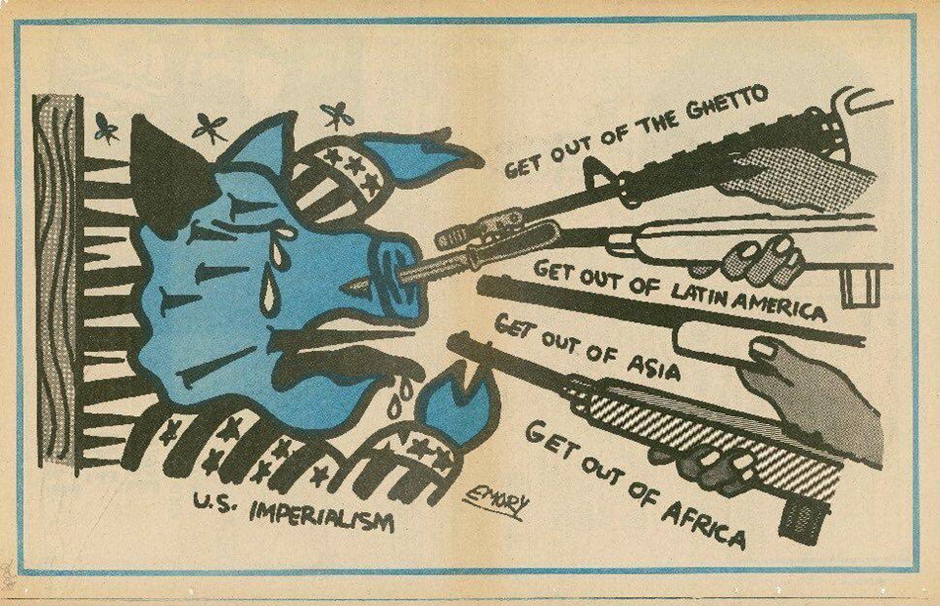
This special issue is grounded in the urgency of this historical conjuncture. As we prepared for publication, in the early morning of February 28, 2026, imperialist-zionist forces launched military strikes against the Islamic Republic of Iran, a criminal act of war that follows years of unilateral coercive measures and other forms of hybrid warfare intended to destabilize the country and bring about regime change. It also comes on the heels of two and a half years of the imperialist-zionist genocide against the Palestinian people, continuing in Gaza despite the so-called ceasefire, along with intensifying settler-colonial violence across the West Bank, brutal regime change in Syria, sustained attacks on Yemen, and an escalating assault on southern Lebanon targeting Hezbollah, all in an attempt to crush the Palestinian liberation struggle and isolate and break the forces that sustain regional resistance. The horrific attacks have already produced numerous martyrs, including over 100 girls slaughtered at their elementary school in Minab city, and the assassination of the revolutionary, anti-imperialist leader Ayatollah Ali Hosseini Khamenei. As Navid and Nina Farnia argue, the principal contradiction of our time remains U.S.-led imperialism, and failure to confront it threatens “the continuity of life itself.” In this sense, Iran fights for us all, and its resistance to this brutality is in defense of “the whole of the Global South,” from Palestine and Sudan to Cuba and Venezuela.[1]
The deepening zionist-imperialist offensive in West Asia unfolds in tandem with expanding U.S. militarism throughout the Americas. On January 3, 2026, U.S. imperialist forces launched a brutal invasion of the Bolivarian Republic of Venezuela, kidnapping President Nicolás Maduro and First Combatant Cilia Flores while killing over a hundred people. Among the fallen were thirty-two Cuban security personnel stationed to defend the presidency, their martyrdom the highest expression of revolutionary internationalism. This assault exemplifies the "Donroe Doctrine," the Trump administration's "corollary" to the Monroe Doctrine. A declining U.S. imperialism, having lost its capacity to dominate the region through economic and ideological means alone, has returned to the openly violent coercive measures of an earlier era. Echoing the 2004 imperialist invasion of Haiti and kidnapping of Haitian President Jean-Bertrand Aristide,[2] the assault on Venezuela seeks to decisively break Venezuelan sovereignty and serve notice to even semi-sovereign projects in the region that refusal of total submission will result in brutal regime change.
At the same time, the siege on Cuba has tightened through a comprehensive energy blockade designed to erode the material foundations of the Cuban Revolution. Trump’s January 29 Executive Order threatening sanctions on any country supplying oil to the island has produced cascading crises across every sector of Cuban society and economy. Hospitals lack fuel for emergency services and life-saving treatments, key industries have been paralyzed, and agriculture, on which Cuba depends for close to 80 percent of its food, has been severely disrupted. Alejandro Rosés Pérez’s analysis of the renewed Monroe Doctrine in the Caribbean, published in this special issue, situates the January 3 attack on Venezuela and the tightening siege on Cuba within Washington’s broader strategy to “reshape hemispheric security arrangements” and expel China, now the region’s second largest trading partner, from the hemisphere.
Renate Bridenthal's addendum on the Arctic, also published in this special issue, extends this hemispheric analysis northward, demonstrating how the same imperialist strategy that bombs Iran and Venezuela and blockades Cuba now reaches for Greenland, transforming the polar region into a new arena for U.S. imperialist ambition. Across the Caribbean, West Asia, and the Arctic alike, the same imperialist power projects itself through hybrid warfare. Imperialism wages war not only with missiles and drones but with financial strangulation, energy manipulation, psychological warfare, propaganda, and economic siege. Sovereignty, and with it international law, is violated openly and with impunity.
This impunity operates at multiple scales, connecting imperialist violence abroad to fascist state violence at home. After an ICE agent fatally shot Renée Nicole Good in Minneapolis on January 7, 2026, Vice President JD Vance defended the killing by asserting that the agent was protected by "absolute immunity" and that Good's death was "a tragedy of her own making." This open defense of state violence should not surprise anyone in a country founded on centuries of genocide against Indigenous nations and the violent enslavement of African peoples.
This racialized impunity enables the government to bomb Iran and blockade Cuba while simultaneously conducting militarized ICE raids on immigrant communities and enacting ongoing terror and structural violence against working-class Indigenous, Black, and Brown communities at home. The same state that funds genocide abroad likewise incarcerates Black, Brown, Indigenous, and working-class peoples. Prisons like the notorious Metropolitan Detention Center in New York—where Maduro and Flores are detained alongside Palestinian political prisoner Tarek Bazrouk and others targeted by the carceral state—undergird U.S. capitalist- imperialism.
Within this world systemic context, where a crisis-ridden U.S. imperialism accelerates violence to maintain polarized accumulation, labor is a decisive political terrain. This special issue brings together two fronts often treated separately, the projection of imperialist power abroad and the disciplining of labor at home, examining them as mutually constitutive dimensions of the capitalist-imperialist system. As John Watson of the League of Revolutionary Black Workers insisted in his 1969 interview, reprinted in this special issue, repression at the "point of production" mirrors imperialist repression abroad; the struggle against the boss in Detroit and the struggle against the empire in Vietnam are intimately connected. This insight animates many of the contributions in this issue as they interrogate the historical and material conditions that sustain empire and the forms of resistance undertaken to dismantle it.
Co-editor Jeannette Graulau extends and historicizes this horizon in her essay titled “In the Name of Revolution: Four Latin American Speeches for a Better World,” which anchors the special issue within the long durée of the Monroe Doctrine. Tracing the doctrine from James Monroe’s 1823 declaration to its contemporary revival as a framework for military intervention, economic siege, and hemispheric control, she contextualizes the current aggressions within two centuries of U.S. imperialist expansion, occupations, coups, and sanctions across Nuestra América. By centering four landmark UN General Assembly speeches delivered by Fidel Castro in 1960, Ernesto “Che” Guevara in 1964, Salvador Allende in 1972, and Gustavo Petro in 2025, Graulau shows how revolutionary leaders confronted the doctrine “in the house of the empire,” transforming the UN into a global stage for anti-imperialist clarity. Together, these speeches pose what Graulau calls three “elemental historical truths” about the Monroe Doctrine: first, that the U.S. empire “sustains itself through wars”; second, that oppressed peoples “fully and clearly understand” who the perpetrators are; and third, that “this is the opportunity to speak the truth on behalf of humanity.” In doing so, Graulau frames these speeches as foundational texts for renewing an “achievable utopia” grounded in sovereignty, solidarity, and collective emancipation.
Capitalist Racism and the Making of Labor Imperialism
If the revolutionary tradition points towards solidarity liberation, the historical record also demands that we confront the social forces that have consistently blocked that path. To grasp what is at stake in the question of labor's role, we must first examine the mechanisms through which labor in the capitalist-imperialist core was historically integrated into the system of unequal exchange. The concept of labor imperialism provides the necessary analytical framework, naming the alignment—material, ideological, and institutional—of organized labor with imperialism, monopoly capital, and colonial domination. The dominant labor formations in the capitalist-imperialist core have more often than not functioned to discipline and incorporate sections of the working class into ruling class projects, blocking international working-class solidarity as a result. This alignment has taken many forms: anti-communist purges, collaboration with imperialist state foreign policy, endorsement and participation in Global South regime change operations, suppression of class struggle-oriented and anti-imperialist labor formations in the Global South, suppression of rank-and-file dissent in the capitalist-imperialist core, and the insulation of labor leadership from democratic accountability when empire is at stake.
The theoretical foundations of this analysis were laid out sharply by V. I. Lenin in “Imperialism and the Split in Socialism” (1916), reprinted in this issue. Writing in the midst of World War I, Lenin defines imperialism as "monopoly capitalism; parasitic, or decaying capitalism; moribund capitalism," and demonstrates how monopoly superprofits enable the formation of a labor aristocracy, "a stratum of workers who are bribed by the bourgeoisie", who function as a social base for opportunism and chauvinism. He warns that unless the working-class movement rids itself of these elements, it will remain a "bourgeois labour movement." Crucially, Lenin emphasizes that imperialism sustains itself not only through economic coercion but through ideological manipulation: "flattery, lies, fraud, juggling with fashionable and popular catchwords," and promises of reforms designed to detach workers from revolutionary struggle.
This theoretical framework finds its concrete expression in the history of the U.S. labor movement, where the formation of a labor aristocracy has been inextricably bound up with racialized hierarchy and exclusion. From its inception, U.S. labor was structured by "capitalist racism."[3] White workers secured relative advantages through the super-exploitation of Black labor—first through slavery, then through Black Codes, job segregation, prison labor, and union exclusion, while major unions were marked by institutionalized racism. Black workers responded by building independent organizations, from the Colored National Labor Union in 1869 to the Brotherhood of Sleeping Car Porters in 1925 and the Dodge Revolutionary Union Movement in 1969.[4] These struggles did more than demand inclusion. They exposed how the labor aristocracy rested on a foundation of what Gerald Horne described as “class collaboration embodied in whiteness” and racialized super-exploitation.[5]
Indigenous nations faced a parallel but distinct form of exclusion. U.S. labor institutions and capital have treated tribal sovereignty as an obstacle to union jurisdiction and corporate expansion, refusing to recognize Indigenous nations' authority to determine labor relations on their own lands. For nearly seventy years after the NLRA's enactment in 1935, the National Labor Relations Board interpreted the Act as not applying to tribal governments, leaving them exempt from its provisions. In 2004, however, the Board reversed course, asserting jurisdiction over tribal government enterprises for the first time. The San Manuel Indian Bingo & Casino decision exemplifies this dynamic: a federal agency unilaterally extending its authority over tribal commercial operations, thereby undermining Indigenous sovereignty while facilitating capital accumulation through the continued dispossession of Indigenous peoples.[6]
Empire at the Point of Production: Labor Zionism and the Institutions of Colonial-Imperialist Complicity
Labor Zionism must be understood within this same analytical framework. The zionist entity's Histadrut was disguised as a union federation but in actuality has functioned as a central institution of settler colonial state-building and governance, enforcing racist exclusionary labor regimes that have displaced and super-exploited Palestinian workers. As Suzanne Adely argues in her contribution to this issue, labor Zionism is inseparable from imperialism. Adely traces how the zionist entity's Histadrut functioned as "the cornerstone of Labor Zionism," using its "image as a 'progressive' institution to spearhead—and whitewash—racism, settler colonial dispossession, genocide and ethnic cleansing against the Palestinian people since the 1920s." This project found fertile ground in the United States, where "a deliberate campaign by zionist institutions sought to build support for labor Zionism in the U.S.," coinciding with the broader purging of left politics from American unions. As the AFL-CIO emerged as a "staunch collaborator with the U.S. imperialist apparatus" abroad, its leadership forged alliances with Histadrut, cementing labor Zionism's place in the U.S. labor movement at the expense of its once-vibrant anti-imperialist and anti-zionist currents. The AFL-CIO leaders promoted the zionist entity's claimed labor-centered development as "a successful example of noncommunist 'nation-building'" for the Global South, presenting Israel to the U.S. public as a staunch anti-communist ally.[7]
The AFL’s alignment with U.S. imperialism also found expression in labor's support for U.S. backed coups and counterinsurgency across the globe. During the Cold War, the AFL-CIO's American Institute for Free Labor Development (AIFLD) collaborated with the CIA to undermine democratically elected nationalist, leftwing governments in Guatemala (1954), Brazil (1964), and Chile (1973), helping to lay the groundwork for brutal military dictatorships.[8] In Venezuela, the AFL-CIO's Solidarity Center funded and supported the CTV labor federation as it planned protests designed to induce a military coup against Hugo Chávez in 2002, and continued working with opposition labor groups to undermine Chávez's socialist labor policies for years afterward.[9]
Against this history, another, more radical tradition of labor organizing in the belly of the beast has persisted. The reprinted 1969 interview with John Watson of the League of Revolutionary Black Workers captures this marginalized current. Watson situates Black workers' struggles in Detroit within the same global terrain as anti-colonial liberation movements, insisting that repression at the "point of production" mirrors imperialist repression abroad. He exposes how labor bureaucracies align with imperialist policy, pointing specifically to the United Auto Workers (UAW) and AFL-CIO as key antagonists. Watson recounts how UAW Secretary-Treasurer Emil Mazey branded the League "a greater threat to unionism than the Communists were in the '30s and '40s," while the UAW sent 350,000 letters denouncing the League and violated its own constitution by refusing to defend Black workers fired for militant activity. Watson notes that the AFL-CIO similarly threatened to "crush" Black organizing efforts in the skilled trades, which were historically "some of the most segregated and racist unions in the country."
Against these entrenched bureaucracies, Watson articulates a strategic vision linking workplace struggle to global anti-colonial resistance. He observes that when workers strike a single plant, the company mobilizes "outside police... the courts... the mass media"—the full resources of the ruling class—to suppress them. This mirrors how U.S. imperialism "concentrate[s] superior forces in a small area of the world in order to suppress a liberation movement." Drawing from Che Guevara, Watson argues that the solution is to "spread their forces thin throughout the world by the opening up of 'two, three, many Vietnams,'" forcing capital to disperse its repressive power. For Watson, this meant building the League into a national organization capable of coordinating strikes across plants and industries. This anti-colonial lens led the League to recognize Palestine as part of the same struggle. As Adely notes in her essay, the League's 1969 statements and the "wildcat strikes led by Arab Auto workers against the United Auto Workers (UAW) leadership's support for Israel in 1973" represented an early call for Boycott, Divestment and Sanctions against the zionist entity, grounded in "anti-colonial, global worker internationalism."
Reviving Anti-Imperialist Labor Internationalism
This internationalist tradition has surged back into visibility in response to the accelerated imperialist violence of the current conjuncture. Over the past two and a half years of the zionist-imperialist effort to crush Palestinian and regional resistance and reassert imperialist control across West Asia, a resurgent labor internationalism has emerged, drawing on the same anti-colonial insights that animated Watson and the League half a century ago.
In the U.S. context, Suzanne Adely explains how Labor for Palestine, founded in 2004, has expanded to include close to "50 affiliates around the country in various sectors, industries and geographies," building collectively to encourage workers to support the Palestinian call and honor the "BDS picket line" in the face of intensified imperialist-colonial violence. The Palestinian Youth Movement's (PYM) Mask Off Maersk campaign has been instrumental in this labor internationalist resurgence, targeting not only arms manufacturers but the supply chains and logistical infrastructure that make genocide possible. Maersk, the world's largest integrated shipping and logistics company, has facilitated the transport of hundreds of millions of dollars in weapons components destined for Israel, including shipments to major U.S. contractors such as Lockheed Martin and Raytheon.[10]
Through their campaign, PYM has demonstrated that logistics are central to imperialism’s circulatory system. Under sustained international pressure, Maersk has been forced to publicly acknowledge its role in shipping military cargo, and in June 2025, it suspended dealings with companies operating in illegal West Bank zionist settlements.[11] Moreover, dockworkers in Spain and France have refused to handle Israel-bound shipments, and Moroccan port workers have taken similar action.[12] Rather than appealing to state institutions that have repeatedly failed to enforce international law, Mask Off Maersk has operationalized a “people's arms embargo” from below, reviving a tradition of labor internationalism rooted in strategic disruption. The campaign recalls port worker solidarity with anti-apartheid and other anti-imperialist struggles, while adapting that legacy to contemporary supply-chain capitalism.[13]
Parallel to these mobilizations, Progressive International has conducted systematic research to map the subcontractor networks that sustain the imperialist-zionist war economy. As Sachin Peddada explained in an AISC podcast, the military-industrial system depends on "hundreds, if not thousands of subcontractors", small factories dispersed across towns and cities that produce essential components. These firms operate on thin margins with little public scrutiny. "If even one of those supply routes is disrupted," Peddada noted, "they have to scramble to find a new supplier and that slows down the process of production. It slows down the death in Palestine." By identifying these nodes through public procurement data, this research enables a shift from symbolic protest to actionable intervention at logistical choke points. This work has revealed the vulnerability of decentralized war production, opening possibilities for community-level organizing and localized disruption capable of slowing the machinery of imperialist violence, whether aimed at Gaza, Caracas, Tehran, Port-au-Prince, or Havana.
The anti-imperialist labor internationalist tradition has also found powerful expression through the organizing of the Unione Sindacale di Base (USB) in Italy. Founded in 2010 through a merger of rank-and-file unions, USB has drawn its base from public sector workers, logistics workers, and communities with large migrant populations, consistently prioritizing anti-imperialism and Palestine as central to domestic labor struggles. Arab and immigrant workers in European logistics sectors, many of them USB members, have organized strikes and blockades to disrupt the genocide’s supply chains.[14] USB's Genoa-based dockworkers' collective (CALP) issued the defiant call to "block everything" if the Global Sumud Flotilla was attacked, a threat that materialized into strikes shutting down ports, railways, and highways across Italy in April 2025. As an organizer declared during the 2025 general strike, "Our story is part of the story of the Palestinian people. And when we defend the Palestinian people, we defend ourselves. Their struggle is our struggle."[15]
Labor internationalism reached a new stage with coordinated actions across the Mediterranean in early 2026. On February 6, dock and port workers from Italy (USB), Greece (Enedep), Spain's Basque Country (LAB), Turkey (Liman-Is), and Morocco (ODT) launched an International Day of Protest titled "Dockworkers Don't Work for War," with actions in more than twenty major Mediterranean ports and growing solidarity from German and U.S. ports. Workers declared that "ports are places of work, not war," explicitly refusing to handle arms shipments and denouncing the transformation of port infrastructure into logistics hubs for mass murder.[16] While the genocide in Gaza remained central, the action constituted a broader refusal of the entire imperialist war machine. The action was supported by the anti-imperialist World Federation of Trade Unions, signaling growing international coordination among workers who recognize that war abroad is tied to austerity, wage suppression, and resurgent fascism at home.[17]
These mobilizations formed the immediate context for the International Online Rally: No Work for War!” organized by the No War on Venezuela network, where speeches by Eglims Peñuela Lovera and Virgilio Barreto- included in this special issue— were delivered.[18] In her address, Peñuela Lovera argued that "imperialist action can only be combated through revolutionary internationalism, through solidarity among peoples." Barreto framed the January 3 U.S. military attack on Venezuela as a last-ditch effort to recolonize a country that has resisted sanctions, blockade, and information warfare. "We are a free, independent, and sovereign country," he affirmed. "We take orders from no external power… We are not, and will never be, anyone's colony” he defiantly declared.
Labor in National Liberation and the Dual Character of Internationalism
These interventions from radical Global South organizers point to a crucial dimension of labor internationalism that extends beyond challenging the labor aristocracy and disrupting supply chains in the capitalist-imperialist core. Although workers in the belly of the beast increasingly assert their power to disrupt the machinery of war, labor in the Global South has long served as a central pillar of anti-colonial struggle.
This tradition is crystallised in the Vietnamese and Palestinian national liberation struggles, which Patrick Higgins analyzes in an interview published in last month's Pen is My Machete issue. Higgins argues that "a People's War consists of much more than violence… it requires a vanguard party capable of guiding violence toward specific political and strategic goals."[19] As Navid Farnia elaborates in his introduction to the special issue, “From Viet Nam to Palestine,” the Vietnamese resistance understood that people's war transcends national borders, forging dialectical connections between struggles in the capitalist-imperialist core and periphery, a truth confirmed from General Vo Nguyen Giap’s revelation that the Vietnamese drew inspiration from Detroit's 1967 uprising in planning the Tet Offensive. "We learned from Detroit to go to the cities,” General Giap explained.[20]
This same dialectical understanding extends from the battlefield to the terrain of labor itself. Unions and cooperatives are not merely formations concerned with the conditions of extraction and distribution of surplus value, but function, according to Higgins, as "fighting organizations that teach the people the art of organization" in the struggle for national liberation. Drawing on the Palestinian experience, Higgins discusses how the fedayīn and Marxist-Leninist factions within the PLO, in Jordan from 1968 to 1970, conjoined military activity with strikes, demonstrations, and mass organizing, threading together militias, labor unions, women's committees, and trade associations into the fabric of a "People's War." The martyrdom of the thirty-two Cuban internationalists—workers in uniform who gave their lives defending Venezuela's sovereignty—is proof that the struggle against empire at the point of production and the struggle for national liberation remain inseparable fronts in the same war.
This struggle is hemispheric in scope. As Jeannette Graulau argues in her introductory essay to four “transcendental” Latin American speeches reprinted in this issue, leaders from Fidel Castro to Salvador Allende to Gustavo Petro contested the Monroe Doctrine at the United Nations. These speeches, she writes, "raised our common Bolivarian quest for emancipation and unity," challenging the very logic of hemispheric domination that the "Donroe Doctrine" now seeks to revive. They remind us that the fight against U.S. imperialism in our hemisphere has always been a unified struggle, one in which Cuban internationalists falling in defense of Venezuela, Palestinian fedayeen organizing in Jordan, and Arab auto workers striking in Detroit are all connected.
This same people's war spirit animates Ramón Pedregal Casanova's militant call, reprinted in this special issue, to labor and social movements worldwide to "reverse-engineer" the genocidal U.S. blockade of Cuba by "blocking the empire's trade routes, its misinformation channels, and closing off its embassies around the world." Such actions transform the debt owed to Cuba into "offensive" internationalist action.
Labor internationalism, in short, has a dual character. In the imperialist core, it requires breaking with labor aristocracy, labor imperialism, and labor zionism by building active solidarity with Global South workers under imperialist attack, including through shutting down military supply chains. In the Global South, labor serves as a pillar of national liberation, embedded within people's armies fighting to achieve and defend sovereignty. These two dimensions are inseparable.
Cuba and the Call for “Offensive” Internationalism
The remaining contributions in this issue extend the analysis across multiple fronts, examining the broader terrain of anti-imperialist struggle that shapes and is shaped by anti-systemic state and working-class resistance, and honoring the intellectual traditions that make this analysis possible. This spirit of resistance resonates in Jeannette Graulau's interview with a retired Cuban Communist doctor, a Fidelista who served in four internationalist medical brigades in Africa and Latin America. Speaking frankly from Havana about the hardships imposed by the blockade, she insists that the crisis indeed strengthens "the revolutionary blood of the Cuban nation." In this spirit, she delivers a message that must be heard across the capitalist-imperialist core: Cubans “don’t want regime change!”
Dan Kovalik's analysis of President Petro's meeting with Trump offers a glimpse of the diplomatic terrain on which these struggles are waged. Kovalik reveals how Colombia's president navigated the pressures of the revived Monroe Doctrine to secure a legal victory for his nation. Roberto Fernández Retamar's classic essay, reprinted here, places José Martí and Lenin side by side, the former launching the first anti-imperialist struggle of the American continent against the Monroe Doctrine, the latter distilling revolutionary theory for the colonial world. Together they remind us that Cuba's resistance, from the nineteenth century to the present, is rooted in a deep revolutionary lineage that continues to inspire struggles for sovereignty across the Global South.
The material reality of the blockade is laid bare in Tumba el bloqueo, the Cuban Ministry of Foreign Affairs' report documenting in numbers what the retired doctor describes in words: the genocidal intent and devastating impact of U.S. policy. Julio Huato's address to a Cuba-Palestine solidarity protest in Mexico City cuts to the heart of the matter. Cuba is targeted not because it threatens U.S. military power, but because it represents a living example of socialist sovereignty and internationalist solidarity. "What makes Cuba unacceptable to the United States is its example", an example that has inspired generations across the Global South and, as Huato insists, demands from us todos y todo por Cuba.
The reprint of Tamanisha J. John and Kevin Edmonds' piece from Black Agenda Report exposes how Caribbean governments have betrayed Cuba. Their silence and compliance with U.S. empire betrays the region's "unpayable debt" to Cuban internationalism. The authors document how "imperial narratives often frame Cuban aid and development assistance in a negative light, convincing large swaths of people internationally that Cuba's extension of development assistance is 'harmful.'" They provide facts to correct this record, demonstrating "the continuation of US imperialist strategy in the Western Hemisphere that directly forces compliance from the states in the region." Against this imperialist pressure, John and Edmonds point to mass anti-imperialist struggle as the only path to genuine sovereignty and self-determination.
The Pambazuka News reprint of Essam Abdelrasul Bubaker Elkorghli and Barry Lituchy's moving tribute to Michael Parenti, who passed away as this issue was being prepared, reminds us of the radical scholar-organizer tradition that makes revolutionary analysis possible. Parenti, who "spoke and taught against the system that banished him from its intellectual industry," embodied a tradition of speaking truth to imperialist power from within the belly of the beast and siding unconditionally with the world's dispossessed and oppressed, a tradition carried forward in the pages of this issue.
Across all these contributions runs a single thread: the recognition that imperialism is a unified global system, and that resistance must be equally unified, internationalist, and uncompromising. In the present conjuncture, Iran’s proud defiance of genocidal, zionist-imperialism, together with the Palestinian and other Axis of Resistance forces, stands as a leading light, illuminating a path of sovereignty and self-determination for the Global Majority and setting the horizon of a unified anti-imperialist struggle.
Corinna Mullin is a member of AISC.
________________________________________________________________________________
[1] Navid Farnia and Nina Farnia, "Iran v. US Imperialism: An Interview with Navid Farnia & Nina Farnia," Pambazuka News, January 22, 2026, https://www.pambazuka.org/Iran-vs-US-Imperialism .
[2] Jemima Pierre, "Haiti: An Anatomy of Invasion," Black Agenda Report, February 10, 2026, originally published 2024, https://www.blackagendareport.com/essay-haiti-anatomy-invasion-jemima-pierre-2024 ; Partido Comunista Revolucionario – RCI Mexico, "Manifesto against imperialist aggression in Latin America," February 24, 2026, Available at: https://marxist.com/manifesto-against-imperialist-aggression-in-latin-america.htm
[3] Charisse Burden-Stelly, Black Scare / Red Scare: Theorizing Capitalist Racism in the United States (Chicago: University of Chicago Press, 2023).
[4] Philip S. Foner, *Organized Labor and the Black Worker, 1619-1981* (Chicago: Haymarket Books, 2018).
[5] Gerald Hone, "Gerald Horne: Against Left-Wing White Nationalism (Organizing Upgrade)," Monthly Review, February 20, 2024, https://monthlyreview.org/gerald-horne-against-left-wing-white-nationalism-organizing-upgrade/ .
[6] Riley Plumer, "Overriding Tribal Sovereignty by Applying the National Labor Relations Act to Indian Tribes in Soaring Eagle Casino and Resort v. National Labor Relations Board," Law and Inequality 35 (2017): 131. Thank you to Nina Farnia for suggesting inclusion of this case and its implication for Indigenous sovereignty.
[7] Jeff Schuhrke, No Neutrals There: US Labor, Zionism, and the Struggle for Palestine (Chicago: Haymarket Books, 2025).
[8] Kim Scipes, AFL-CIO's Secret War against Developing Country Workers: Solidarity or Sabotage?(Lanham, MD: Lexington Books, 2010); Jeff Schuhrke, "How the 'AFL-CIA' Undermined Labor Movements Abroad," Jacobin, February 9, 2024.
[9] Tim Gill, "Newly Revealed Documents Show How the AFL-CIO Aided US Interference in Venezuela," Jacobin, May 8, 2020.
[10] Palestinian Youth Movement, "Mask Off Maersk Campaign" https://www.palestinianyouthmovement.com/our-work/mask-off-maersk
[11] Tyler Walicek, "Palestinian Youth Movement Vows to Make Genocide Support Too Costly for Maersk," In These Times, October 8, 2025, https://inthesetimes.com/article/palestinian-youth-movement-maersk-peoples-arms-embargo-genocide-gaza-palestine .
[12] Aseel Saleh, "Moroccan dockworkers call for boycott of Maersk's arms shipment to Israel," Peoples Dispatch, April 17, 2025, https://peoplesdispatch.org/2025/04/17/moroccan-dockworkers-call-for-boycott-of-maersks-arms-shipment-to-israel/ .
[13] Kaleem Hawa, Lea Kayali, and Abdullah Farooq, "Mask off Maersk Shows How to Win an Arms Embargo," Democratic Left, August 8, 2025, https://democraticleft.dsausa.org/2025/08/08/mask-off-maersk-shows-how-to-win-an-arms-embargo/ .
[14] Tasnima Uddin, "The Making of Italy's Pro-Palestine General Strike," Jacobin, October 16, 2025, https://jacobin.com/2025/10/italy-general-strike-palestine-labor .
[15] Ibid.
[16] Peter Cole, "Don't Like War? Then Don't Work! Remembering When Dockworkers Shut Down the Ports on May Day," In These Times, April 26, 2018; Marc Wells, "Mediterranean dockworkers prepare International Day of Protest against escalating global war," February 2, 2026.
[17] USB Ports, Enedep, ODT, Liman-Is, LAB, "Call for an International Joint Day of Action for Ports," published by World Federation of Trade Unions, December 30, 2025.
[18] "International Online Rally: No Work for War! In Solidarity with the Mediterranean Port Workers' General Strike (February 6)," YouTube video, posted by UNAC, February 7, 2026, https://www.youtube.com/watch?v=UbifQZYb3owq .
[19] Patrick Higgins, "Arab Revolution, Palestine National Liberation, and Anti-Imperialist Struggle, Part 2," The Pen is My Machete Blog, January 31, 2026, https://www.anti-imperialists.com/blog/arab-revolution-palestine-national-liberation-and-anti-imperialist-struggle-part-2 .
[20] Navid Farnia, "Introduction: From Viet Nam to Palestine," Pen is My Machete, December 31, 2025, https://www.anti-imperialists.com/blog/introduction-from-viet-nam-to-palestine/ .