Renewed Monroe Doctrine: Notes on the U.S. Militarist Offensive in the Caribbean
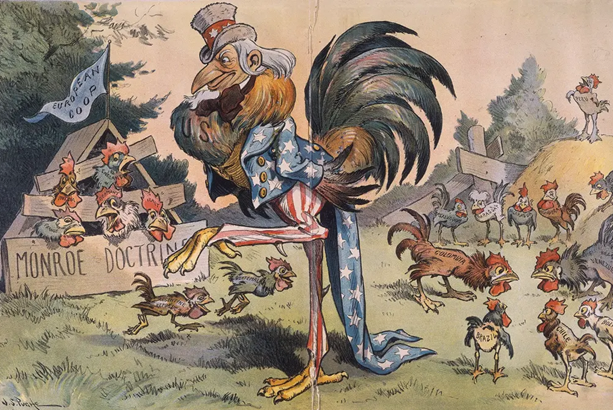
In recent months, the Caribbean has become the stage for a series of militaristic and belligerent actions carried out by the United States.
Beginning in August, Washington deployed around 12 warships, 15,000 troops, one aircraft carrier, and dozens of air assets in the Caribbean Sea, specifically in waters off the Venezuelan coast, under the pretext of intensifying the “war on drugs,” in a clear maneuver of political coercion against the Bolivarian government. This naval deployment evolved into a complete blockade of Venezuelan petroleum trade in December. On January 3rd, U.S. forces launched “Operation Absolute Resolution,” which involved air and ground attacks in Caracas and ended with the kidnapping of President Nicolás Maduro and his wife, First Combatant Cilia Flores. According to official reports, at least two civilians and fifty-five members of the military were killed as a result of the bombings and clashes, including thirty-two Cuban troops assigned to security tasks on Venezuelan soil.
Cuba subsequently became the next target of Donald Trump’s belligerent drive. On January 29, 2026, the Republican president signed Executive Order 14380, declaring the Cuban government an “unusual and extraordinary threat” to U.S. national security. The order imposed tariffs of up to 50% on any country that sells or supplies oil to the island, with the clear aim of provoking internal collapse and bringing down the Cuban government. This oil blockade, designed to trigger internal destabilization and regime change in Havana, has further aggravated Cuba’s ongoing energy crisis of recent years.
These developments confirm a trend that analysts had already identified from the outset of Trump’s second administration. The U.S. government is adopting a markedly more aggressive approach to managing its relations with Latin America and the Caribbean, seeking to reinforce its control over strategic sectors, limit the presence of external rivals, and weaken the response capacity of governments that challenge its interests in the region. The administration itself has labeled this renewed imperialist orientation toward the Latin American subcontinent the “Donroe Doctrine,” a revitalization of the principles behind James Monroe’s 1823 slogan, “America for the Americans.”
The new U.S. militarism in the Caribbean essentially entails an escalation of “regime-change” strategies targeting Venezuela and Cuba, along with a broader effort by Washington to consolidate its geopolitical power in Latin America and the Caribbean and to reshape its engagement with the region. Both aims are consistent with the thrust of the new National Security Strategy, released in December 2025, which prioritizes hard-power instruments to reinforce U.S. hegemony in the Western Hemisphere in response to China’s growing presence. [1]
“The Hour” of Cuba and Venezuela
Cuba and Venezuela have not simply been adversarial counterparts to the Trump administration. These countries have undergone radical political processes whose foundations have generated significant contradictions with Washington and its traditional mechanisms of imperialist power in the region.
The 1959 Cuban Revolution has been of cardinal importance for the contemporary political history of Latin America, as it produced a structural transformation of the Cuban political, economic, and social order and has for years served as a reference point for left-wing movements in the region. Its socialist and anti-imperialist character, together with the nationalization of strategic sectors, quickly strained relations with the United States, resulting in the severing of diplomatic ties in 1961 and the imposition of an economic blockade that remains in force to this day. These coercive policies, which have been tightened at various conjunctures throughout the revolutionary process, have turned Cuba into a symbol of resistance to U.S. hegemony in the region.
In Venezuela, the Bolivarian Revolution launched by Hugo Chávez in 1999 sought to remake the Venezuelan state by moving beyond the neoliberal model and adopting a nationalist approach to the management of natural resources. The nationalization of the Venezuelan oil industry in the early 2000s, to the detriment of major U.S.-based transnational corporations, became a crucial turning point in this process and gave rise to some of the principal points of friction with Washington. In response, the White House applied a variety of destabilizing mechanisms aimed at toppling the Bolivarian government, notably including sanctions on Venezuela’s energy sector from 2015 onward, with harmful consequences for the country’s internal stability and economic development.
Nevertheless, the resilience demonstrated by the Bolivarian project over a decade of sanctions exposed — as in the case of Cuba — the ineffectiveness of these coercive instruments. As a result, Trump’s second administration embraced a far more aggressive course of action, which led to the naval blockade and the January 3 attacks that culminated in the kidnapping of President Nicolás Maduro.
As a backdrop for this operation, the United States chose to instrumentalize the fight against narcotrafficking as a weapon to incriminate the Venezuelan government. The current U.S. administration constructed a narrative presenting Venezuela as a “narco-state,” alleging that its government and institutions are linked to criminal networks responsible for producing and shipping drugs to the United States. To sustain this narrative, Trump and Rubio pointed to the Tren de Aragua and the Cartel of the Suns as the backbone of one of the “largest cocaine-trafficking networks in the world,” allegedly led by Nicolás Maduro and other senior officials in the Bolivarian government.
These accusations, however, stand in contrast to information published by major anti-narcotics agencies such as the Drug Enforcement Administration (DEA) and the United Nations Office on Drugs and Crime (UNODC), whose most recent annual reports do not identify Venezuela as a key actor in drug-trafficking routes to the United States.[2] At this stage, it seems clear that the claims about a Venezuelan “narco-state” have been part of a campaign with a specific political purpose: legitimizing the use of military force to intervene in a sovereign nation.
The most immediate objectives of the operations in Venezuela are related to the country's energy reserves and the U.S. interest in reinforcing its control over the strategic minerals of Latin America and the Caribbean, as outlined in the new National Security Strategy. In fact, the Venezuelan case is driven by two factors: first, Washington’s assessment that advances in artificial intelligence and other highly energy-intensive fields require securing control over Venezuelan hydrocarbons; and second, the way in which U.S. sanctions opened the door to a substantial influx of Chinese, Russian, and Iranian capital—geopolitical rivals of the United States—into Venezuela’s oil sector, a scenario deemed unacceptable by the current administration.[3]
The Trump government is now seeking to restore access to Venezuelan oil on terms that are highly favorable to U.S. interests, and it assumes that this can only be achieved through intense direct pressure on the Venezuelan executive branch, such as that created by Nicolás Maduro’s kidnapping. This logic helps clarify the nature of the negotiations with Venezuela’s current interim president, Delcy Rodríguez, through which Washington has effectively obtained de facto control over Venezuela’s oil exports.
After the intervention in Venezuela, Donald Trump has publicly stated that the end of shipments of “free Venezuelan oil” to Cuba would mean the collapse of the Cuban economy. In doing so, he announced the hypothetical end of the longstanding relationship between Caracas and Havana, which for twenty-five years has involved exchanges of Venezuelan crude for the services of Cuban professionals, particularly in the health sector. This assertion is inaccurate: recent data on Cuban oil imports show that shipments from Venezuela had already fallen sharply in recent years, forcing Cuba to turn to other suppliers such as Mexico. [4] Nevertheless, an abrupt shift in relations with Caracas would clearly be a severe blow—both materially and symbolically—for the Caribbean island.
With the oil blockade announced on January 29, Cuba and its revolutionary project face a significantly complex situation, which adds to the difficulties encountered in recent years in attempting to steer post-pandemic economic recovery. The country’s capacity to respond to this challenge will largely depend on the solutions it finds to secure crude-oil supplies and on the support it could receive from specific geopolitical allies.
Regional Dimension
The U.S. militaristic actions in the Caribbean must also be analyzed in light of their alignment with Washington’s broader geopolitical objectives in Latin America and the Caribbean. As made evident in the new National Security Strategy, the current Republican administration, while acknowledging the global decline of U.S. hegemony, is actively pursuing a renewed Monroe Doctrine to reinforce its hemispheric power and limit the presence of external actors, particularly China.
This new U.S. offensive is unfolding in notably more aggressive terms. The White House’s current policies toward its southern neighbors are marked by a virulent character, reflected in mounting trade and tariff pressures, threats to take control of the Panama Canal, and escalating confrontations with left-leaning governments. The deployment of ships and troops in the Caribbean Sea and the armed attacks on Venezuela are thus interpreted as both a projection of U.S. military power and a new step in the coercive relations that Washington seeks to impose on Latin American and Caribbean states.
In this context, it is crucial to examine the positions adopted by regional governments in response to events in Venezuela and the escalating threats against Cuba, as these responses expose a deep and widening fracture within Latin American and Caribbean political consensus. A group of countries—including Cuba, Venezuela, Mexico, Brazil, Colombia, Nicaragua, and Honduras, albeit with differences in emphasis—have rejected U.S. imperialist interventionism and denounced the violation of the principles that historically underpin hemispheric and international relations, particularly sovereignty and non-intervention. Yet it is deeply troubling that hesitation, silence, and outright complicity prevail across much of the region, whether driven by the pursuit of short-term concessions from Washington or by fear of political and economic retaliation from the White House.
This regional paralysis has created a permissive environment in which the United States can more easily consolidate its hegemony in Latin America and the Caribbean and advance core elements of its geopolitical agenda, including efforts to contain China’s expanding presence in the region. Absent a more coordinated and forceful response from Latin American governments, militaristic actions in the Caribbean—both symbolic and material—will continue to function as instruments of coercion, enabling Washington to reshape hemispheric security arrangements, discipline dissenting states, and secure primacy over key zones of geoeconomic competition within its traditional sphere of influence. The window for meaningful regional resistance is narrowing, and the moment to act is now.
Alejandro Rosés Pérez is a researcher and member of the Latin America and Caribbean Team at the Center for Research on International Politics (CIPI) based in Cuba. He holds a degree in International Relations (2024) from the Higher Institute of International Relations “Raúl Roa” (ISRI) and specializes in political dynamics in Latin America and the Caribbean, with a focus on Venezuela and CARICOM. He has published articles in journals such as Cuadernos Nuestra América, Política Internacional, and Ad Hoc.
____________________________________________________________________________________
[1] U.S. National Security Strategy 2025 (Washington, DC: The White House, December 2025), 18–19, https://www.whitehouse.gov/wp-content/uploads/2025/12/2025-National-Security-Strategy.pdf ;
[2] Tricontinental: Institute for Social Research, “US Threats to Venezuela and the Use of the ‘War on Drugs’ to Justify Coercion,” Tricontinental Newsletter (2025),https://thetricontinental.org/newsletterissue/us-threats-venezuela/?utm_source=chatgpt.com ; TRT World, “Trump Used Spectre of Drug Smuggling to Attack Venezuela,” January 16, 2026, https://www.trtworld.com/article/16528fc9396e?utm_source=chatgpt.com ; KCRA 3 News, “Get the Facts: Is Venezuela a Primary Drug Trafficker to the U.S.?,” January 3, 2026, https://www.kcra.com/article/venezuela-drug-trafficking-cocaine-fentanyl/69676930?utm_source=chatgpt.com .
[3] Reuters, “Russia Says U.S. Restrictions on Its Role in Venezuela’s Oil Business Are Discrimination,” February 11, 2026, https://www.reuters.com/business/energy/kremlin-says-russia-will-seek-clarification-us-venezuela-oil-restrictions-2026-02-11/ ; Reuters, “US Pushes for Venezuela Investment, Energy Secretary Says Sanctions Relief Excludes China, Iran and Russia,” February 12, 2026, https://www.reuters.com/business/energy/us-energy-secretary-set-arrive-venezuela-with-herculean-task-oil-recovery-2026-02-11/ ; Columbia University SIPA, Energy Policy Center, “US Action Threatens Venezuela-China Oil Flows, Debt and Strategic Ties,” January 7, 2026, https://www.energypolicy.columbia.edu/venezuela-china-oil-ties-severely-impacted-by-us-action/ .
[4] Financial Times, “Mexico risks Donald Trump’s ire with Cuban oil shipments,” Financial Times, January 6, 2026, https://www.ft.com/content/f04088c3-66af-4d7c-b5fd-df0e423bd837 ; Trading Economics, “Cuba: Imports by Country,” United Nations COMTRADE data (2025), https://tradingeconomics.com/cuba/imports-by-country ; AirInsight, “Cuba runs out of jet fuel as U.S. blockade tightens,” January 2026, https://airinsight.com/cuba-runs-out-of-jet-fuel-as-us-blockade-tightens/ (all accessed 2026).