Israeli ‘Battle-Tested’ Weapons and Counterinsurgency Tactics in Latin America: The Moment to Act is Now
The speech delivered by U.N. Special Rapporteur on the Occupied Palestinian Territories Francesca Paola Albanese to members of the Hague Group in Bogotá on July 25, 2025, was unambiguous. ‘The moment to act is now,’ said Albanese. Guided by her uncompromising loyalty to international law, she added:
‘Millions are watching - hoping - for leadership that can birth a new global order rooted in justice, humanity, and collective liberation. This is not just about Palestine. This is about all of us.’[1]
These words could not be more eloquent. For her call for action may be, at last, an authentic legal revolution in the womb of a moribund United Nations system, and the beginnings of a new and future multipolar legal order.
However, most Latin American governments have chosen not to act now. Seemingly affected by a curious case of political amnesia, they have forgotten the nefarious role that Israeli ‘battle-tested’ weapons and counterinsurgency tactics and personnel played in Latin American ‘dirty wars.’[2] From 1959 onwards, and more so after 1973, Israel became the best arms dealer to Latin American dictators, authoritarian populists, and neoliberal autocrats. Military dictators Miguel Ydígoras Fuentes (g. 1958-1963) and Kjell Eugenio Laugerud García (r. 1974-1978) of Guatemala; Luis Somoza Debayle (r. 1957-1963) and his brother Anastasio ‘Tachito’ Somoza Debayle (r. 1967-1979), sons of Anastasio Somoza García (r. 1937-1956) of Nicaragua; Augusto Pinochet Ugarte (g. 1973-1989) of Chile; Jorge Rafael Videla (r. 1976-1981) and the Junta Militar of Argentina; and recently Iván Duque (g. 2018-2022) and Álvaro Uribe (g. 2002-2010) of Colombia, are among the best clients of Israeli weapons.
Latin American dictators emerged when the United States led a hemispheric war against the so-called ‘Bolshevik threat,’ needed for the restructuring of monopoly capital on a world scale. A shifting class alliance between the agrarian, industrial, and financial bourgeoisies of the region and foreign capital sustained the rise of military dictatorships. Throughout the 1950s-1960s, Latin American dictators adapted Israeli counterinsurgency military doctrine and tactics with the goal of annihilating guerrilla, indigenous, peasant, and revolutionary nationalist movements. Israel gained an early official military presence in the region through the Central American Defense Council (hereafter CONDECA). Working as part of the United States South Command and headquartered in Guatemala, CONDECA was a military organization that trained military personnel in counterinsurgency warfare from 1959 to 1979.[3]
Relying upon counterinsurgency specialists from Israel, France, South Korea, and Taiwan, CONDECA was a mini-NATO established by the United States against the Cuban Revolution. Its expansion in the region was the response of the empire to the rise of guerrilla and nationalist liberation movements in Guatemala, Nicaragua, Honduras, and El Salvador. Its goals were to facilitate arms transfers to right-wing militaries and paramilitaries, maintain constant surveillance of communications between the Cuban government and Central American governments, and monitor the activities of guerrilla groups. Through its operations, the United States enforced its dominion over the Panama Canal and guaranteed low-cost access to crude oil from Brazil, Mexico, Venezuela, Peru, and Jamaica. The resource-dimension of CONDECA was particularly relevant if one considers that the Nicaraguan guerrilla strategy led to the rise of a revolutionary military movement in Panama under General Omar Torrijos Herrera (g. 1968-1978) (the country was not a member of CONDECA), and further south in Peru, with General Juan Velasco Alvarado (g. 1968-1975).CONDECA activities reached a peak in 1976, when the Nicaraguan National Guard under Somoza and the United States Southern Command carried out the Águila IV operation in northern towns of the country where the Sandinista Front of National Liberation had gained ground.[4]
Figure 1: Notorious clients of Israeli weapons.
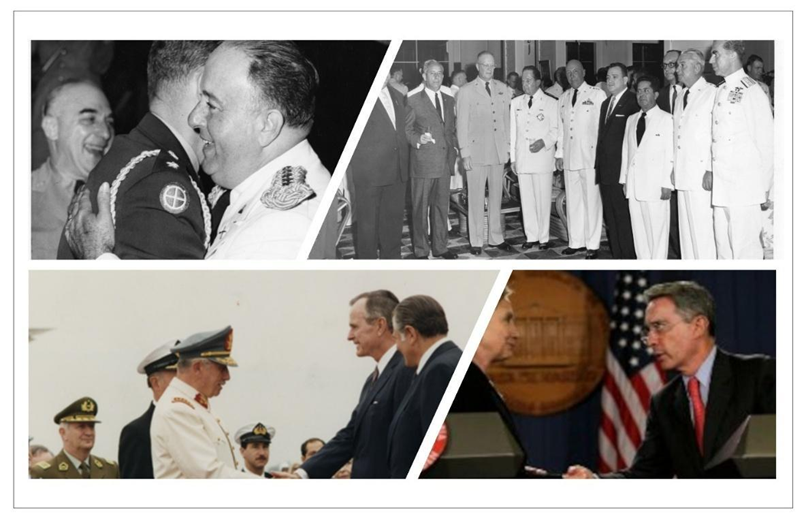
From left to right: (a) Military dictator Anastasio Somoza García, embraced by U.S. General Harry Vaughan (left) with U.S. Colonel Jack Brause in the background. Harry S. Truman Library. (b) Military dictator Miguel Ydígoras Fuentes of Guatemala (fourth from left to right) at a welcoming party hosted by U.S. Major General Truman Landon in Panama in July 1959. Harry S. Truman Library. (c)Former President Álvaro Uribe Vélez of Colombia, with U.S. Secretary of State Hillary Clinton in 2010. Archivo de Fotografía de la Presidencia 2002-2010, República de Colombia. (d) Military dictator Augusto Pinochet Ugarte, greeted by the late U.S. President George H.W. Bush. Servicio Nacional del Patrimonio Cultural de la República de Chile.
Israel consolidated its weapons-provider role when the Carter administration reoriented the war against communism towards ‘the institutionalization of dictatorial regimes.’[5] Responding to the emerging contradictions in the class alliances that sustained the military regimes of the region that threatened economic interests of the United States, President Carter adopted a human rights approach to military aid. The approach created the conditions for official and legal arms transfer deals between Latin American bourgeoisies and Israel.[6] Arms transfers, seemingly autonomous and independent from United States intervention, allowed the Carter administration to manufacture domestic consent and overcome the ‘Vietnam syndrome’ while intensifying the war against guerrillas and revolutionary nationalist, indigenous and peasant movements in Latin America. A few years later, President Reagan copied from President Carter the strategy of ‘institutionalization of dictatorial regimes’ and extended unconditional support to the civilian-military regime of Álvaro Magaña Borja (r. 1982-1984) of El Salvador.[7]
Israel embraced its role as arms dealer to Latin American dictators. Ya’akov Meridor, a former Minister of Economy of Israel and member of the paramilitary Zionist organization Irgun, then stated that Israel could supply arms to Taiwan, South Africa, the Caribbean or any other place where the United States sold weapons. In 1970, Meridor sent a loud message to the United States government: ‘Let us do it […] Israel will be your intermediary.’[8] The Minister was confident that Israel could rapidly achieve the status of ‘best arms shop’ of the empire. At the time, the political economy of the agro-military complex of Israel produced what one may call ‘surplus violence,’ in the form of large volumes of small arms and weapons that could be rapidly shipped to Latin America at a profit.[9] Specialists agreed that l only one fifth of the arm production of Israel was destined for ‘domestic use’; 80% of the weapons it manufactured at the time were destined for the export market.[10] Also, Israel had accumulated experience in ‘fighting against Soviet arms (as well as using them).’ By the early 1970s, Israel had an inventory of Soviet-made artillery guns, rocket launchers, tanks, and other weapons seized in Egypt-initially in the late 1950s, but more so in 1967 and 1972- which it then adapted, developed, and improved its own arsenal.
Arms transfers from Israel to Latin America have reached astonishing levels. Drawing on the Arms Transfers Database compiled by the Stockholm International Peace Research Institute (hereafter SIPRI), it is possible to trace the scale, and types of weapons that Israel has officially transferred to Latin America since 1957.[11] As Figure 2 shows, Guatemala, Honduras, El Salvador, and Nicaragua (before 1980), were the Central American countries that made purchases of Israeli ‘battle-tested’ weapons. These countries were governed by dictatorial regimes waging dirty wars. Israeli transfers of ‘battle-tested’ weapons to South America targeted countries ruled by military dictators, authoritarian populists, and neoliberal autocrats who institutionalized various forms of State terrorism, as Figure 3 illustrates.
Figure 2: Israeli transfers of ‘battle-tested’ weapons to Central America.
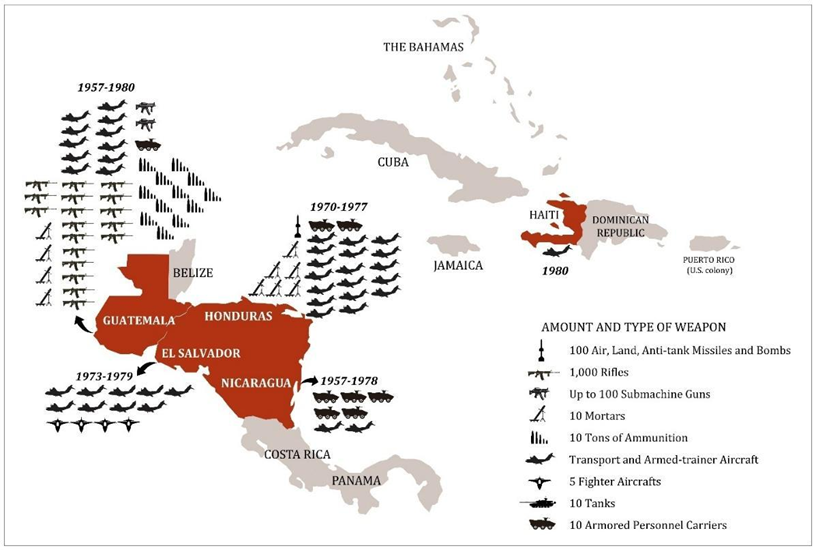
Figure 3: Israeli transfers of ‘battle-tested’ weapons to South America.
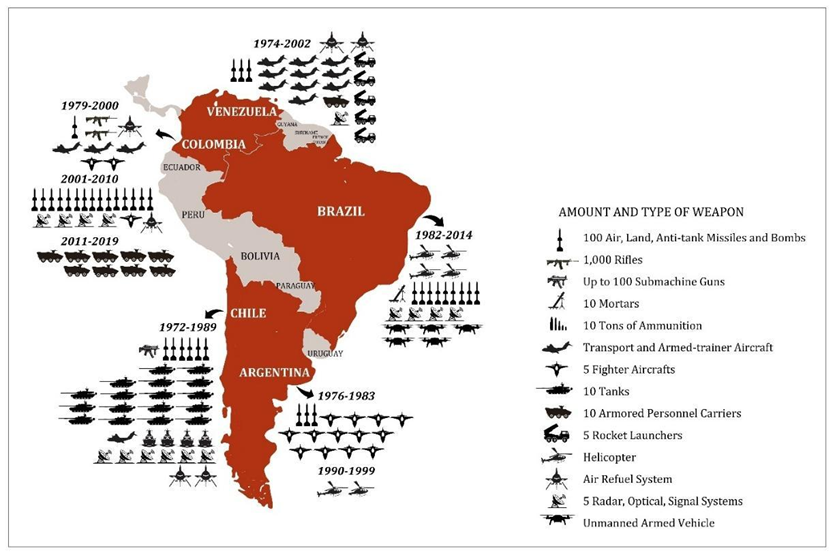
Mapping SIPRI data allows one to draw two important observations about Israeli arms transfers to the region. First, all wars against guerrilla, indigenous, and peasant movements waged in Latin America from the 1950s to the 2000s, relied upon Israeli weapons. Certainly, Israel was by no means the exclusive supplier of weapons to the region; the United States empire remained the principal supplier of arms and counterinsurgency equipment and personnel. However, the principal clients of Israel were the notorious dictators and authoritarian rulers of the region. This irrefutable historical truth leads to a second significant observation: that Israeli weapons and counterinsurgency doctrine and tactics have contributed to the militarization of Latin America. This historical problem stands against all emancipatory agendas of Latin American progressive governments. The commitment of the Community of Latin American and Caribbean States to transform Latin America into a ‘Zone of Peace’ is impossible so long as governments turn a blind eye to this problem. This problem reached an unprecedented scale in the Central American isthmus.[12] Inhabited by more than 50 million people spread across 538,281 square kilometres, the region was in the early 1980s ‘a gigantic military arsenal’ used against its indigenous peoples.[13] It was ‘a critical area, a weak link in the imperialist chain,’ where the success of the Nicaraguan revolution made the region ‘more important than South East Asia in the 1960s or even the Middle East.’[14]
Besides arms transfers, Israel globalized its counterinsurgency military doctrine, extending it to Latin America.[15] Although it has changed since the 1990s, the doctrine originally adapted warfare principles and tactics from European colonial empires and Nazi Germany.[16] From the experience of the British Empire in Asia, Israel adopted the tactic of geographically isolating indigenous populations. From the French colonial experience in Algiers and Vietnam, which was codified and taught at the Centre d’Entraînement à la Guerre Subversive (Subversive War Training Center) of the French War College, Israel learned the importance of reliability of communications and rapid mobility of military personnel and firepower. From Nazi Germany, Israel borrowed the Wehrbauern or ‘farmer-soldier’ figure and its Blut-und-Boden or ‘blood-and-soil’ fanatic-nationalist component.[17] In its colonization war against Palestinians, Israel transformed the ‘farmer-soldier’ model into a militia scheme fed by its youth populations.[18] It supplied machine guns, anti-tank weapons, mortars, and stocks of food, fuel, and materials needed to build fortifications and mini-colonies in the occupied territories. In exchange, militias supplied the ‘fresh biological material’ to populate conquered lands, fulfilling specific ideological requirements while continually revitalizing the Zionist ideology.[19]
Guatemala was the country most affected by the globalization of Israeli counterinsurgency tactics. Supported by the United States South Command, Israel built in the country its ‘largest military complex outside Israel.’[20] Its operations included an ammunition factory built in Alta Verapaz, which functioned in different periods as an armored-vehicle assembly plant and became an extermination camp under dictator Rios Montt.[21] Additionally, the Israeli Nahal or Young Combatants Movement proved useful to the dictators of the country. The latter sought to adapt this agro-military scheme to the goal of eradicating guerrillas and Maya-led resistance movements. Extensively investigated by the Guatemalan Comisión para el Esclarecimiento Histórico (Commission for Historical Truth), the program implanted soldiers in strategic zones inhabited by indigenous Maya people. These soldiers imposed a militarized-agrarian colonization scheme, aiming at the economic strangulation of indigenous populations.[22] Death squads, right-wing paramilitary groups, and the military supported these colonies.
Declared enemies of the State, agrarian Maya communities in Ixcán and El Quiché regions were victims of crimes against humanity.[23] Moreover, three hundred Israeli counterinsurgency specialists aided and facilitated the military operation Tierra Arrasada (Scorched Earth) launched by dictator Efraín Ríos Montt (r. 1982-1983), which led to the largest genocidal war against Maya populations in recent history.[24] Ríos Montt openly credited Israel and its military training for the success of his coup d’etat in 1982. The agro-military colonial model did not die with the fall of the dictator. Rather, it acquired new impetus under the rise of Reaganomics. By 1986, there were 74 ‘model villages’ or agro-military colonies in Guatemala.[25] Each village functioned like a garrison, where the military installed megaphones that constantly transmitted fundamentalist Zionist-Christian evangelical messages to terrorize Maya populations. Similar agro-military colonies emerged in Costa Rica (1966 and 1969), El Salvador (1972), and Panamá (1971), albeit with moderate success.[26]
Other countries adopted Israeli counterinsurgency doctrine. The Commando School of the Peruvian Armed Forces borrowed Israeli military tactics for its counterinsurgency training courses. Based in Panama, the School of the Americas (rebranded as the Western Hemisphere Institute for Security Cooperation), included in its military curriculum lessons based upon Israeli military counterinsurgency doctrine. Its ‘Mobile Training Groups’ (hereafter MTGs), which played a crucial role under the Kennedy administration and its Alliance for Progress, sent Israeli counterinsurgency ‘specialists’ to Andean countries. MTGs were responsible for the training of armies and paramilitary groups. In the Spring of 1967, a specialized MTG went on ‘a secret mission to Bolivia,’ where it created a ‘battalion of 650 rangers highly trained in counterinsurgency warfare.’[27] This was the group of rangers that captured and assassinated Che Guevara at the Quebrada del Yuro ravine near La Higuera in October 1967.[28]
Colombia, the country where the Hague Group convened a month ago, imported all sorts of Israeli counterinsurgency tactics and equipment during the 1980s. The Colombian military then trafficked Israeli mercenaries to run a ‘death squad school’ in the Magdalena Medio region. Former Israeli army officer Yitzhak Shoshan was the special advisor to the Urabá Banana Trading Company, dealing with labor strikes and insurgency in the last years of the 1980s. Yair Klein, the retired Israeli army colonel ‘who miraculously escaped from prison in Sierra Leone in 2000,’ turned many right-wing militias into professional war machines, working with the Colombian military. One of his best students, Carlos Castaño Gil, became leader of the right-wing paramilitary group Fuerzas Autodefensas Unidas de Colombia.[29] Along with Meneses Báez and many other Colombian men, Carlos Castaño Gil travelled to Israel to learn counterinsurgency tactics and gain first-hand knowledge.[30]
From the 1990s onward, right-wing populists and neoliberal autocrats adopted old and new Israeli counterinsurgency tactics. They have criminalized anti-imperialist, indigenous, and peasant movements and trades unions, portraying them as ‘terrorists’ who stand in the way of ‘democracy,’ ‘peace,’ and ‘Christian civilization.’[31] No Latin American country has remained untouched by new forms of counterinsurgency warfare. For these reasons, Latin America must act now to stop the Israeli genocidal war against Palestinians. The moment entails an unprecedented historical challenge that will determine if the Latin American revolutionary consciousness lives beyond Cuba, Nicaragua, and Venezuela, or is forever buried in the living scars and open wounds that remain from decades of counterinsurgency warfare. Thousands of victims of imperialist violence and State terrorism are the reminder that our Latin American lands breed indomitable spirits that cannot be silenced. Indeed, the moment to act is now.
Jeannette Graulau is a member of AISC.
__________________________________________________________________________________
[1] Albanese, Francesca, Remarks of Francesca Albanese, the UN Special Rapporteur on the situation of human rights in the Palestinian territory occupied since 1967, at the Hague Group Emergency Conference of States in Bogotá, Colombia, July 16, 2025 [online] https://progressive.international/wire/2025-07-16-francesca-albanese-a-revolutionary-shift-is-underway/en.
[2] I borrowed the phrase ‘battle-tested’ weapons from an unnamed British journalist, in: Editor, ‘An arms deal?,’ The Economist, Vol. 277(Saturday, November 22, 1980), p. 45.For the history of ‘dirty wars’ see: Grandin, Greg, The last colonial massacre: Latin America in the Cold War (Chicago: University of Chicago Press, 2004); Pereyra, Daniel, ‘Argentina: militares torturadores,’ Mientras Tanto, 90 (2004), pp. 79-96;
[3] Flores Macal, Mario, ‘Integración militar en Centroamérica,’ Anuario de Estudios Centroamericanos, 4 (1978), pp. 672-674;Solano Muñoz, Edgar, ‘CONDECA: la integración militar en Centroamérica entre 1956 y 1979,’ Estudios Latinoamericanos 51 (2023), pp. 115-133.
[4] Solano Muñoz, ‘CONDECA: la integración militar en Centroamérica,’ p. 129.
[5] Marini, Ruy Mauro, ‘The Nicaraguan Revolution and the Central American revolutionary process,’ Contemporary Marxism, 3 (1981), pp. 62-66, p. 63.
[6] Ferrero Blanco, María D., ‘Las relaciones interdependientes de los Somozas de Nicaragua con EE.UU. (1936-1979),’ Hispania Nova Revista de Historia Contemporánea 10 (2012) [online] http://hispanianova.rediris.es/10/articulos/10a003.pdf ; Howard, Esther, ‘Arms suppliers to dictators,’ Journal of Palestine Studies, 12 (1983), pp. 224-230.
[7] For a critical history, see: Dunkerley, James, The Long War: dictatorship and revolution in El Salvador (New York & London: Verso, 1985); Espinoza, Eduardo, The liberation struggle in El Salvador (New York: 1804 Books, 2018).
[8] Ferrero Blanco, ‘Las relaciones interdependientes de los Somozas de Nicaragua con EE.UU.’
[9] I borrowed the concept from Neil Faulkner, in Faulkner, Neil, Marxist history of the world: from Neanderthals to neoliberals (New York & London: Pluto Press, 2013).
[10] For more on this subject, see Lissak, Moshe, ed., Israeli society and its defense establishment: the social and political impact of a protracted violent conflict (London: Routledge, 1984).
[11] SIPRI, SIPRI Arms Transfers Database (Solna, Sweden: SIPRI, 2025) [online] https://www.sipri.org/databases .
[12] Vázquez Olivera, Mario, ‘Del terror al exterminio. Un apunte sobre las matanzas de civiles en El Salvador y Guatemala durante la década de 1980,’ Revista Pueblos y Fronteras, 18 (2023), pp. 1-29.The rest of the paragraph borrows heavily from this work.
[13] Bermúdez, Lilian, ‘Centroamérica: la militarización en cifras,’ Revista Mexicana de Sociología, 46 (1984), pp. 27-48, p. 28.
[14] Marini, ‘The Nicaraguan Revolution and the Central American revolutionary process,’ p. 64.
[15] Hurtado Meza, Lourdes C., ‘Guerreros contrasubversivos: historia temprana de los comandos del Perú,’ Anthropologica XLIII (2025), pp. 367-407; Pereyra, Daniel, ‘Argentina: militares torturadores,’ Mientras Tanto, 90 (2004), pp. 79-96; Rostica, Julieta, ‘La transnacionalización de ideas: la Escuela Contrasubversiva de Argentina a Guatemala,’ Diálogos: Revista Electrónica de Historia, 19 (2018), pp. 170-197.
[16] Giniewski, Paul, ‘Stratégie et politique d’Israël en 1959,’ Politique étrangère, 3 (1959), pp. 315-328.
[17] Brenner, Lenni, Zionism in the age of dictators (London and Canberra: Croom Helm, 1983).
[18] Duclos, Louis J., ‘Description de l’occupation militaire israélienne,’ Politique étrangère, 4(1972), pp.499-534, pp. 519-522.
[19] Basallote Marín, Antonio, ‘El sionismo y la nueva derecha Historia de unas relaciones y nuevas alianzas,’ Revista de Estudios Internacionales Mediterráneos 33 (2022), pp. 253-278.
[20] Hidalgo Luna, Alberto, ‘Redes transnacionales en la Guerra Fría interamericana: el complejo militar israelí en Guatemala,’ Revista pueblos y frontera digital, 20 (2025), pp. 1-30.
[21] Vázquez Olivera, ‘Del terror al exterminio,’ p. 13.
[22] For a comprehensive discussion, see: García García, Glenda, and Marina de Villagrán, De héroes a genocidas Trayectoria política y militar de dos oficiales del ejército de Guatemala (1954-2010) (Guatemala: Universidad de San Carlos de Guatemala, 2019).
[23] Hidalgo Luna, ‘Redes transnacionales en la Guerra Fría interamericana.’
[24] Cárdenas Méndez, Eliana, ‘Estados nacionales y víctimas sacrificiales: consideraciones sobre el genocidio Maya-Ixil en Guatemala,’ European Scientific Journal, 14 (2018), pp. 121-143.
[25] Hidalgo Luna, ‘Redes transnacionales en la Guerra Fría interamericana.’
[26] Cordero, Fernando, ‘La presencia de Israel en América Central,’ Ibero-Americana, Nordic Journal of Latin American Studies, XIV (1985), pp. 89-114, pp. 98-99.
[27] Ibid.
[28] Ariet García, María C., ‘Che Guevara: 8 de octubre, día aciago en la Quebrada del Yuro,’ Cuba Debate, 8 de octubre (2020) [online] http://www.cubadebate.cu/especiales/2020/10/08/che-guevara-8-de-octubre-dia-aciago-en-la-quebrada-del-yuro .
[29] Galindo, Ricardo, ‘Estudio estratégico del tráfico de armas en la Comunidad Andina de Naciones,’ Tesis de Maestría, Instituto de Altos Estudios Nacionales, Facultad de Seguridad y Desarrollo, Quito, Ecuador, junio de 2005, p. 66.
[30] Calvo Ospina, Hernando, El terrorismo de Estado en Colombia (Caracas: Editorial el perro y la rana, 2018), pp. 157-163.
[31] For the role of neo-Pentecostalism in counterinsurgency warfare, see Amestoy, Norman R., ‘De la crisis del modelo liberal a la irrupción del movimiento Iglesia y Sociedad en América Latina (ISAL),’ Teología y cultura 13 (2011), pp. 7-26; Basallote Marín, Antonio, ‘El sionismo y la nueva extrema derecha Historia de unas relaciones y nuevas alianzas,’ Revista de Estudios Internacionales Mediterráneos, 33 (2022), pp. 253-278.