Bilal’s Beacon and Regrounding the Collective in Legal Education
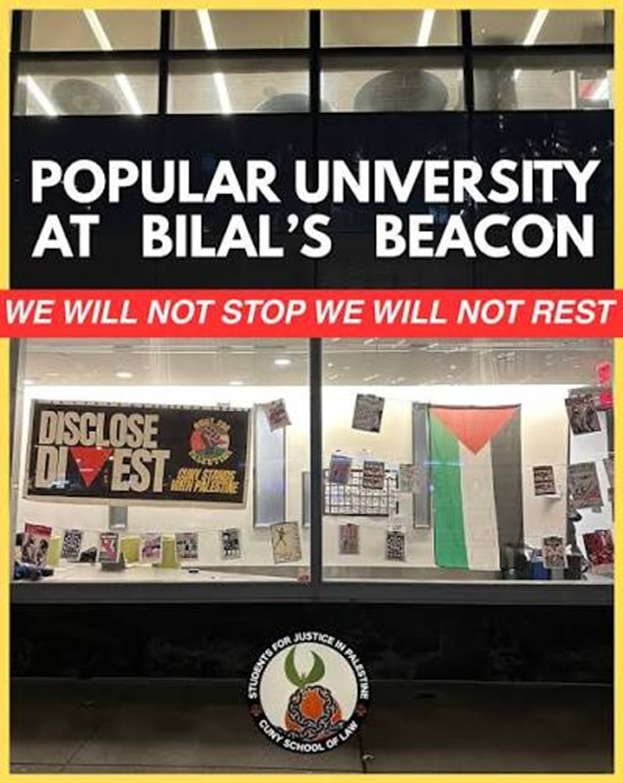
Named in honor of slain Palestinian journalist Bilal Jadallah Hassan Salem, murdered by the zionist-imperialist genocide, and in the context of a resurgent McCarthyism overwhelmingly targeting Palestine solidarity organizing, CUNY law students founded Bilal’s Beacon: the Popular University for Palestine at CUNY School of Law to reassert the role of law students as active participants in collective struggle. Historically, movement theorists have cast agents of the law, lawyers in particular, as inherently risk-averse, positioned to intervene only after harm has already been rendered legible to the state or to movement actors themselves. Legal education reinforces this posture by training us to see ourselves as isolated actors climbing a professional hierarchy, oriented toward individual achievement rather than collective responsibility.
Intense periods of repression and crackdown on movements reveal the true function of this system, which is to fragment us. The law becomes the primary instrument through which division is produced and enforced. When organizing is criminalized, when speech is surveilled, and when solidarity is reclassified as misconduct, the promise of individual protection dissipates. This is not a new condition. Movement lawyering itself was forged in response to repression and shaped by the legacies of lawyers and legal workers who, in the 1960s and 1970s, defended anti-imperialist activists opposing the Vietnam War, as well as Black and Puerto Rican liberation organizers, at a time when the law was openly mobilized to surveil, criminalize, and dismantle collective struggle. The law, then as now, is not an abstract system we will someday step into; it is a living structure that already disciplines our bodies, our speech, and our political imagination. To practice law without interrogating this reality, where legal frameworks are deployed to suppress dissent, isolate organizers, and shield state violence, is to accept a legal order that privileges race, class, nationality and gender hierarchies and individual advancement over collective liberation.
The Popular University for Palestine at CUNY School of Law was created precisely to rupture this model. By reclaiming the Beacon and renaming it Bilal’s Beacon, we reground ourselves in the truth that knowledge is produced collectively and in struggle. This space was designed to rupture with the competitive, depoliticized law school classroom, by insisting that legal education must be accountable to the communities most impacted by state violence. It calls on us to reclaim our roles not merely as future lawyers entering a deeply flawed system, but as students with a duty to one another in the present. Bilal’s Beacon stands as a refusal to separate learning from mourning, theory from praxis, or law from the material realities it produces.
Organizers at Bilal’s Beacon anchored this reclamation of collective purpose in four concrete demands aimed at compelling the institution to divest from and refuse complicity with systems of oppression. Rejecting the fragmented and risk-averse posture of traditional legal training, these demands call for unified institutional action: that CUNY Law make an immediate and unequivocal demand to CUNY Central to drop its appeal against students’ FOIL lawsuit seeking full disclosure of CUNY’s investments in Israeli war crimes and colonization; that the Dean of Students refuse to comply with the June 2024 Office of Civil Rights agreement requiring the university to provide the federal government with the names of students identified in complaints alleging discrimination on the basis of national origin; that CUNY Law reinstate the censored student graduation speaker position eliminated in retaliation for pro-Palestine speech; and that the law school establish a comprehensive ICE safety plan for campus. Taken together, these demands directly confront the legal and administrative tools currently being used to discipline solidarity, insisting that the law school actively protect its community rather than capitulate to repressive external pressures.
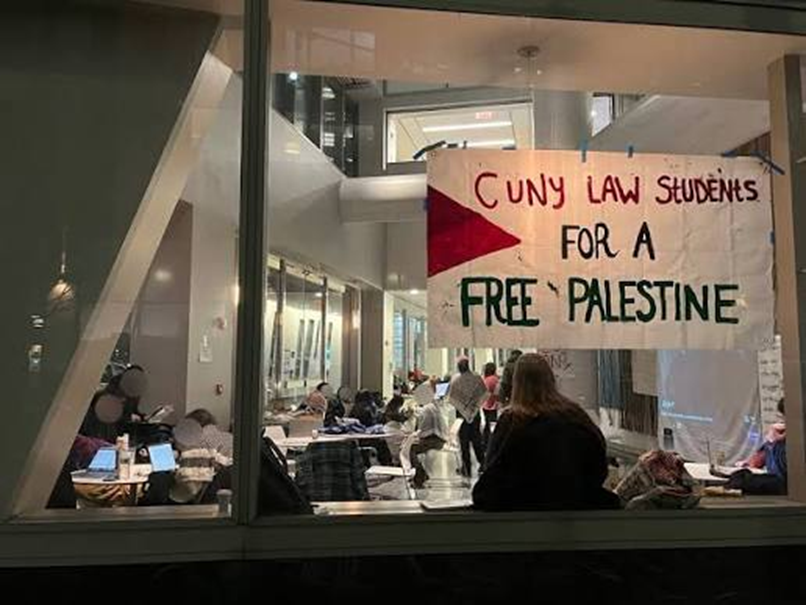
Within the held space of Bilal’s Beacon, this philosophy was lived daily through a praxis of mutual aid, political education, and resilient community. The Popular University hosted strategy sessions, FOIL-writing workshops, letter writing to political prisoners like 21 year old Tarek Barzouk who is serving 17 months in federal prison, an email zap session for the Filton 24 hunger strikers, and film screenings that connect current struggles to CUNY’s radical history, including the student de-occupations at CCNY and Brooklyn College in 1969 with demands for open admissions, Black and Puerto Rican studies programs and other racial and economic justice demands. The Palestinian Youth Movement choir performed songs and hymns honoring Palestinian resistance and culture.
Bilal’s Beacon became a hub for material solidarity, raising thousands of dollars for Gaza and distributing letters from Palestinian children. Faced with administrative threats and forced removal of banners, the community responded not with dispersion but with deepened cohesion—sharing meals, hosting yoga and potlucks, and receiving support from faculty and allied organizers. This programming consciously built the collective capacity and care that the conventional law school model suppresses, embodying the principle that our education must be forged in solidarity and accountable to ongoing struggles.
Bilal’s Beacon stands as a refusal to separate learning from mourning, theory from praxis, or law from the material realities it (re)produces. Regrounding our roles as future lawyers means recognizing that we are not being trained simply to navigate an existing legal hierarchy, but to decide whether we will reproduce or dismantle it. As we mark the fiftieth anniversary of the end of the Vietnam War and of Vietnamese liberation, we are reminded that law has long been mobilized both to suppress liberation struggles and—when taken up collectively—to confront empire itself. The collective demands articulated through the Popular University reject the individualized savior model of lawyering and instead insist on solidarity and shared risk. Bilal’s Beacon reminds us that law, when divorced from the collective, becomes a tool of control; we seek instead to transform it into a tool of struggle in the service of Palestinian liberation and of all oppressed peoples.